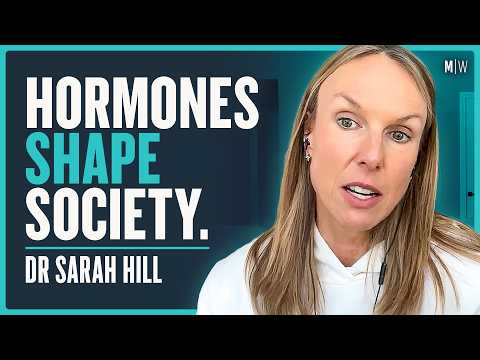
The War Inside Women: How Hormones Influence Psychology - Dr Sarah Hill
Chris Williamson (host), Dr Sarah Hill (guest)
In this episode of Modern Wisdom, featuring Chris Williamson and Dr Sarah Hill, The War Inside Women: How Hormones Influence Psychology - Dr Sarah Hill explores how Cycling Hormones Shape Women’s Minds, Desire, and Wellbeing Dr. Sarah Hill explains how women’s sex hormones—estrogen and progesterone—create two distinct psychological and physical states across the menstrual cycle, each optimized for a different reproductive job: attraction/sex and implantation/pregnancy.
How Cycling Hormones Shape Women’s Minds, Desire, and Wellbeing
Dr. Sarah Hill explains how women’s sex hormones—estrogen and progesterone—create two distinct psychological and physical states across the menstrual cycle, each optimized for a different reproductive job: attraction/sex and implantation/pregnancy.
She argues that the misery many women experience as PMS is largely a product of medical and cultural ignorance about these shifts and of living in an environment mismatched to our biology (sleep, diet, stress, work patterns).
The discussion covers how hormone changes alter perception, threat sensitivity, sexual desire, partner preferences, chronic disease symptoms, and even drug metabolism, and how hormonal birth control flattens and distorts these natural rhythms.
Hill contends that denying sex-based biological differences has harmed women in science, medicine, and culture, and calls for women and men to understand the “period brain” as a normal, functional design rather than a defect.
Key Takeaways
The menstrual cycle produces two distinct versions of the female brain and body.
The first half of the cycle (high, rising estrogen) orients women toward attraction, sex, and outward engagement, while the second half (progesterone-dominant) orients them toward safety, energy conservation, and potential pregnancy support.
Get the full analysis with uListen
Many PMS symptoms are functional adaptations, made worse by ignorance and lifestyle mismatch.
Heightened threat sensitivity, fatigue, hunger, and social withdrawal in the luteal phase are designed to protect a potentially pregnant woman, but modern one-size-fits-all schedules, under-eating, over-training, and poor sleep turn these shifts into severe misery.
Get the full analysis with uListen
Hormones change how women perceive men and how men perceive women.
Near ovulation, women become more sexually motivated, more socially outgoing, and better at detecting testosterone-linked cues of genetic quality in men, while men find ovulating women’s scent, movement, and overall presence more attractive and hormonally arousing.
Get the full analysis with uListen
Luteal-phase sex is less about desire and more about bonding.
Although libido drops after ovulation, sex that does occur is more often driven by the need for connection and pair-bonding; neurochemical data (in humans and prairie voles) suggest non-conceptive sex in this phase strengthens relationships.
Get the full analysis with uListen
Hormonal birth control flattens natural rhythms and can alter mood and attraction.
The pill suppresses ovulation and endogenous hormones, creating a quasi-permanent progestin-dominant state that dampens sexual desire, may shift partner preferences, and is linked—especially in teens—to higher rates of depression and anxiety due to loss of progesterone’s calming metabolites.
Get the full analysis with uListen
Medicine and research have systematically treated women as small men, with real costs.
Most biomedical studies either exclude women, study them only in low-hormone days, or remove hormones in animal models, leading to drugs and protocols that don’t account for cyclical changes in immunity, drug metabolism, pain, or chronic disease symptoms.
Get the full analysis with uListen
Women can reduce suffering by aligning lifestyle with their cycle and tracking patterns.
By monitoring mood, energy, desire, appetite, and sleep across several cycles—and adjusting calories, training intensity, rest, and expectations—many women could turn the ‘cliff’ of late-cycle crashes into a manageable ‘wave’ instead of chronic PMS.
Get the full analysis with uListen
Notable Quotes
“It seems kinda crazy that we would be designed in a way that we're supposed to be intentionally feeling bad.”
— Dr. Sarah Hill
“Women are a somewhat different version of themselves during the last two weeks of the cycle than they are during the first two weeks.”
— Dr. Sarah Hill
“Women have been absolutely mishandled by science and by medicine, and one of the results of that is PMS.”
— Dr. Sarah Hill
“We’ve all been led to believe that the path to our freedom is to deny that biological sex matters.”
— Dr. Sarah Hill
“You're not really yourself when you're on the pill… and that could be for better or for worse.”
— Dr. Sarah Hill
Questions Answered in This Episode
If luteal-phase threat sensitivity is adaptive, how can women distinguish between useful warnings and anxiety amplified by modern stressors?
Dr. ...
Get the full analysis with uListen AI
How should training, nutrition, and sleep protocols be adjusted across the cycle to optimize performance and minimize burnout?
She argues that the misery many women experience as PMS is largely a product of medical and cultural ignorance about these shifts and of living in an environment mismatched to our biology (sleep, diet, stress, work patterns).
Get the full analysis with uListen AI
What ethical and practical changes are needed in drug trials and clinical practice to properly account for women’s cyclical physiology?
The discussion covers how hormone changes alter perception, threat sensitivity, sexual desire, partner preferences, chronic disease symptoms, and even drug metabolism, and how hormonal birth control flattens and distorts these natural rhythms.
Get the full analysis with uListen AI
Given the trade-offs, how should women and clinicians weigh the benefits of hormonal birth control against its psychological and relational side effects?
Hill contends that denying sex-based biological differences has harmed women in science, medicine, and culture, and calls for women and men to understand the “period brain” as a normal, functional design rather than a defect.
Get the full analysis with uListen AI
Could acknowledging and designing around sex differences at work (without lowering standards) improve both women’s health and organizational performance?
Get the full analysis with uListen AI
Transcript Preview
Two books on the vagina. Congratulations.
(laughs) I think it's a little bit more complex than that. I think it's a little more complex than that, but thank you.
Why this one?
Well, you know, actually, you know, it, it was the biologist in me that kind of led me to this one. Um, so the first book was really more about my, uh, I ended up in a rabbit hole because of my personal experiences with the pill. And this one, I ended up in a rabbit hole because I couldn't understand why women feel so terrible during the last two weeks of their cycle. Um, you know, and from an evolutionary perspective, like, it doesn't make a lot of sense for women, like, to all have a disorder. Right? It just doesn't make any sense because generally if there's some sort of a trait and it's causing problems, it'll get selected out of the population, and there's been all this really wonderful work that's been done in our field looking at, you know, the impact of estrogen and how when estrogen is high and rising across the cycle, that it does all of these really amazing functional things within the human, you know, within the, within women's brains and then with their behavior and everything else. But, like, n- n- there's nothing like that about what goes on in the second half of the cycle. Instead, it just seems like women feel terrible. And so I was trying to understand why that is. So, like, what is the deep evolutionary wisdom behind self-loathing, (laughs) you know-
(laughs)
... that tends to go on during the second half of the cycle? And, you know, so, like, why does it happen and i- is it supposed to, and is there some way that we can all feel better? So it was really sort of an evolutionary puzzle for me that I wanted to solve.
Like, crazy to think that that's, for some, maybe even most women, 50% of their life.
Yeah, it is. It's, like, 50% of your life, and it seems kinda crazy that, you know, that we would be designed in a way that we're supposed to be intentionally feeling bad. And so I thought there had to be something else going on, right? That it probably didn't make sense that we're just supposed to feel terrible.
What actually happens in the brain across the month?
Well, so to introduce you to the cycle, we just have to understand that, you know, the whole purpose of having a cycle in the first place is reproduction. And for a male to reproduce, all you have to do is one thing, right? And that one thing is have sex. Uh, and for a female, it's a little bit more complicated tha- than that because we're mammals, and that means that we need to do two things in order to successfully reproduce, right? One is have sex, and that means doing things like attracting partners, being able to tell the difference between high-quality and low-quality partners, wanting to have sex, looking sexy, you know, smelling sexy, finding men sexy, et cetera, et cetera, et cetera. And there's a whole bunch of research that finds that, in fact, that that's true, right? And that all of those things tend to, um, correlate to times in the cycle when estrogen is high and rising, an egg is about to be released, and sex can lead to conception, right? So that's job one for reproduction if you're a human female. Job two is implantation and pregnancy, right? And so this is where a female body has to allow this, you know, foreign genetic material, you know, half foreign genetic material, um, this, this embryo implant, um, and then, of course, um, be able to carry it to term for nine months. And this is the set of activities that's coordinated by our other sex hormone, progesterone. And this is the sex hormone nobody talks about, right? It's like we think, like, estrogen, and then with guys, we think testosterone, and there's really not a whole lot of talk about progesterone. And so I was kinda curious about, like, what actually goes on during the point in the cycle when progesterone is the dominant hormone, right? Are these things actually trying to guide our, our brain and behavior in a way that will help to facilitate pregnancy, right? Because we find that, you know, human, b- like, women are, become very much oriented toward men and toward sex, um, in the first half of the cycle when estrogen is high and rising. And so I was really trying to figure out, like, is there some method to our madness, right, during the second half of the cycle, um, when progesterone is dominant, and might it be, um, creating shifts in the way that we feel and experience the world that might be functional? And might they feel a little bit dysfunctional just simply because we don't really give voice to them? And, and by giving voice to them, I don't mean that we all need to sit around and talk about how we feel during the second half (laughs) of the cycle. But instead, it's this idea that, you know, the, the way that women have been handled by science and by medicine is that we're just like small, less hairy versions of men, and so nobody's really given too much, paid too much attention to the fact that our hormones cycle and that what our bodies need and, and the way that we experience the world and even the way that we experience symptoms of chronic diseases or chronic conditions like ADHD and, um, and things like, uh, diabetes and autoimmune disease, and that all of this might actually shift across the cycle with our shifting hormones. Um, and as it turns out and as I talk a lot about in the new book, The Period Brain, is these things do change across the cycle, right? And it turns out that women are a somewhat different version of themselves during the last two weeks of the cycle than they are during the first two weeks of the cycle and that a lot of the misery that we experience is a result of the fact that we've totally ignored that, right? It's just like nobody wants to acknowledge that biological sex matters when it does, and the result of this is that women have been absolutely mishandled by science and by medicine, and one of the results of that is PMS.
Install uListen to search the full transcript and get AI-powered insights
Get Full TranscriptGet more from every podcast
AI summaries, searchable transcripts, and fact-checking. Free forever.
Add to Chrome