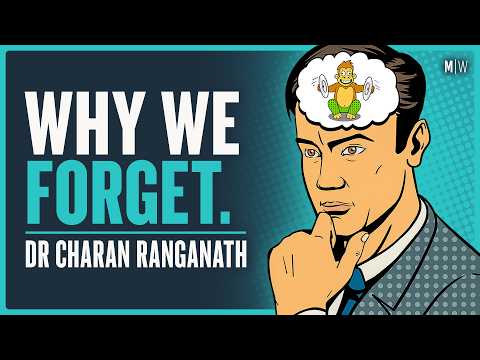
The Neuroscience Of How To Improve Your Memory & Focus - Dr Charan Ranganath
Chris Williamson (host), Dr. Charan Ranganath (guest), Narrator
In this episode of Modern Wisdom, featuring Chris Williamson and Dr. Charan Ranganath, The Neuroscience Of How To Improve Your Memory & Focus - Dr Charan Ranganath explores neuroscientist Reveals How Memory Shapes Reality, Happiness, And Future Decisions Dr. Charan Ranganath explains that memory’s main purpose isn’t recording the past, but helping us interpret the present and simulate the future. He distinguishes the ‘experiencing self’ from the ‘remembering self,’ showing how incomplete, biased memories drive most of our life decisions. Using research, clinical cases, and examples like LeBron James, he outlines how memory actually works: what gets stored, why we forget, and how emotions and context warp recall. He then offers practical principles (MEDIC) and strategies for remembering better, managing negative rumination, and using memory as a tool rather than a tyrant.
Neuroscientist Reveals How Memory Shapes Reality, Happiness, And Future Decisions
Dr. Charan Ranganath explains that memory’s main purpose isn’t recording the past, but helping us interpret the present and simulate the future. He distinguishes the ‘experiencing self’ from the ‘remembering self,’ showing how incomplete, biased memories drive most of our life decisions. Using research, clinical cases, and examples like LeBron James, he outlines how memory actually works: what gets stored, why we forget, and how emotions and context warp recall. He then offers practical principles (MEDIC) and strategies for remembering better, managing negative rumination, and using memory as a tool rather than a tyrant.
Key Takeaways
Aim to remember better, not more.
Human memory is designed to be selective, not encyclopedic. ...
Get the full analysis with uListen AI
Use the MEDIC framework to strengthen memory (Meaning, Error, Distinctiveness, Importance, Context).
Tie new information to what you already know (Meaning), test yourself and allow mistakes (Error), focus on what makes things unique (Distinctiveness), leverage emotional or personal significance (Importance), and connect memories to specific places, times, or states (Context) to make them stick.
Get the full analysis with uListen AI
Deliberate retrieval and struggle beat passive review.
Actively trying to recall information—getting it partly wrong, then correcting it—forces the brain to update and stabilize memories, making them more robust and more accessible in different contexts than simply rereading or re-listening.
Get the full analysis with uListen AI
Minimize “memory blockers” to fully encode important moments.
Stress, fatigue, depression, and especially multitasking (e. ...
Get the full analysis with uListen AI
Leverage context and cues instead of relying on willpower.
Memory is heavily organized by context—room, song, emotional state—so use environmental cues (photos, music, revisiting places, end-of-day reflection) to pull out more of what you’ve experienced, and recognize that walking into a new room or state can temporarily ‘hide’ what you meant to remember.
Get the full analysis with uListen AI
Interrupt negative memory loops by intentionally recalling positives.
Current mood biases what you recall and how you reconstruct it, creating vicious cycles in low mood or depression. ...
Get the full analysis with uListen AI
Design your life for meaningful and distinctive experiences.
Routine, low-novelty periods blur together and make weeks ‘disappear’ in hindsight, as during lockdowns. ...
Get the full analysis with uListen AI
Notable Quotes
“We should aim to remember better, not more.”
— Dr. Charan Ranganath
“We’re blessed with this incomplete memory, because what we remember tends to be what we need.”
— Dr. Charan Ranganath
“When we’re remembering, we’re never really replaying the past. We’re imagining how the past could have been.”
— Dr. Charan Ranganath
“You want memory to be your co-pilot, not in the driver’s seat.”
— Dr. Charan Ranganath
“If it were just about the past, memory would be useless. We survived the past; we only need what matters for the present and the future.”
— Dr. Charan Ranganath
Questions Answered in This Episode
How can I systematically apply the MEDIC framework to studying, work projects, and important life events without making life feel over-engineered?
Dr. ...
Get the full analysis with uListen AI
What are practical ways to distinguish between an actual memory and a vivid imagination when emotions are strong or the event is old?
Get the full analysis with uListen AI
How can someone with a tendency to ruminate build daily habits that harness memory’s flexibility to reduce anxiety and depression rather than reinforce them?
Get the full analysis with uListen AI
What’s the right balance between documenting experiences (photos, videos) and simply being present, if the goal is to maximize both enjoyment and future recall?
Get the full analysis with uListen AI
How might understanding error-driven learning change the way we design education, skill training, and even digital tools that are currently optimized for ease rather than productive struggle?
Get the full analysis with uListen AI
Transcript Preview
Why is memory important?
Well, memory is probably not important for the reason people think it is, right? So we always think, "Oh, memory is important" when we can't remember. (laughs) Then we get frustrated about it, we say, "Oh, why can't I remember this person's name?" And, "Why can't I remember the name of that guy who was in that thing?" Why memory is really important is because it's absolutely central to helping us understand the present, where we are in space, when we are in a time, and to be able to plan and imagine possible futures. So if you look at people with memory disorders, their problem in life is not that they can't remember the past per se, it's that their in- inability to remember the past makes it hard for them to remember whether they've eaten recently, or they end up repeating themselves over and over again, or they just don't have much foresight into what they will do in the future. They have all of these deficits that keep them from living independently, not because they can't tell you what happened, you know, an hour ago or something, it's because that inability leads them to just not be able to do almost anything that, uh, healthy people do in society on a day-to-day basis.
Yeah. So you've sort of touched on something there. You've got a self that experiences stuff-
Mm-hmm.
... and you've got a self that remembers you experiencing stuff.
Mm-hmm.
What is the relationship, the difference, the tension between these two selves?
Well, one of the things that we know from memory research is that the overwhelming majority of what we experience will be forgotten, right? So if your listeners end up telling somebody, "Hey, I heard this great interview on this podcast. The interviewer was on fire," you know, and so then they, they describe it to one of their friends. If they spend 10 minutes describing this long-form conversation that we're having, that would be a huge success memory-wise, right? There's no way anyone's gonna regurgitate every word of what we said, and many of the important points we talk about, people will probably forget, right? So here's the thing. Now I wanna make a decision about my life. Now I wanna make a decision about whether to take a vacation. Well, what do I do? I think about all the past vacations I've taken, where I went, and whether I liked them or not, and if I do that, I'm gonna be relying not on what I experienced, but on memory, which is much, much more, much less complete, right? It's this tiny fraction of what we actually experience. And so, uh, Danny Kahneman, the Nobel Prize-winning psychologist, referred to this idea that we have an experiencing self that lives through all of these things that we do. But the remembering self only has access to a tiny bit of that information, and that's the basis on which we decide, am I happy right now? What do I wanna do in the future? Um, you know, where am I? (laughs) And so forth. Uh, we're really in this situation where we make most of our decisions based on the remembering self, and, and it's almost as if they're two different people, because of the fact that the experiencing self is in the present, and the remembering self is in the past. It's like if you're a fan of that show, Severance, it's a bit like that.
Install uListen to search the full transcript and get AI-powered insights
Get Full TranscriptGet more from every podcast
AI summaries, searchable transcripts, and fact-checking. Free forever.
Add to Chrome