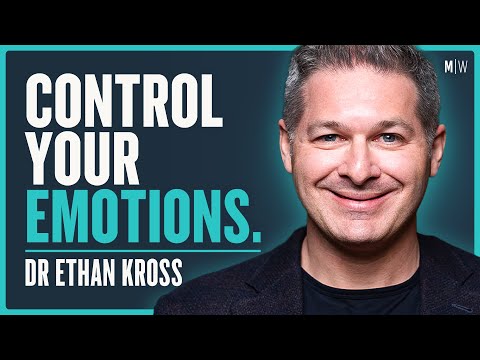
How To Stop Feeling Negative Emotions All The Time - Dr Ethan Kross
Chris Williamson (host), Ethan Kross (guest), Narrator, Narrator, Narrator
In this episode of Modern Wisdom, featuring Chris Williamson and Ethan Kross, How To Stop Feeling Negative Emotions All The Time - Dr Ethan Kross explores scientist Reveals Practical Tools To Master And Reshape Your Emotions Dr. Ethan Kross explains what emotions are, why they evolved, and why even so‑called “negative” emotions are essential tools when experienced in the right dose and duration.
Scientist Reveals Practical Tools To Master And Reshape Your Emotions
Dr. Ethan Kross explains what emotions are, why they evolved, and why even so‑called “negative” emotions are essential tools when experienced in the right dose and duration.
He argues that most people were never given a user manual for their emotional life, then outlines a science-backed toolkit for emotion regulation built from decades of lab and real‑world research.
The conversation covers internal tools (sensation, attention, perspective), external tools (spaces, relationships, culture), and how to combine them into personalized “stacks” that actually work.
Kross closes by showing how to make emotional regulation more automatic through implementation plans (WHOOP) and by intentionally designing your environment, social circle, and daily habits.
Key Takeaways
Treat emotions as tools, not enemies—even the negative ones.
Emotions are coordinated mind–body responses to meaningful events that evolved to help us survive and thrive; anger corrects injustices, sadness forces reflection, and anxiety mobilizes preparation, as long as intensity and duration stay within healthy bounds.
Get the full analysis with uListen AI
You can’t always control what you feel first, but you can control how you engage with it.
Intrusive thoughts and automatic reactions are largely outside conscious control, yet what you do next—how you respond, reframe, and regulate—is highly influenceable through learnable strategies.
Get the full analysis with uListen AI
Build a personalized emotion “toolbox” rather than seeking one magic fix.
Studies show people naturally use 3–4 regulation tools per day and that effective combinations differ across individuals and situations; the job is to self‑experiment, keep what works, and layer tools rather than chasing a universal hack.
Get the full analysis with uListen AI
Leverage sensory inputs and attention shifts for fast emotional relief.
Deliberate use of music, touch, taste, nature, and comforting spaces, plus strategic distraction (taking breaks, time away from triggers) can quickly dial down distress or dial up energy when used in line with your actual goal.
Get the full analysis with uListen AI
Use psychological distance to think more clearly under stress.
Techniques like mental time travel (future or past), coaching yourself in the second or third person (“Ethan, here’s what you’ll do”), or even using a second language can create space from raw emotion and unlock more objective, constructive thinking.
Get the full analysis with uListen AI
Curate your environments, relationships, and feeds to support emotional health.
Designing physical spaces (plants, photos, nature), choosing supportive listeners who both validate feelings and help reframe, and pruning toxic digital or social inputs reduce unnecessary triggers and make regulation easier than constant resistance.
Get the full analysis with uListen AI
Turn regulation into habit with WHOOP: Wish, Outcome, Obstacle, Plan.
Identifying a specific emotional goal, visualizing the payoff, anticipating internal obstacles, and creating concrete if‑then plans (e. ...
Get the full analysis with uListen AI
Notable Quotes
“Our emotions are tools—but they’re very unwieldy tools.”
— Dr. Ethan Kross
“You may not control when an emotion shows up, but once it’s activated there are many things you can do to push that experience around.”
— Dr. Ethan Kross
“If your goal in life is ‘good vibes only,’ number one, good luck.”
— Dr. Ethan Kross
“Your moment-to-moment experience of life is almost exclusively determined by the emotions that you’re feeling. This isn’t a dress rehearsal.”
— Chris Williamson
“We don’t open up the gym for mental fitness. We never teach people the machines.”
— Dr. Ethan Kross
Questions Answered in This Episode
Which of the emotion regulation tools discussed (sensation, attention, perspective, space, people, culture) do I already use unconsciously, and which new ones could I deliberately test this week?
Dr. ...
Get the full analysis with uListen AI
How might my social media feeds, work culture, or close relationships be quietly shaping my emotional baseline—for better or worse?
He argues that most people were never given a user manual for their emotional life, then outlines a science-backed toolkit for emotion regulation built from decades of lab and real‑world research.
Get the full analysis with uListen AI
What are my most common emotional ‘triggers,’ and what specific if‑then plans (WHOOP) could I create to handle them more skillfully next time?
The conversation covers internal tools (sensation, attention, perspective), external tools (spaces, relationships, culture), and how to combine them into personalized “stacks” that actually work.
Get the full analysis with uListen AI
In what ways am I unintentionally engaging in toxic positivity or chronic avoidance instead of allowing negative emotions to serve their functional role?
Kross closes by showing how to make emotional regulation more automatic through implementation plans (WHOOP) and by intentionally designing your environment, social circle, and daily habits.
Get the full analysis with uListen AI
How could I build an ‘emotional advisory board’—a small set of people I trust—to help me reframe problems and experiment with healthier emotional responses?
Get the full analysis with uListen AI
Transcript Preview
... the director of the Emotion and Self-Control Laboratory at the University of Michigan. What's that mean?
Well, what that means is we get to ask two kinds of questions, uh, in my lab. So number one, we, we try to understand how do people work when it comes to managing their emotions? And we really care about getting in there to understand the mechanics that underlie what we call emotion regulation. And then the second kind of question we tackle is, how can we use this understanding of the nuts and bolts that explain how people can manage their emotions to actually help them do a better job of that in their daily lives outside the lab? And so, um, trying to address those two big picture issues is something that keeps us really busy and is something that is, uh, really fun, a fun way to spend your, your life.
Mm-hmm. Uh, from your time, decades looking at them, what, what are emotions from a definitional perspective? How do you come to actually define them?
(inhales deeply) It's a great question, and, you know, it's, it's, uh, it's funny. I often, um, when I'm speaking about this topic to folks, I, I often ask people, "Hey, who, who here feels comfortable coming up to the front and, uh, just telling us what, what it means to have an emotion? What is an emotion?" It's kind of wild. We experience emotions... According to this one study that I cite in my book, about 90% of the time that we're, we're awake, we're experiencing some type of emotional response. We, we are truly an emotional species. And yet if you ask people, as I often do in presentations or when I'm teaching, "What's an emotion?" people often just stop and they have trouble answering that question. So let me, let me pose it to you actually before I go give you the, give you my definition. What do you think an emotion is? And don't worry about being right or wrong.
Yeah. Uh, a state in the brain that informs us of, uh, what is going on in the rest of our body.
So, um, not bad, not bad. So I, I, I define emotions as, uh, responses we have to events in our lives that we deem meaningful, i.e. they capture our attention in some way. And these could be situations that happen to us as we're navigating the world outside or even situations we imagine in our minds. And when we encounter those circumstances, it's almost like a software program that gets loaded up to help us manage that circumstance, and that software program has a few different pieces, few different components. So emotions activate what we call a loosely coordinated set of responses. So what do I mean by that? Well, when we experience emotion, there's, there's often a physiological component. So if I experience a little bit of anxiety, I often feel that in my stomach. It, it kind of feels like the stomach is, is wringing, I've got to go to the toilet right away. Uh, depending on how potent a response it is, that predicts the strength of that impulse. Um, our emotions are also capturing our cognition, how we're thinking about our circumstances. So anxiety will kind of zoom us in on the potential threat in front of us. Um, and then, and then there are motor responses and facial displays that often come along with our emotions. So can you tell when someone is angry at you sometimes-
Install uListen to search the full transcript and get AI-powered insights
Get Full TranscriptGet more from every podcast
AI summaries, searchable transcripts, and fact-checking. Free forever.
Add to Chrome