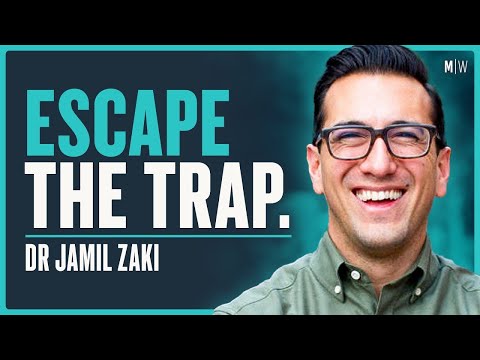
How To Be More Hopeful In A Cynical World - Dr Jamil Zaki
Chris Williamson (host), Dr Jamil Zaki (guest)
In this episode of Modern Wisdom, featuring Chris Williamson and Dr Jamil Zaki, How To Be More Hopeful In A Cynical World - Dr Jamil Zaki explores why Cynicism Fails Us And How To Rebuild Trust And Hope Dr. Jamil Zaki explains cynicism as a distorted worldview where negativity bias is elevated into a blanket belief that people are selfish, dishonest, and untrustworthy. He outlines how this stance erodes trust, harms health, damages careers, and becomes self‑fulfilling and socially contagious, despite being mistakenly seen as smart and sophisticated. Zaki contrasts cynicism with both gullibility and true skepticism, arguing that most of us systematically underestimate how trustworthy and kind people actually are. He then offers practical tools to move from cynicism to data‑driven hope: challenging our assumptions, tracking real interactions, taking social “leaps of faith,” and reshaping our media diet and mindset around reciprocity and agency.
Why Cynicism Fails Us And How To Rebuild Trust And Hope
Dr. Jamil Zaki explains cynicism as a distorted worldview where negativity bias is elevated into a blanket belief that people are selfish, dishonest, and untrustworthy. He outlines how this stance erodes trust, harms health, damages careers, and becomes self‑fulfilling and socially contagious, despite being mistakenly seen as smart and sophisticated. Zaki contrasts cynicism with both gullibility and true skepticism, arguing that most of us systematically underestimate how trustworthy and kind people actually are. He then offers practical tools to move from cynicism to data‑driven hope: challenging our assumptions, tracking real interactions, taking social “leaps of faith,” and reshaping our media diet and mindset around reciprocity and agency.
Key Takeaways
Cynicism is negativity bias turned into a total theory of people.
We’re wired to notice and remember threats more than positives; cynicism arises when we generalize a few bad experiences into a global belief that most people are selfish and untrustworthy, and then use that to predict the future.
Get the full analysis with uListen AI
Cynicism masquerades as wisdom but actually reduces accuracy and intelligence.
Studies show most people assume cynics are smarter and better lie detectors, yet data reveal they do worse on cognitive tasks and are less accurate at spotting deception because they rely on a blanket ‘no one can be trusted’ heuristic instead of evaluating evidence.
Get the full analysis with uListen AI
Living cynically is a short‑term safety play that backfires long‑term.
Cynics trust less, preemptively attack or withdraw, and avoid vulnerability, which protects them from some acute betrayals but leads over time to more loneliness, depression, poorer physical health (including higher heart disease), lower earnings, and shorter life.
Get the full analysis with uListen AI
Cynical expectations become self‑fulfilling for individuals and organizations.
When leaders or peers assume others will cheat (e. ...
Get the full analysis with uListen AI
Trust is fragile and our information diet heavily distorts how common bad behavior is.
We gossip far more about cheaters than cooperators and news and social media over‑amplify extreme negative stories, so our mental model is trained on tail‑events rather than the quieter everyday cooperation that actually dominates social life.
Get the full analysis with uListen AI
The antidote to cynicism is not blind optimism but informed skepticism and active hope.
Skepticism means evaluating each person and context rather than trusting everyone or no one; hope means believing things could turn out well and then mapping concrete steps toward that future, which increases agency and action instead of complacency.
Get the full analysis with uListen AI
You can retrain your worldview by tracking real interactions and taking ‘leaps of faith’.
Techniques like “encounter counting” (logging daily social interactions), pausing to question cynical thoughts, adopting a reciprocity mindset, adjusting your media diet, and deliberately being more vulnerable with others expose how often people actually respond with reliability and warmth.
Get the full analysis with uListen AI
Notable Quotes
“Cynicism is what happens when you turn negativity bias into an entire worldview.”
— Dr. Jamil Zaki
“If you scratch a cynic, you'll find a disappointed idealist.”
— George Carlin (quoted by Dr. Jamil Zaki)
“Cynicism is not a signifier of intellect. It's a replacement for it.”
— Chris Williamson
“Cynicism is an attempt at safety… playing poker by folding every hand immediately without even looking at your cards.”
— Dr. Jamil Zaki
“Cynicism is not the opposite of naivete, it's a version of naivete… A gullible person unthinkingly trusts everybody. A cynical person unthinkingly trusts no one.”
— Dr. Jamil Zaki
Questions Answered in This Episode
How can someone distinguish, in real time, whether they’re being healthily skeptical or unconsciously cynical in a given situation?
Dr. ...
Get the full analysis with uListen AI
What practical boundaries should a recovering cynic set so they can take social ‘leaps of faith’ without becoming genuinely exploited?
Get the full analysis with uListen AI
How might leaders redesign workplace policies and cultures to avoid the Boston Fire Department trap of institutionalized mistrust?
Get the full analysis with uListen AI
Given modern media incentives toward outrage and negativity, what would a realistic, sustainable ‘balanced media diet’ actually look like day to day?
Get the full analysis with uListen AI
For people whose cynicism stems from real early betrayals or insecure attachment, what therapeutic or relational steps are most effective for earning back trust in others?
Get the full analysis with uListen AI
Transcript Preview
Why do people tend towards cynicism? Th- why is it so alluring?
Well, uh, it's a great question, maybe let's define cynicism first, just so we have our terms straight. Uh, the way that psychologists like me refer to cynicism is different than the ancient Greek school of philosophy, led by Antisthenes and Diogenes, we can talk about that all you want in a moment, but as psychology now defines cynicism, it's a theory about people. The idea that, in general, people are selfish, greedy, and dishonest, and therefore we might not wanna trust them. Now, why do we tend towards thinking this way, to your question. I think that this is actually a pretty ancient bias in the way that our minds work, uh, something that researchers call negativity bias, so it turns out that our minds are built such that we pay much more attention to harmful or threatening information than to the good stuff, so we pay more visual attention to, um, to threats than to positive information. We remember negative events more than positive ones, and we make decisions more based on what we'd like not to lose than what we would like to gain. And you can see how this bias might be there for a reason. It might have helped us survive, maybe 200,000 years ago a person who was worried about a predator on the horizon might do better than their friend who was blissed out by the sunset on the opposite horizon, so a useful bias in some ways, but one that I think has gotten us in a lot of trouble in our modern context.
Draw the line between negativity bias and cynicism. Is cynicism simply negativity interpersonally at work at scale?
I think that cynicism is what happens when you turn negativity bias into an entire worldview, uh, when you allow it not only to color the information that you're taking in, but your expectations of the future as well, right? So, I teach a class of about 500 students every year, and at the end of the course, I get all these, uh, different, uh, pieces of feedback, reviews of the class, and usually around 480 of them are positive, but of course, three nights later, I'm trying to fall asleep, and I'm only remembering (laughs) the two or three most negative informa- uh, reviews that I've received, and again that's a- that's simple negativity bias. If I were to then transform that into a view of undergraduate students or people in my class and say, "Ah, kids these days, they're not respectful, they don't like their teachers, uh, they don't wanna learn," that would be turning negativity bias into cynicism, not just, uh, taking in information asymmetrically, focusing on the negative, but really almost elevating that into a philosophy.
Right, so as opposed to just absorbing it, you're then projecting it, you're using it to predict the future too.
Exactly, that's exactly right.
Install uListen to search the full transcript and get AI-powered insights
Get Full TranscriptGet more from every podcast
AI summaries, searchable transcripts, and fact-checking. Free forever.
Add to Chrome