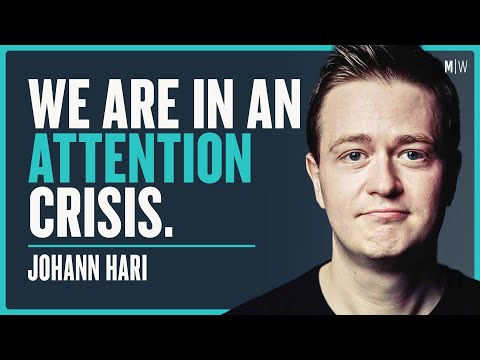
Why You Can't Pay Attention And Focus - Johann Hari
Johann Hari (guest), Chris Williamson (host), Narrator
In this episode of Modern Wisdom, featuring Johann Hari and Chris Williamson, Why You Can't Pay Attention And Focus - Johann Hari explores johann Hari Exposes Modern Attention Crisis And How To Fight Back Johann Hari argues that we are living through a genuine attention crisis driven by at least 12 scientifically-identified causes, many of which have intensified in the modern world. He describes how collapsing focus undermines our ability to achieve personal goals, know who we are, and coordinate as a society, using stories from his godson, social media stars, and his own three‑month digital detox. Hari distinguishes between individual tactics (sleep, tech barriers, flow, better habits) and systemic fixes (regulating business models, pollution, work culture, and childhood) and warns that self-help alone becomes “cruel optimism” if it ignores structural factors. He calls for a dual strategy: take radical personal responsibility for your own attention while also banding together to change the environmental and technological conditions that are “pouring itching powder” on our minds.
Johann Hari Exposes Modern Attention Crisis And How To Fight Back
Johann Hari argues that we are living through a genuine attention crisis driven by at least 12 scientifically-identified causes, many of which have intensified in the modern world. He describes how collapsing focus undermines our ability to achieve personal goals, know who we are, and coordinate as a society, using stories from his godson, social media stars, and his own three‑month digital detox. Hari distinguishes between individual tactics (sleep, tech barriers, flow, better habits) and systemic fixes (regulating business models, pollution, work culture, and childhood) and warns that self-help alone becomes “cruel optimism” if it ignores structural factors. He calls for a dual strategy: take radical personal responsibility for your own attention while also banding together to change the environmental and technological conditions that are “pouring itching powder” on our minds.
Key Takeaways
You can only think about one thing at a time—multitasking is a myth.
Neuroscientist Earl Miller explains that what we call multitasking is rapid switching, which triggers the ‘switch-cost effect’: IQ drops comparable to—or worse than—being stoned, productivity plummets, and it can take ~23 minutes to regain previous focus after an interruption.
Get the full analysis with uListen
Attention operates on multiple levels, and all are being disrupted.
James Williams’ model distinguishes the spotlight (immediate focus), starlight (medium/long-term goals), daylight (how we know what we want), and ‘stadium lights’ (collective societal focus). ...
Get the full analysis with uListen
Sleep deprivation alone can create a massive attention crisis.
We sleep about 20% less than a century ago; even a week of six-hour nights impairs attention to the level of legal intoxication. ...
Get the full analysis with uListen
Flow states are a renewable, powerful source of deep attention—but they require the right conditions.
Mihaly Csikszentmihalyi’s research shows flow arises when we pursue a single, meaningful task at the edge of our abilities, without interruption. ...
Get the full analysis with uListen
The current social media business model is structurally hostile to your attention.
Platforms profit by maximizing ‘time on device’ via surveillance and algorithmic optimization. ...
Get the full analysis with uListen
Self-help without systemic change becomes “cruel optimism.”
Meditation apps, focus hacks, and willpower can help, but telling people “just push Do Not Disturb” ignores forces like 24/7 work expectations, addictive design, pollution, and dismantled childhood play. ...
Get the full analysis with uListen
Protecting attention requires both personal boundaries and collective action.
On the personal side, Hari uses tools like phone safes, blocking apps, strict sleep, long social media breaks, and environment design. ...
Get the full analysis with uListen
Notable Quotes
“If you can't pay attention, you can't achieve your goals.”
— Johann Hari
“We are living in a perfect storm of cognitive degradation as a result of this constant interruption.”
— Johann Hari (paraphrasing Earl Miller)
“We are not medieval peasants begging at the court of King Zuckerberg for a few little crumbs of attention from his table. We are the free citizens of democracies. We own our own minds, and we can take them back.”
— Johann Hari
“Play stupid games, win stupid prizes.”
— Naval Ravikant (quoted by Chris Williamson)
“The alternative to cruel optimism is not pessimism. The alternative is authentic optimism.”
— Johann Hari
Questions Answered in This Episode
How can I redesign my daily environment—sleep, tech use, workspace—to reduce task-switching and reclaim deep focus?
Johann Hari argues that we are living through a genuine attention crisis driven by at least 12 scientifically-identified causes, many of which have intensified in the modern world. ...
Get the full analysis with uListen AI
What long-term goals (starlight) actually matter to me, and how is my current digital behavior helping or hindering them?
Get the full analysis with uListen AI
In what ways might I be unconsciously accepting ‘cruel optimism’—expecting small self-help tweaks to fix structurally-driven attention problems?
Get the full analysis with uListen AI
What collective changes (e.g., right to disconnect, platform regulation, cultural norms around kids and smartphones) am I willing to support or advocate for?
Get the full analysis with uListen AI
How can I deliberately cultivate more flow states in my week by choosing meaningful, challenging, single-focus activities and protecting them from interruption?
Get the full analysis with uListen AI
Transcript Preview
If you can't pay attention, you can't achieve your goals. "I wanna read this book." Or a bigger goal, "I wanna write a book. I wanna set up a business. I wanna be a good dad." Whatever it might be. Whatever your goals are, if you lose your ability to pay attention, you cannot achieve those goals. That's true at a personal level and that's true at the level of a whole society, right? A society of people who a- are dawdling and can't pay attention won't be able to achieve collective goals either.
(wind blowing) Johann Hari, welcome to the show.
Hey, Chris. Good to be with you.
Really glad to have you back, man.
I'm very excited. Hooray.
Yes. Precisely.
(laughs)
So you say that each book that you write is trying to solve or work out a different mystery. Why did you get interested in the mystery of attention?
Oh, God. You know, for so many years, I felt my own attention getting worse. I looked at so many of the people I knew, and I could see their attention was getting worse. But I was responding to that by saying... really by blaming myself, like everyone else I knew was blaming themselves, and thinking, "Oh, you know, you're just weak. You're not strong enough. You don't have enough willpower." Um, and then I, I was sort of... I also reassured myself by saying, "Well, every generation feels like this, right?" You can read letters from monks almost a thousand years ago, where one of them writes to the other one and says, "Ugh, my attention ain't what it used to be," right? It's not an exact quote, but that's the gist of what they said. And I thought, "Okay, so this is just, you know, you get older, your attention gets worse." But really, it was looking at the young people in my life and some young people I love that made me think, "You know what? This really does feel markedly different." And then I started looking at some of the studies of this. There's a small study, for example, of American college students that found that on average, they focus on any one task for 65 seconds, and the average office worker focuses on any one task for three minutes. And I thought, "Well, is something deeper going on here?" So I ended up going on this huge journey all over the world, fortunately pre-plague. Uh, I, I met, interviewed over 200 of the leading experts in the world about focus, what causes it to boost, what causes it to deteriorate. I went from Miami to Moscow to Melbourne, um, and I went to places that have been affected by this attention crisis in all sorts of different ways, from a favela in Rio de Janeiro, where attention had collapsed in a particularly disastrous way, to an office in New Zealand, where they found an incredible way to boost attention. And, and what I concluded, having met the kind of leading experts in the world, is there's actually scientific evidence for 12 factors that can boost or, or, or degrade your attention. Loads of those factors have been really significantly increasing in recent times, and we are in a real and acute attention crisis, which is actually on course to get even worse unless we deal with these deep underlying causes of the crisis.
Install uListen to search the full transcript and get AI-powered insights
Get Full TranscriptGet more from every podcast
AI summaries, searchable transcripts, and fact-checking. Free forever.
Add to Chrome