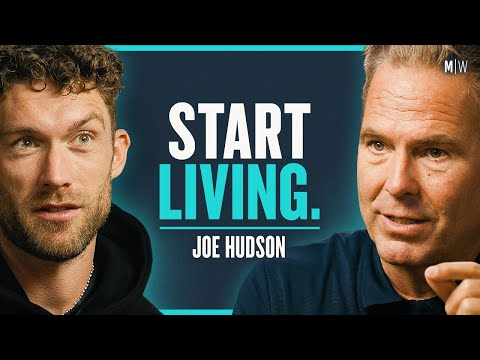
Why You Feel Helpless… and How to Break the Loop - Joe Hudson (4K)
Chris Williamson (host), Joe Hudson (guest)
In this episode of Modern Wisdom, featuring Chris Williamson and Joe Hudson, Why You Feel Helpless… and How to Break the Loop - Joe Hudson (4K) explores breaking helplessness loops by feeling emotions, setting boundaries, embracing love Chris Williamson interviews coach Joe Hudson after attending Hudson’s weeklong intensive, using it as a lens to discuss living with an “open heart” in the real world.
Breaking helplessness loops by feeling emotions, setting boundaries, embracing love
Chris Williamson interviews coach Joe Hudson after attending Hudson’s weeklong intensive, using it as a lens to discuss living with an “open heart” in the real world.
Hudson argues that most suffering (rumination, depression, conflict, overwhelm) comes from resisting emotions and from shame-based self-rejection; relief comes from turning toward pain with curiosity and compassion.
They unpack practical frameworks: how patterns are recreated (attract/manipulate/prove), how to set boundaries without power struggles, how to use emotions for decision-making, and how to break rumination loops by emotional expression.
The conversation also touches on integrating sensitivity with high performance (open-hearted “ruthlessness”), handling social judgment through “vagal authority,” and why sustainable success comes from loving the process rather than chasing outcomes.
Key Takeaways
Closing your heart is usually more painful than staying open.
Hudson claims there’s “nothing that feels better with a closed heart,” and that self-protection is often fear-based conditioning rather than evidence-based safety. ...
Get the full analysis with uListen AI
People recreate familiar pain through attraction, manipulation, and “proving.”
Hudson describes how a pattern (e. ...
Get the full analysis with uListen AI
Heartbreak can expand capacity to love—if you don’t resist the pain.
Hudson challenges the idea that heartbreak is purely damaging: the closing-off happens when pain is avoided, not when the heart breaks. ...
Get the full analysis with uListen AI
Depression often reflects self-rejection: harsh inner voice plus blocked anger/sadness.
Hudson frames depression as extreme negative self-talk, emotional repression (especially anger), disconnection, and prolonged nervous-system “attack. ...
Get the full analysis with uListen AI
The fastest fear intervention is compassion, not fixing.
To someone afraid to stop abandoning themselves, Hudson’s prescription is: “Of course you’re scared… I’m right here with you. ...
Get the full analysis with uListen AI
Notable Quotes
““I don’t know anything that feels better with a closed heart.””
— Joe Hudson
““We’re scared of love.””
— Joe Hudson
““Every time your heart breaks open, it increases your capacity to love.””
— Joe Hudson
““If I couldn’t feel that judgment, what would I have to feel?””
— Joe Hudson
““Efficiency without awareness is just a faster way to burn out.””
— Joe Hudson
Questions Answered in This Episode
On the ‘mapping’ framework: How can someone tell the difference between “proving” a pattern (interpretation bias) and noticing a real recurring behavior in others?
Chris Williamson interviews coach Joe Hudson after attending Hudson’s weeklong intensive, using it as a lens to discuss living with an “open heart” in the real world.
Get the full analysis with uListen AI
Hudson says heartbreak is something he looks forward to—what practices make heartbreak growth-producing instead of shutting someone down?
Hudson argues that most suffering (rumination, depression, conflict, overwhelm) comes from resisting emotions and from shame-based self-rejection; relief comes from turning toward pain with curiosity and compassion.
Get the full analysis with uListen AI
In depression, Hudson highlights repressed anger: what are safe ways to access and express anger without dumping it onto partners, coworkers, or children?
They unpack practical frameworks: how patterns are recreated (attract/manipulate/prove), how to set boundaries without power struggles, how to use emotions for decision-making, and how to break rumination loops by emotional expression.
Get the full analysis with uListen AI
Boundaries: What are examples of “open-hearted boundaries” in friendships and workplaces (not just romantic relationships)?
The conversation also touches on integrating sensitivity with high performance (open-hearted “ruthlessness”), handling social judgment through “vagal authority,” and why sustainable success comes from loving the process rather than chasing outcomes.
Get the full analysis with uListen AI
Vagal authority: What concrete techniques help someone regain nervous-system calm in the moment they’re being mocked or challenged?
Get the full analysis with uListen AI
Transcript Preview
Joe Hudson, welcome to the show.
Thanks, Chris. Good to see you, man.
Feels different- [laughing] -to speak to you now.
Yeah, I bet.
It feels different.
Yeah.
Uh, the audience will know that I spent a long week with you, uh, at your intensive retreat.
Yeah.
Um, so yeah, to now sit down back in my domain after having spent a week [chuckles]
[chuckles]
-desperately trying to survive in yours feels, uh- [laughing] feels somewhat different.
Yeah. It was great to have you there.
It was a very strange, very meaningful experience, uh, especially given that it's completely sober. You know, there's a lot of talk of how important it is to-- how popular it is, at least, to do the psychedelic trip down to Costa Rica or the Ayahuasca DMT thing.
Yeah.
Like, y- you can get pretty far without having to add anything in, except for a morning coffee, if you've got the right container and practices.
Yeah, the... I don't know if you've ever seen the data on the work, but, uh, we change negative self-talk by a standard deviation across all the participants, and, and all, and the neuroses drops by a little less than a standard deviation. So yeah, cool stuff can happen.
Harvard, who's doing the study?
Uh, there's this- there's a researcher who worked at Harvard. She no longer does. And then we add somebody at, um, Columbia, who's doing it, and then we just now have another person doing another research project on us, so.
Well, it doesn't surprise me.
Quantum physics from Oxford-
Okay
... is the new, new person who's at least talking to us about it. We haven't figured out what we're doing yet.
Oh. One of the questions that came up after we spent a week together was: is it hard to live in the real world with an open heart?
Yeah.
It was one of the first questions that I thought of.
It's hard not to, is my experience. I, I don't know anything that, um... I, I don't know anything that feels better with a closed heart. So we have this thing that our brain does that tells us that, "Oh, I'm gonna get hurt, or I'm gonna get in trouble, or I'm gonna get taken advantage of if I close my heart or if I don't close my heart, if I don't protect myself," and but there's not a tremendous amount of evidence for that. Like, Gandhi didn't get taken advantage of, or Martin Luther King didn't get taken advantage of. Um, a really open-hearted mother doesn't particularly get taken advantage of. Some might, some might not, but, uh, they're not really correlated. And so my experience is that if you close your heart down, it hurts. It's just painful. And we talk about it a lot in our society as, like, "If you don't forgive, then you're punishing yourself." That would be, like, the typical way to say it, but my experience is just any time that my heart starts closing down, it hurts.
Install uListen to search the full transcript and get AI-powered insights
Get Full TranscriptGet more from every podcast
AI summaries, searchable transcripts, and fact-checking. Free forever.
Add to Chrome