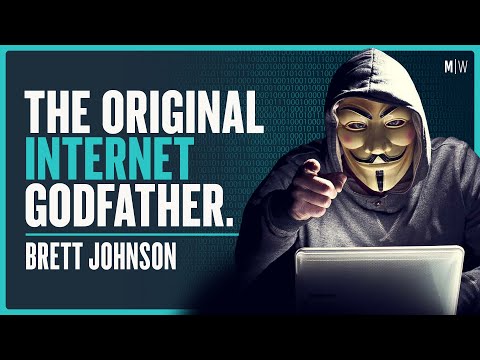
The United States' Most Wanted Hacker - Brett Johnson
Brett Johnson (guest), Chris Williamson (host)
In this episode of Modern Wisdom, featuring Brett Johnson and Chris Williamson, The United States' Most Wanted Hacker - Brett Johnson explores from Internet Godfather To Guardian: Inside America’s Cybercrime Underworld Brett Johnson, once dubbed the “original internet godfather,” recounts his evolution from a child fraudster in Eastern Kentucky to running ShadowCrew, the first major organized cybercrime marketplace and precursor to today’s Darknet markets.
From Internet Godfather To Guardian: Inside America’s Cybercrime Underworld
Brett Johnson, once dubbed the “original internet godfather,” recounts his evolution from a child fraudster in Eastern Kentucky to running ShadowCrew, the first major organized cybercrime marketplace and precursor to today’s Darknet markets.
He explains how he built large‑scale identity theft, tax-refund fraud, and ATM schemes, became a U.S. Most Wanted fugitive, and even continued committing crimes while working inside Secret Service offices before going to prison and escaping a minimum-security camp.
The conversation explores the psychology behind his criminality—abandonment fears, attachment issues, and the ego and status dynamics of online crime communities—as well as the mechanics of cybercrime: trust systems, social engineering, laundering, and nation‑state hacks.
Johnson closes by detailing his rehabilitation, the structural failures of the criminal justice system, and his current work helping law enforcement and businesses fight the very crimes he once pioneered, offering practical advice for individual protection.
Key Takeaways
Cybercrime is driven more by psychology and social engineering than pure technical genius.
Johnson argues that 98–99% of cybercriminals are not elite coders but skilled manipulators who exploit known vulnerabilities and human trust using off‑the‑shelf tools, with social engineering usually determining whether attacks succeed.
Get the full analysis with uListen AI
Trust mechanisms are the foundational infrastructure of organized online crime.
ShadowCrew introduced vouching, escrow, reviews, and persistent forums so anonymous criminals could reliably trade stolen data and services—transforming scattered IRC chats into a structured “eBay for crime” and enabling scalable cybercrime.
Get the full analysis with uListen AI
Ego, status, and community validation can become stronger motivators than money.
Once basic financial needs were met, Johnson continued escalating schemes largely to maintain god‑like status in cybercrime forums, mirroring behaviors seen in communities like WallStreetBets where people risk real assets for online clout.
Get the full analysis with uListen AI
Most major breaches exploit known, unpatched weaknesses and basic security failures.
Cases like Equifax and SolarWinds show attackers repeatedly using publicly documented vulnerabilities, weak passwords (e. ...
Get the full analysis with uListen AI
Re-entry from prison often sets people up to fail without real support and opportunity.
Johnson describes being released with no viable employment options, strict computer bans, and no structured support, leading him back to petty fraud—illustrating why recidivism remains high without external help, therapy, and practical pathways.
Get the full analysis with uListen AI
Structured cognitive and social support can be pivotal in breaking criminal cycles.
A nine‑month cognitive behavioral therapy program, unwavering support from his wife and sister, and ongoing FBI mentorship (akin to a sponsor system) helped Johnson recognize triggers, voice relapse risks, and avoid returning to crime—even during COVID.
Get the full analysis with uListen AI
Individuals can meaningfully reduce fraud risk with a few basic protections.
Johnson’s core advice: freeze credit with all three bureaus for every household member, set up account alerts and active monitoring, and use a password manager—steps he says will put you ahead of roughly 97% of potential victims.
Get the full analysis with uListen AI
Notable Quotes
“You torture yourself more than law enforcement could ever think about, because you're always concerned and worried about what's going to happen.”
— Brett Johnson
“ShadowCrew was basically this communication channel and this marketplace, an eBay of criminal activity.”
— Brett Johnson
“Criminals are very good about using legal off‑the‑shelf products and services and using those for criminal activities.”
— Brett Johnson
“You're released from prison with the exact same tools you go in with.”
— Brett Johnson
“That person who's broken the law, you're going to pay for them one way or the other… Where do you want to pay that bill?”
— Brett Johnson
Questions Answered in This Episode
How could law enforcement and policymakers adapt to target the social-engineering and trust aspects of cybercrime rather than just its technical components?
Brett Johnson, once dubbed the “original internet godfather,” recounts his evolution from a child fraudster in Eastern Kentucky to running ShadowCrew, the first major organized cybercrime marketplace and precursor to today’s Darknet markets.
Get the full analysis with uListen AI
What would a scalable, AA-style rehabilitation framework for former criminals actually look like in practice, and who should be responsible for running it?
He explains how he built large‑scale identity theft, tax-refund fraud, and ATM schemes, became a U. ...
Get the full analysis with uListen AI
Given that most major breaches use known exploits, why do so many large organizations still fail to implement basic security hygiene and patch management?
The conversation explores the psychology behind his criminality—abandonment fears, attachment issues, and the ego and status dynamics of online crime communities—as well as the mechanics of cybercrime: trust systems, social engineering, laundering, and nation‑state hacks.
Get the full analysis with uListen AI
Where should societies draw the ethical line between whistleblowing, journalism, and criminal hacking in cases like Assange, Manning, and Snowden?
Johnson closes by detailing his rehabilitation, the structural failures of the criminal justice system, and his current work helping law enforcement and businesses fight the very crimes he once pioneered, offering practical advice for individual protection.
Get the full analysis with uListen AI
How can we balance victims’ understandable desire for retributive justice with evidence that rehabilitative approaches reduce recidivism and long-term harm?
Get the full analysis with uListen AI
Transcript Preview
I'm the guy that continues to break the law from inside Secret Service offices for the next 10 months, until they find out about it. I take off on a cross-country crime spree, steal $600,000 in four months. Wake up one morning, United States Most Wanted, and, uh, (laughs) that gets your attention. (wind blowing sound)
What does it mean to be on the United States Most Wanted list? Is there-
(laughs)
... like, is there a particular type of criteria that you need to meet for that? Is it, is it like being top 10 in the Billboard charts?
Well, I, I will say you did not probably do well in Sunday school. So, it's, you're not a good guy if you've made the United States Most Wanted list. You are the, uh, the bane of society at that moment in time. And, and me, I mean, for those who don't know the Secret Service, they called me the original internet godfather. I got that title. I was committed ... Uh, I committed 39 felonies. I was placed on the United States Most Wanted list. I had an escape from prison. And what, uh, the big thing of all that was is I built and ran the first organized cybercrime community. It was called ShadowCrew, precursor of today's Darknet and Darknet markets, that U.S. Most Wanted. So ShadowCrew makes the front cover of Forbes August 2004. Headline, "Who's Stealing Your Identity?" October 26, 2004, United States Secret Service, they arrested 33 people, six countries, six hours. I'm the guy publicly mentioned as getting away. I headed that ring. They picked me up four months later. They gave me a job. And I'm the guy that continues to break the law from inside Secret Service offices for the next 10 months, until they find out about it. I take off on a cross-country crime spree, steal $600,000 in four months. Wake up one morning, United States Most Wanted, and, uh, that gets your attention. Um, it's one of those oh-shit moments. You know, I was in Las Vegas the night before. I'd stolen $160,000 out of ATMs. Woke up that next morning and there's my name on Carter's Market with U.S. Most Wanted beside of it. And, um, I sat there and stared at it for a while. Finally, I said out loud, I was like, "Well, Brett, you've made the United States Most Wanted list. What now?" And I, I was like, "I'm going to Disney World." So that's what idiot did. Went to Disney World, lasted about six weeks. Secret Service, they came and got me, arrested me, sent me to prison, then I escaped. Uh, your question, what's it like to be United States Most Wanted? It is one of the scariest things on the planet. You, um ... I was already on the run, but you don't have any friends. You're, you're constantly watching your back. Every day is the highest high and the lowest low. You make it through a day without being arrested and you're like, "Yes, I've made it." And, but you're constantly scared of everything. I would, uh, you know, I'd just take these long drives. You couldn't talk to anybody. I would, uh, there's a ... You've seen Breaking Bad, right?
Install uListen to search the full transcript and get AI-powered insights
Get Full TranscriptGet more from every podcast
AI summaries, searchable transcripts, and fact-checking. Free forever.
Add to Chrome