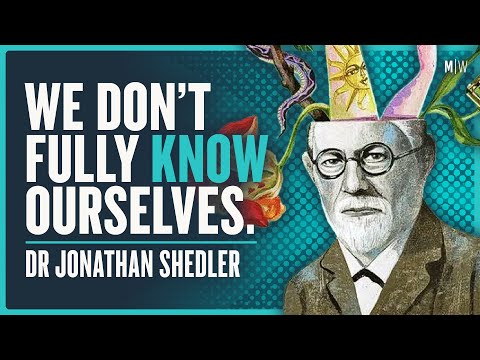
14 Concepts To Understand Psychoanalysis - Dr Jonathan Shedler
Dr Jonathan Shedler (guest), Chris Williamson (host), Narrator
In this episode of Modern Wisdom, featuring Dr Jonathan Shedler and Chris Williamson, 14 Concepts To Understand Psychoanalysis - Dr Jonathan Shedler explores unconscious Patterns, Psychoanalysis, And How Therapy Really Changes Us Dr. Jonathan Shedler explains core psychoanalytic ideas and contrasts them with today’s brief, symptom-focused therapies, which he argues are often superficial. He emphasizes that much of our mental life is unconscious, and that we keep repeating relational patterns formed in early childhood without realizing it. Through a deep, ongoing therapeutic relationship, these patterns are re-enacted with the therapist, examined, and gradually transformed into greater self-knowledge and freedom. Along the way, he unpacks concepts like moral masochism, false self, transference, projective identification, splitting, and psychological defenses, and shows how they play out both in personal life and modern culture.
Unconscious Patterns, Psychoanalysis, And How Therapy Really Changes Us
Dr. Jonathan Shedler explains core psychoanalytic ideas and contrasts them with today’s brief, symptom-focused therapies, which he argues are often superficial. He emphasizes that much of our mental life is unconscious, and that we keep repeating relational patterns formed in early childhood without realizing it. Through a deep, ongoing therapeutic relationship, these patterns are re-enacted with the therapist, examined, and gradually transformed into greater self-knowledge and freedom. Along the way, he unpacks concepts like moral masochism, false self, transference, projective identification, splitting, and psychological defenses, and shows how they play out both in personal life and modern culture.
Key Takeaways
Much of what drives us is unconscious and only surfaces in relationships.
We don’t fully know our own motives, fears, and patterns; they show up most clearly in how we repeatedly relate to others, which is why a real therapeutic relationship—not apps or quick techniques—is central to meaningful change.
Get the full analysis with uListen AI
Deep therapy focuses on underlying patterns, not just symptom management.
Modern, brief therapies often target thoughts and behaviors at the surface, whereas psychoanalytic work tries to understand the deeper conflicts and relational templates that keep recreating the same problems, such as chronic depression or repeated relationship failures.
Get the full analysis with uListen AI
We endlessly repeat and reenact unresolved patterns unless they are made conscious.
Old relational scripts from childhood (e. ...
Get the full analysis with uListen AI
Defenses like projection, splitting, and reaction formation distort how we see others.
To avoid facing painful aspects of ourselves, we may see others in black-and-white terms, attribute our own impulses to them, or overdo the opposite of what we really feel—mechanisms that fuel culture wars, online hatred, and personal conflicts.
Get the full analysis with uListen AI
A ‘false self’ can form when we live to meet others’ needs instead of our own.
If parents use a child to fill their own narcissistic gaps (looks, talent, achievement), the child may grow into an adult who seems successful yet feels empty and alienated, never having discovered what genuinely matters to them.
Get the full analysis with uListen AI
Depression is often a signal, not the root problem.
Shedler likens depression to fever: a nonspecific response to many possible underlying issues, often relational or emotional; effective therapy explores what in a person’s inner life and relationships is giving rise to depressive feelings, rather than just trying to suppress the symptom.
Get the full analysis with uListen AI
You can test whether your therapy is truly meaningful by how conflict is handled.
In good psychoanalytic therapy, you can bring up feeling upset with your therapist, and they respond with curiosity rather than defensiveness; working directly on how the therapeutic relationship “gets messed up” is a central part of the change process.
Get the full analysis with uListen AI
Notable Quotes
“We don’t fully know our own hearts and minds. Nobody does.”
— Dr. Jonathan Shedler
“We count on the patient to fuck up the therapy relationship in the same kinds of ways that they fuck up their other relationships.”
— Dr. Jonathan Shedler
“Depression is like the psychological equivalent of fever. It’s a nonspecific response to an enormous range of underlying difficulties.”
— Dr. Jonathan Shedler
“The most toxic and hateful people in the world are 100% convinced they fight for what is true and right.”
— Dr. Jonathan Shedler
“There are things that we can do to develop a freer will, freer than before, and that might make all the difference.”
— Dr. Jonathan Shedler
Questions Answered in This Episode
How can an ordinary person start to recognize their own repetitive relationship patterns without being in formal psychoanalytic therapy?
Dr. ...
Get the full analysis with uListen AI
Are there reliable signs that what I experience as ‘moral conviction’ might actually be projection or splitting in disguise?
Get the full analysis with uListen AI
How do you distinguish between a ‘false self’ constructed for others and healthy ambition or role-playing in work and social life?
Get the full analysis with uListen AI
In a culture that rewards fast fixes and productivity, how can depth therapies practically compete and be made more accessible?
Get the full analysis with uListen AI
What should someone do if they realize their current therapy feels “polite” and symptom-focused but never touches the kind of deeper patterns described in this conversation?
Get the full analysis with uListen AI
Transcript Preview
I can't speak to do we or do we not have free will. What I can say with some confidence is there are things that we can do to develop a freer will, freer than before, and that might make all the difference. We can come to know ourselves more fully. Fundamentally, there are things about ourselves and why we do what we do that aren't fully under our control. (wind blows)
For the people who aren't familiar with you, what's your background? Who are you and what do you do?
Uh, I'm a psychologist. I'm a professor of psychology at University of California, San Francisco. Uh, I practice psychoanalytic psychology, which for people who may not know, uh, is based on the understanding that we don't fully know ourselves, that there's such a thing as unconscious mental life, and that we can explore it and understand it and be better for it.
What is unique about that compared with other approaches for psychology?
Yeah. That's a good question. Um, there's been a trend. Uh, so, so first of all, I mean, there's just, just mind-boggling psychological illiteracy in the culture. And, and it's not the fault of... You know, it, it, i- i- it's not the fault of anyone. It's what they're teaching in universities. And, I mean, v- even people who, you know, even people who take university level courses in psychology, um, (laughs) are gonna miss something really important. And the important thing is that over the last 25 to 30 years, the entire field of psychotherapy has really been getting very, very shallow, and there's been, there's been a focus on increasingly brief, increasingly superficial, and increasingly cheap interventions, and they get sold to the public by academic researchers. And I'm not taking shot. I, I am an academic researcher. (laughs) I mean, I'm not, I'm not trying to trash anyone. But they, they get sold to the public as, you know, these are scientific, you know, scientific forms of treatment, they're evidence-based, they're the gold standard, but, but actually they're, they've been getting increasingly superficial. And what I mean by superficial is there's an assumption that, that it can happen very quickly, um, that we can deal with what's on the surface of consciousness, right? So your conscious beliefs and thoughts. Uh, so the focus is very much on managing symptoms and dealing with thoughts and behaviors that are very much on the surface of things rather than the underlying psychology that gives rise to them. The entire tradition that, that I'm part of is, is based on the understanding that, uh, w- we don't fully know our own hearts and minds. Nobody does. It's the nature o- of the human condition. It's rooted in the structure of the brain. We don't fully know ourselves. And, you know, because we don't fully know ourselves, we find ourselves repeating the same kinds of patterns and getting in the sa- into the same kinds of difficulties over and over again in life. And the idea is that by coming to know the parts of ourselves that were previously unknown, uh, that gives us some freedom to be able to do things differently so that we're not doomed to repeating the same patterns over and over.
Install uListen to search the full transcript and get AI-powered insights
Get Full TranscriptGet more from every podcast
AI summaries, searchable transcripts, and fact-checking. Free forever.
Add to Chrome