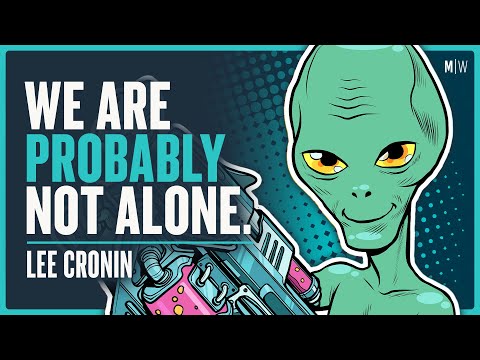
What Will Alien Life Look Like? - Lee Cronin
Lee Cronin (guest), Chris Williamson (host)
In this episode of Modern Wisdom, featuring Lee Cronin and Chris Williamson, What Will Alien Life Look Like? - Lee Cronin explores chemist Lee Cronin Redefines Life, Selection, Time, And Alien Possibility Lee Cronin argues that life is best understood as the universe developing memory through material structures that persist and influence the future, rather than via traditional biology-only definitions. He proposes that selection and evolution begin in inanimate matter, driving increasing complexity from sand-like randomness to cells, technology, and potentially alien civilizations. This leads him to a broad definition of life as any process that builds highly ordered artifacts that can't arise by chance, and to the view that life is likely common in the universe while Earth's specific biochemistry is unique. Along the way, he challenges standard physics concepts like entropy and dark energy, speculates about exotic alien chemistries, and expresses strong techno-optimism about humanity’s future despite existential risk narratives.
Chemist Lee Cronin Redefines Life, Selection, Time, And Alien Possibility
Lee Cronin argues that life is best understood as the universe developing memory through material structures that persist and influence the future, rather than via traditional biology-only definitions. He proposes that selection and evolution begin in inanimate matter, driving increasing complexity from sand-like randomness to cells, technology, and potentially alien civilizations. This leads him to a broad definition of life as any process that builds highly ordered artifacts that can't arise by chance, and to the view that life is likely common in the universe while Earth's specific biochemistry is unique. Along the way, he challenges standard physics concepts like entropy and dark energy, speculates about exotic alien chemistries, and expresses strong techno-optimism about humanity’s future despite existential risk narratives.
Key Takeaways
Treat life as a process that creates non-random artifacts, not a checklist of biological traits.
Cronin suggests defining life by its ability to produce many copies of complex objects that almost never form by chance (e. ...
Get the full analysis with uListen AI
Selection and memory can emerge in purely physical systems long before biology.
He argues that simple structures (like stable sand formations or mineral cracks that trap molecules) can ‘remember’ past configurations by persisting and biasing future outcomes, forming a bridge from random physics to chemistry and eventually to biology.
Get the full analysis with uListen AI
The hardest step is from random chemistry (“sand”) to autonomous molecular machines (“cells”).
Cronin sees the transition into the molecular regime of self-fabricating, mutually reinforcing replicators as the key unknown in origin-of-life research, which his lab is probing with large-scale “chemical internet” experiments that explore chemical space under selection.
Get the full analysis with uListen AI
Look for statistical improbability to find aliens, not for familiar biochemistry.
He argues that if we found many identical complex objects (like computer mice) on Mars, that would be decisive evidence of life, even if the objects themselves aren’t alive, and proposes building detection tools that quantify complexity and assembly history.
Get the full analysis with uListen AI
Life in the universe is likely common, but Earth’s exact biochemistry is probably unique.
Cronin expects selection and evolution to be universal processes, but thinks the specific implementation—DNA, proteins, terrestrial metabolism—is contingent and Earth-specific, with other worlds hosting fundamentally different molecular technologies.
Get the full analysis with uListen AI
Standard entropy/heat-death narratives may be incomplete; time and complexity growth matter.
He provocatively claims entropy is overemphasized, suggests dark energy might just be a measure of time and expanding space, and emphasizes that selection and technological ratchets can keep building structure rather than everything dissolving into uniform heat.
Get the full analysis with uListen AI
Humanity faces challenges, but technological growth makes full extinction unlikely.
Cronin dismisses a single looming “great filter,” noting that even nuclear war or severe climate stress would likely not wipe out all humans, and he expects technology, better resource use, and cyber-physical integration to expand life’s reach and resilience.
Get the full analysis with uListen AI
Notable Quotes
“Life is the process that can build objects in abundance that can't form by random chance.”
— Lee Cronin
“When an object cares about its own existence in time, it's on the way to life.”
— Lee Cronin
“Selection in matter predates biology by a long way.”
— Lee Cronin
“I'm not a creationist, but I want to be one. If I make the Croninites, they are gonna worship me.”
— Lee Cronin
“The Fermi Paradox is not a paradox. It's just because Fermi's imagination wasn't big enough.”
— Lee Cronin
Questions Answered in This Episode
If selection and memory already operate in non-living matter, where exactly should we draw the boundary between life and non-life, or is that boundary fundamentally arbitrary?
Lee Cronin argues that life is best understood as the universe developing memory through material structures that persist and influence the future, rather than via traditional biology-only definitions. ...
Get the full analysis with uListen AI
How could Cronin’s complexity-based definition of life be turned into practical instruments on telescopes or probes to search for alien artifacts or chemistries?
Get the full analysis with uListen AI
What experimental evidence would most convincingly support or falsify his claim that selection is a kind of new “force” driving complexification in the universe?
Get the full analysis with uListen AI
If Earth’s specific biology is unique but life is common, how should we design missions so we don’t miss radically unfamiliar forms of life in our own solar system?
Get the full analysis with uListen AI
What are the philosophical consequences of treating time, creativity, and increasing complexity as fundamental features of the universe rather than emergent quirks of physics?
Get the full analysis with uListen AI
Transcript Preview
There's almost like a new force in the universe, that selection drives complexification such to the point where systems can become self-governing, self-referencing. And when an object cares about its own existence in time, it's on the way to life. (wind blows)
Am I right in thinking that you're in Scotland now?
Yep, I'm in Glasgow.
Given the fact that we might be talking a lot about adaptation in this conversation, how have you adapted to understanding the accents of everybody that's around you in Glasgow? Did that take time?
I, I'm still struggling. I think the thing that I'm getting better at though is being water repellent.
Ah.
Because it's so rainy. (laughs)
Yes. Well, as someone that's from the Northeast of England, I feel your pain.
(laughs) Yeah.
Yeah. It's a, it's a strange, it's a strange climate up there. What does "Life is the universe developing a memory" mean?
(laughs) I'm not sure I know now. It seemed like a good phrase at the time. No, um, I think it's the m- simplest way I can describe the process by soulless matter or stuff that's not directed, is able literally to act on other stuff by experiencing stuff in stuff. Now, that sounds a bit weird-
(laughs)
... but I can unpack that because it's kind of interesting in that, um, um, I think that I realized in the last few months that there is this transition f- to kind of from sand, if you like, all the way to cells, but actually via kind of functional objects. And if you think of sand on the beach, and the sand has no memory so the wind is just blowing it around and, you know, maybe water's coming in. But maybe every now and then some clumps of sand, maybe that some clumps of sand get bro- blown together in a triangle and they become resistant to weathering from either side, and that triangle wi- is able to kind of remain, exist for time. And if that triangle can have a material effect on other sand next door and that carries on, you can see maybe how the triangle that could literally make lots of triangles. And so that, in a way, is like a little rudimentary memory because the effect of that, that chance arrangement has a material, um, influence on the future. And so it's those little bit, little things that occur in the universe able to then, um, remember that by physically building things, I think what I mean. Um, as opposed to say, um, I don't know, you know, if you've got a flame and you burn things, you lose... They're all, the, the, the material that came before is destroyed and no longer exists, so it has harder time to have an influence on the future. And I suppose it's literally meaning that the past has an effect on the future because of the state of the past, like, you know, what the shape of the object is. So that's really what I mean, is that the past really does have a meaning, which is obvious probably to us, but not to physicists who basically think the past doesn't exist.
Install uListen to search the full transcript and get AI-powered insights
Get Full TranscriptGet more from every podcast
AI summaries, searchable transcripts, and fact-checking. Free forever.
Add to Chrome