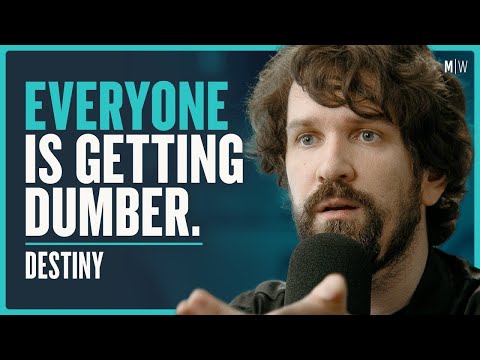
Have We Reached Peak Stupidity? - Destiny (4K)
Chris Williamson (host), Destiny (guest), Narrator
In this episode of Modern Wisdom, featuring Chris Williamson and Destiny, Have We Reached Peak Stupidity? - Destiny (4K) explores destiny Dissects Media Madness, Conspiracy Thinking, And Political Polarization Destiny and Chris Williamson explore how modern media, the internet, and social incentives are eroding our shared sense of reality and driving people into increasingly homogenous yet polarized groups.
Destiny Dissects Media Madness, Conspiracy Thinking, And Political Polarization
Destiny and Chris Williamson explore how modern media, the internet, and social incentives are eroding our shared sense of reality and driving people into increasingly homogenous yet polarized groups.
They discuss the collapse of traditional outlets like VICE, the rise of alternative media, and why epistemic grounding—not mainstream vs. independent—is the core crisis.
A major theme is how online echo chambers, conspiracy thinking, and social identity constellations of beliefs replace careful reasoning, yet most people still have the latent capacity to think critically when properly challenged.
They also touch on culture war flashpoints (trans issues, ‘woke’ politics, Trump, red pill ideology), Destiny’s ADHD diagnosis, and the pressures of being a hyper-online public figure.
Key Takeaways
The real media crisis is epistemic, not just institutional.
Destiny argues that the biggest problem isn’t mainstream vs. ...
Get the full analysis with uListen AI
Complex systems invite conspiracies because people can’t see the ‘workings’.
Using the abacus–calculator–smartphone analogy, he explains that as technology and institutions become more opaque, people fill gaps in understanding with whatever fits their biases, making conspiratorial explanations tempting and hard to dislodge.
Get the full analysis with uListen AI
The internet lets people ‘select their reality’ and hyper-customize communities.
Online, you can curate your world—friends, ideas, kinks, politics—so finely that you never confront disconfirming friction, leading to extreme echo chambers and support networks even for highly fringe or harmful beliefs.
Get the full analysis with uListen AI
Modern tribes are larger, further apart, and internally more rigid.
Destiny describes how people are withdrawing into massive ideological camps that demand tight conformity on an ever-growing list of issues, making minor disagreement feel like a betrayal of core values rather than a policy quibble.
Get the full analysis with uListen AI
People don’t derive beliefs from principles; they inherit ‘constellations’ from groups.
Joining one camp (e. ...
Get the full analysis with uListen AI
Moderation and nuance are socially costly but cognitively possible.
Destiny’s bet experiments and debates show that people can reason carefully when stakes are explicit and hostility is low, but online incentives (status, in-group approval, dunking) push them toward absolutist, 0–100 reactions instead.
Get the full analysis with uListen AI
Personal introspection and bias calibration are more realistic than ‘objectivity’.
He recommends acknowledging your biases (e. ...
Get the full analysis with uListen AI
Notable Quotes
“Nothing can happen anymore without it being part of some grand narrative or grand design.”
— Destiny
“You can select for your reality rather than having to deal with the reality that might not be as much fun to deal with.”
— Destiny
“People don’t genuinely generate beliefs from some consistent underlying system. They inherit constellations of beliefs from social groups.”
— Destiny
“If you treat a person as smart and present them with the right information… I think people can surprise you.”
— Destiny
“There’s no such thing as a wholly good food or a wholly bad food. Foods just do different things.”
— Destiny
Questions Answered in This Episode
How can individuals practically rebuild their own ‘epistemic grounding’ in a media environment that rewards outrage and conspiracy?
Destiny and Chris Williamson explore how modern media, the internet, and social incentives are eroding our shared sense of reality and driving people into increasingly homogenous yet polarized groups.
Get the full analysis with uListen AI
What concrete steps could platforms or educators take to reduce the formation of rigid ideological ‘constellations’ of beliefs?
They discuss the collapse of traditional outlets like VICE, the rise of alternative media, and why epistemic grounding—not mainstream vs. ...
Get the full analysis with uListen AI
Are there specific formats of debate or conversation that you’ve found significantly more effective at changing minds than traditional adversarial debates?
A major theme is how online echo chambers, conspiracy thinking, and social identity constellations of beliefs replace careful reasoning, yet most people still have the latent capacity to think critically when properly challenged.
Get the full analysis with uListen AI
Given your experience with ADHD and medication, how should we rethink the line between ‘authentic self’ and ‘chemically optimized self’?
They also touch on culture war flashpoints (trans issues, ‘woke’ politics, Trump, red pill ideology), Destiny’s ADHD diagnosis, and the pressures of being a hyper-online public figure.
Get the full analysis with uListen AI
If the red pill and peak ‘woke’ have both crested, what do you think the next dominant online ideological wave will look like?
Get the full analysis with uListen AI
Transcript Preview
You just did Piers Morgan?
Um, well, I d- it was, like, a live segment from this morning. Sure, yeah.
Okay. Yeah. How was that? Was that the first time you've spoken to him?
Yeah.
All right. What did you think?
Uh, it was okay. It could have been way worse.
(laughs)
It could have been way better. They brought me in, it was a segment on like, um, the differences between, like, Trump and Biden and their senility. Basically, is Biden's senility gonna be a huge problem? And my opposite person is, like, Tommy Lauren, and it's a very much, like, mainstream media opinion, like, or a mainstream media appearance. So it's like, "Give me your, like, 30-second splurg, give me your 30-second splurg, and the next question." And I hate that back and forth, like, drives me crazy, so.
Mm, well, I mean, it says everything that we're having a discussion about who is the most senile among all of the different politicians that might influence the future.
Yeah. It does.
What a world.
It says a lot. But at the end of the day, the voters only have themselves to blame, so.
(laughs) That's true, but then I guess you can only vote for the people that are there.
No, there's a lot of people to vote for. These are the two most popular ones. I think that the system is delivering the people that have the widest support right now, yeah.
Right, okay.
People, they might not be, um, universally liked, but you only have to have a plurality of the support to make it through. Like, people are looking at you like, "Uh, I guess, like, sure." But people might not like him, like, 80% of people might not like Biden or 80% of people might, might not like Trump, but those 80% of people don't all agree on who should run instead, so that's the issue, right?
Right. Yeah, interesting. I wonder if people could coordinate better, whether or not you would have, uh, better outcomes.
I don't know.
VICE Media, shutting down, no longer publishing. Have you seen this?
Are they shutting down or are they just not gonna publish articles on that website anymore?
That's technically what it is. In a memo to VICE employees Thursday, CEO Bruce Dixon said that the company will be cutting several hundred jobs in the next week as part of its major restructuring. VICE will discontinue publishing content to its own website and instead will put more emphasis on our social channels as we accelerate our discussions with partners to take our content to where it will be viewed most broadly. What do you think?
Cool, I guess. Does anybody read, like, website stuff from VICE? I feel like they were most known for their YouTube video content, like, the investigative journal stuff. I should know the lady's name. I wish I did, but she does really cool stuff. I remember she went to China to investigate the Uyghur stuff.
Install uListen to search the full transcript and get AI-powered insights
Get Full TranscriptGet more from every podcast
AI summaries, searchable transcripts, and fact-checking. Free forever.
Add to Chrome