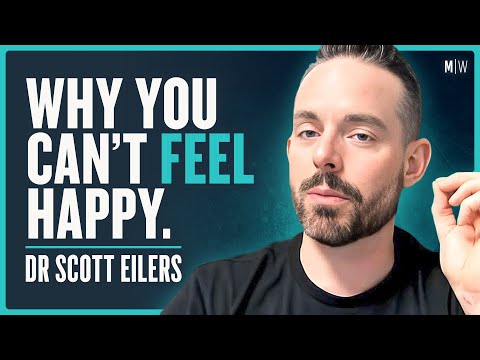
Why You Feel Like a Ghost in Your Own Life - Dr Scott Eilers
Chris Williamson (host), Dr. Scott Eilers (guest), Narrator, Narrator
In this episode of Modern Wisdom, featuring Chris Williamson and Dr. Scott Eilers, Why You Feel Like a Ghost in Your Own Life - Dr Scott Eilers explores depression, Anhedonia, And Why High Achievers Feel Emotionally Empty Dr. Scott Eilers explains depression as less about sadness and more about anhedonia—a loss of joy where life’s usual rewards stop registering, leaving people feeling numb, hollow, or like a ‘ghost’ in their own lives.
Depression, Anhedonia, And Why High Achievers Feel Emotionally Empty
Dr. Scott Eilers explains depression as less about sadness and more about anhedonia—a loss of joy where life’s usual rewards stop registering, leaving people feeling numb, hollow, or like a ‘ghost’ in their own lives.
He distinguishes everyday sadness from clinical mood disorders, outlines why current treatments only help about half of sufferers, and criticizes how the mental health system labels people as “treatment resistant” rather than questioning its own methods.
Eilers explores high‑functioning depression in successful, outwardly thriving people, the unfair burden of chronic mental illness, and why biology, lifestyle, and social factors must be addressed before purely psychological work can stick.
He offers five concrete coping strategies for anhedonia, argues that chasing peak pleasures doesn’t cure depression, and reframes mental health management as an ongoing primary life priority rather than a side quest.
Key Takeaways
Recognize anhedonia as the central feature of clinical depression.
Depression often shows up not as overt sadness but as a lack of emotional payoff from normally rewarding activities—like working for no paycheck—which then erodes motivation, hygiene, and daily functioning.
Get the full analysis with uListen AI
Distinguish situational sadness from mood disorders by duration and causality.
Feeling devastated after a loss or setback is normal; clinical depression is when you feel like you’re grieving or empty for weeks or months without any clear external trigger, suggesting a chronic mood disorder rather than a passing emotion.
Get the full analysis with uListen AI
Don’t assume you’re the problem when standard treatments fail.
With psychotherapy and medication only significantly helping about 50–60% of people even under ideal conditions, the term “treatment resistant” often unfairly implies patient failure instead of highlighting system gaps in training, diagnosis, and personalization.
Get the full analysis with uListen AI
If you’re high functioning and empty, you might still be severely depressed.
People with careers, families, and immaculate lives can feel hollow, driven more by duty or meaning than joy; outsiders misread their output as wellness, causing them to be overlooked in both life and treatment.
Get the full analysis with uListen AI
Treat your mental health like a chronic condition with daily management.
For those with recurring or persistent depression, mental health can’t be an afterthought; like diabetes, it demands ongoing, prioritized habits around sleep, movement, nutrition, substances, and self‑talk to keep symptoms manageable.
Get the full analysis with uListen AI
Use structured strategies to cope with numbness instead of waiting to “feel like it.”
Eilers’ five tools—investments, checking the lock, stacking achievement plus pleasure, exploiting “loophole” activities that still feel good, and ‘apathy‑ception’ (acting despite not caring)—help people function and create future joy even when present emotions are flat.
Get the full analysis with uListen AI
Optimize the body before trying to think your way out of depression.
Because the brain is an organ that needs sleep, oxygen, and energy, Eilers argues for a bio‑psycho‑social order of operations: fix basic biological inputs first, then work on cognition and relationships; otherwise, the brain simply lacks the resources to feel better.
Get the full analysis with uListen AI
Notable Quotes
“Depression is like being told you still have to go to work, but there’s no paycheck anymore.”
— Dr. Scott Eilers
“With depression, we lose our leverage. There’s a gap between what we put in and what we get out.”
— Dr. Scott Eilers
“You can either try to do things that feel good, or you can try to do things that make it feel good to be you.”
— Dr. Scott Eilers
“If you have a chronic mental health condition, managing your mental health should not be a side quest in your life.”
— Dr. Scott Eilers
“Be careful what you wish for in terms of traits.”
— Dr. Scott Eilers
Questions Answered in This Episode
How can someone realistically start applying the five anhedonia strategies if they currently lack motivation to do anything at all?
Dr. ...
Get the full analysis with uListen AI
What would a mental health system look like that took the bio‑psycho‑social order of operations seriously from day one of treatment?
He distinguishes everyday sadness from clinical mood disorders, outlines why current treatments only help about half of sufferers, and criticizes how the mental health system labels people as “treatment resistant” rather than questioning its own methods.
Get the full analysis with uListen AI
How can high‑functioning, outwardly successful people safely signal that they’re struggling without feeling shame or fear of losing status?
Eilers explores high‑functioning depression in successful, outwardly thriving people, the unfair burden of chronic mental illness, and why biology, lifestyle, and social factors must be addressed before purely psychological work can stick.
Get the full analysis with uListen AI
In practical terms, how can a person tell whether they’re in a mild ‘rut’ versus a clinical depressive episode that needs professional help?
He offers five concrete coping strategies for anhedonia, argues that chasing peak pleasures doesn’t cure depression, and reframes mental health management as an ongoing primary life priority rather than a side quest.
Get the full analysis with uListen AI
Given the link between intelligence, awareness, and depression, how can smart, highly self‑reflective people prevent their minds from becoming their worst enemy?
Get the full analysis with uListen AI
Transcript Preview
How would you describe to somebody who's never felt it what depression feels like?
(sighs) It's tricky 'cause it can feel like a lot of different things. It depends on the person, but for a lot of people, depression is not as much the sadness and the despair as it's often portrayed as, and it often is more of a numbness or an emptiness. So one of the core symptoms of depression that nearly everyone experiences to some degree is what's called anhedonia. The literal translation of anhedonia is the loss of joy. So the rewards system in your brain, right, your dopamine pathway that causes you to experience emotions like enjoyment when you're doing something fun, or achievement after you accomplish something, it basically stops functioning. It can, it can be a diminished functioning or it can be a completely absent functioning. And what that feels like on a day-to-day basis is you can go out and do the things you would normally do that would normally make you feel some certain way, and the emotional reaction that you would expect to experience upon completion of those tasks or activities is either significantly dulled from what you usually experience or it is just not there at all. It's very much, I, I hear a lot of people describe it as, uh, as if there were a black hole inside of them where their emotions or their reactions should be. And obviously for many people when you start feeling this way, that's where the lack of motivation that we see with depression comes from. It's not that these people actually stop caring about their lives or the people in them or their jobs or whatever, it's that you don't feel anything when you do it. And you know, we're, we're reward-based mammals, right? And so if we don't feel anything when we do things that are hard or challenging that require effort, the natural reaction is to stop doing them. And that's where you see, that's where you see the person who, you know, can't get out of bed, can't take care of their home, can't take care of their hygiene. It, it, it's, it's that there's no, there's no reward in it. It's like, you know, if you were going to work and your boss pulls you aside and says, "Hey, just so you know, we're out of money. We can't pay you anymore. I don't know when we're gonna be able to pay you again, but we still want you to come in and do all your stuff, you're just not gonna get paid for it for a while." That wouldn't be a really compelling proposition to most people, right? And that's kind of what it feels like to be told you still have to, like, stay alive and do stuff when you're severely depressed is, "I'm working for no paycheck."
Mm. What's the, what's the difference between feeling sad and actually being depressed?
Mainly the intensity, the duration, and the causality, right? So this, I really do think we need to rework some of our clinical terms because depression, you know, when, when a psychologist like me says depression, we're talking about a chronic mental health condition, right? But depression is also an emotion, and it is emotion that all human beings experience under certain circumstances. So somebody you love dies, you lose a job, your house burns down. These are extreme examples. I know they don't have to be that extreme, but we all face challenges in life that cause us to feel sad or depressed, and that doesn't mean you have depression. Where we draw the line is that a person who experiences a clinical or a chronic depression, they're gonna feel like that. They might feel like someone they love died, for example, for no apparent reason, like nothing happened, nothing changed. I just wake up one day and I feel like I'm grieving. I feel like something horrible has happened. I feel like my life has no meaning, but I cannot rationally explain to you, "Here's what happened to make me feel that way. Here's what changed. Here's why I didn't feel that way a week ago and now I do today." And for most people, m- depression isn't technically a diagnosis, right? Mood disorders are a category of diagnoses. Uh, there's no such thing as, as depression, just, you know, as a, as a, like a Z code. When s- most people when they say they're depressed, they're referring to major depressive disorder. Major depressive disorder is an episodic mood disorder when a person experiences depression in episodes and they also experience non-depressed periods. So they kind of go back and forth between these two states, sometimes with no rhyme or reason. And so when a person is getting into these deep, dark places of depression, and this sounds a little subjective, I know, but when there's nothing happening in their life that would reasonably seem to make them feel that way, that is when we would start to say, "Maybe this person has a chronic mood disorder."
Install uListen to search the full transcript and get AI-powered insights
Get Full TranscriptGet more from every podcast
AI summaries, searchable transcripts, and fact-checking. Free forever.
Add to Chrome