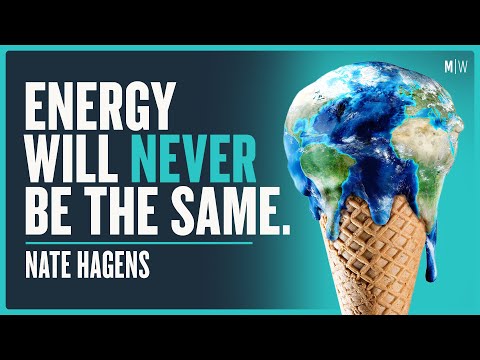
The World’s Coming Energy Catastrophe - Nate Hagens
Nate Hagens (guest), Chris Williamson (host)
In this episode of Modern Wisdom, featuring Nate Hagens and Chris Williamson, The World’s Coming Energy Catastrophe - Nate Hagens explores energy Blindness, Fossil Decline, And Redefining Prosperity In Modern Civilization Nate Hagens explains that modern civilization is built on a one‑time windfall of cheap fossil energy, especially oil, which effectively provides hundreds of billions of “energy slaves” doing work for us at almost no cost.
Energy Blindness, Fossil Decline, And Redefining Prosperity In Modern Civilization
Nate Hagens explains that modern civilization is built on a one‑time windfall of cheap fossil energy, especially oil, which effectively provides hundreds of billions of “energy slaves” doing work for us at almost no cost.
We culturally mistake technology, money, and human ingenuity for the source of our wealth, while ignoring the biophysical foundations of ecology, materials, and energy, all of which are finite and being rapidly drawn down.
Because money is created as debt, our economic system is structurally obligated to grow, yet the quality and flow rate of accessible fossil fuels are peaking or declining, creating a looming mismatch between financial claims and real energy.
Hagens argues that this will force a societal shift toward using less energy and materials, and that our challenge is to redesign status, meaning, and flourishing so we can live well with less throughput rather than clinging to current consumption levels.
Key Takeaways
Recognize that money is ultimately a claim on energy, not an abstract score.
Every dollar spent mobilizes real energy and materials; debt represents a claim on future energy. ...
Get the full analysis with uListen AI
Develop personal “energy awareness” and audit how energy underpins your daily life.
Consciously noticing all the devices, transport, heating/cooling, and goods that rely on fossil fuels helps shift perception from taken‑for‑granted convenience to appreciation and more selective use.
Get the full analysis with uListen AI
Prepare for a future with lower per‑capita energy by redefining what a good life means.
Since cheap high‑quality fossil fuels are finite, flourishing will increasingly depend on meaningful relationships, health, nature, and low‑energy forms of status rather than material throughput.
Get the full analysis with uListen AI
Build social capital and community as key forms of “real wealth.”
Strong relationships and local networks reduce psychological stress, buffer shocks, and become more valuable as material abundance and financial reliability wobble.
Get the full analysis with uListen AI
Support policies that price non‑renewable resource use rather than taxing human labor.
Shifting taxes from income to resource and pollution inputs (e. ...
Get the full analysis with uListen AI
Shift status games away from conspicuous consumption toward prosocial, low‑energy achievements.
Humans will always seek status, but culture can reward things like craftsmanship, ecological stewardship, community leadership, or health instead of cars, square footage, and luxury goods.
Get the full analysis with uListen AI
Mentally rehearse and normalize using less before you are forced to.
Experimenting now with lower energy use—fewer flights, less stuff, more local living—can reduce loss aversion and make the eventual systemic constraints less psychologically and socially destabilizing.
Get the full analysis with uListen AI
Notable Quotes
“Without energy all of our technology would just be sculptures. Without energy our cities would be museums.”
— Nate Hagens
“We’re treating fossil fuels culturally as if they were interest, but the reality is we’re drawing down the principal ten million times faster than it was sequestered.”
— Nate Hagens
“Money is a claim on energy, and debt is a claim on future energy.”
— Nate Hagens
“Our economic system is geared toward measuring our progress by the size of our energy use. GDP is really just a measure of how much stuff we burn.”
— Nate Hagens
“We’re not going to stop comparing ourselves to others, but we can change how we compete in ways that use less energy and materials.”
— Nate Hagens
Questions Answered in This Episode
If money and debt are ultimately claims on energy, how should central banks and governments rethink fiscal and monetary policy in a world of peaking fossil fuels?
Nate Hagens explains that modern civilization is built on a one‑time windfall of cheap fossil energy, especially oil, which effectively provides hundreds of billions of “energy slaves” doing work for us at almost no cost.
Get the full analysis with uListen AI
What practical steps can individuals take in the next 5–10 years to reduce dependence on high‑energy lifestyles without feeling like they are sacrificing quality of life?
We culturally mistake technology, money, and human ingenuity for the source of our wealth, while ignoring the biophysical foundations of ecology, materials, and energy, all of which are finite and being rapidly drawn down.
Get the full analysis with uListen AI
How could status systems realistically be shifted in modern, digital societies so that low‑energy behaviors and roles become high‑prestige?
Because money is created as debt, our economic system is structurally obligated to grow, yet the quality and flow rate of accessible fossil fuels are peaking or declining, creating a looming mismatch between financial claims and real energy.
Get the full analysis with uListen AI
Given the intermittency of renewables and limits of nuclear, what mix of technologies and behavior changes could maintain grid stability while total fossil fuel use declines?
Hagens argues that this will force a societal shift toward using less energy and materials, and that our challenge is to redesign status, meaning, and flourishing so we can live well with less throughput rather than clinging to current consumption levels.
Get the full analysis with uListen AI
What kinds of social, political, or psychological tipping points might finally force mainstream acknowledgment of the energy–economy mismatch Nate describes?
Get the full analysis with uListen AI
Transcript Preview
We live as part of a system and the things that have been supporting the system since you and I have been alive are unlikely to continue for too much longer and so we're gonna have to change how we get our evolutionary neurotransmitters. The emotional states of our ancestors probably with using less energy and materials than we do today.
What I find particularly interesting about your work is that you're looking at energy, you're also looking at human flourishing, you're also looking at economics, you're looking at the past, the present, the future. Given the fact that many of the people listening won't be familiar with your world view and your work, what is important in the story of how we got here? So what do we need to know about our history before we can assess where we're at at the moment?
It's a big question. Uh, I think, uh, we live in a culture that focuses on technology and human ingenuity and money as the things that describe our wealth and our future trajectory. And I think, uh, culturally, educationally we misunderstand or fail to recognize the importance of ecology and energy to our lives. And, uh, we live as part of a system, so for the last 20 years I've tried to connect the dots of how the pieces of the human ecosystem fit together. Uh, you mentioned economy, which is technology and materials and energy and human ingenuity. There's also, uh, the environment and climate change and other species and biodiversity and ecosystem health. There's also anthropology and neuroscience, which I know you spend a lot of time on who we are as evolved, a- a- animals have arrived here after 300,000 years. But, um, because our- our brains and our bodies were shaped from the past and we are biological organisms and energy is the central currency in nature. Animals were the first investors. And we just think of investing money, but everything we do requires energy. Every single thing that ends up in a good or service that contributes to GDP, or gross domestic product, our, the size of our economy requires energy to invent, to mine the materials for it, to create, to distribute, to operate, to maintain, to fix, and to dispose of. Without energy all of our technology would just be sculptures. And so without energy our cities would be museums. And this makes sense, right, except we assume that we will have the energy we have now, uh, indefinitely and that's where the risk comes in. And I think, um, what's happening in Ukraine and Russia right now is causing people to become a little bit more aware of, "Oh my God, we're really dependent on energy." Well, in this case Germany and Europe are really recognizing what's- what's happening. So long story short, um, we live as part of a system and the things that have been supporting the system since you and I have been alive are unlikely to continue for too much longer and so we're gonna have to change how we get our evolutionary neurotransmitters. The- the emotional states of our ancestors probably with using less energy and materials than we do today.
Install uListen to search the full transcript and get AI-powered insights
Get Full TranscriptGet more from every podcast
AI summaries, searchable transcripts, and fact-checking. Free forever.
Add to Chrome