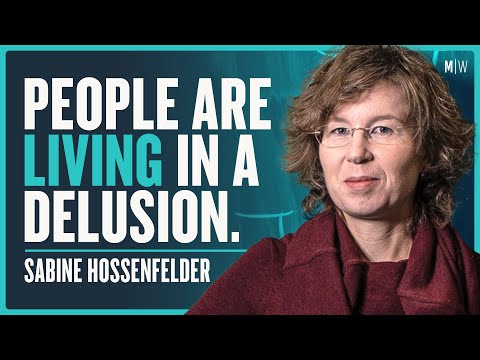
Are We Living In A Simulation? - Sabine Hossenfelder
Sabine Hossenfelder (guest), Chris Williamson (host), Chris Williamson (host)
In this episode of Modern Wisdom, featuring Sabine Hossenfelder and Chris Williamson, Are We Living In A Simulation? - Sabine Hossenfelder explores physicist Sabine Hossenfelder Dismantles Cosmic Myths About Reality And Free Will Sabine Hossenfelder discusses why popular ideas like the simulation hypothesis, fine‑tuning, and many speculative cosmology stories are not genuinely scientific but often oversold as such. She stresses the limits of current physics: we cannot yet simulate the universe, explain the Big Bang, or reliably predict its ultimate fate, and honest answers often amount to “we don’t know.”
Physicist Sabine Hossenfelder Dismantles Cosmic Myths About Reality And Free Will
Sabine Hossenfelder discusses why popular ideas like the simulation hypothesis, fine‑tuning, and many speculative cosmology stories are not genuinely scientific but often oversold as such. She stresses the limits of current physics: we cannot yet simulate the universe, explain the Big Bang, or reliably predict its ultimate fate, and honest answers often amount to “we don’t know.”
On free will and quantum mechanics, she argues that known laws combine determinism with randomness in ways that make traditional free will hard to reconcile with physics, regardless of the interpretation of quantum theory. She also explores questions about consciousness, artificial intelligence, mathematics as the “language” of reality, and thought experiments like Boltzmann brains.
Throughout, Hossenfelder pushes for evidence-based thinking, resisting comforting narratives and philosophical speculation that outruns what physics can currently justify.
Key Takeaways
The simulation hypothesis is not a scientific theory without a concrete algorithm.
Claiming our universe is a computer simulation effectively claims to have a theory of everything implementable on a computer; without specifying how to compute chaotic, scale‑invariant systems like climate or fluids exactly, it remains unsupported speculation rather than physics.
Get the full analysis with uListen
Our current laws of physics make traditional free will very hard to defend.
Fundamental laws appear either deterministic or deterministic plus truly random quantum events; in neither case is there room for a kind of free will that lets us step outside those laws to influence outcomes, unless you redefine what you mean by ‘free will.’
Get the full analysis with uListen
We genuinely do not know how the universe began or how it will end.
General relativity breaks down at the Big Bang, and speculative add‑ons like bounces or pre‑Big‑Bang universes are mathematically allowed stories but not empirically required; similarly, extrapolating the universe’s fate trillions of years forward accumulates uncertainties we cannot eliminate.
Get the full analysis with uListen
Fine‑tuning arguments rest on unquantifiable probabilities and arbitrary choices.
Saying constants are ‘improbably’ suited for life assumes a probability distribution we can’t justify and arbitrary notions of ‘small’ changes; moreover, alternative sets of constants might still allow complex chemistry, weakening claims that our universe is uniquely fine‑tuned.
Get the full analysis with uListen
Boltzmann brain paradoxes hint at constraints on the laws of nature.
If the universe and its dynamics were fully ergodic over infinite time, random fluctuations would almost surely produce fleeting conscious brains; taking this seriously suggests the real laws (especially involving gravity or the strong force) may not be ergodic in that way.
Get the full analysis with uListen
Mathematics is our best tool, but not necessarily the ultimate one.
Math currently underpins our strongest theories, yet Hossenfelder notes that in principle one can map ‘reality to reality’ via physical simulations (e. ...
Get the full analysis with uListen
Conscious, general AI may be limited by what is computable and by resources.
If, as Penrose suggests, consciousness involves non‑computable physics, algorithmic AI will never be truly conscious; even setting that aside, modern AI systems face serious scaling, resource, and reproducibility issues, especially on poorly defined, ‘general’ problems.
Get the full analysis with uListen
Notable Quotes
“If you claim that it’s actually based on science, that’s when I get a problem.”
— Sabine Hossenfelder (on the simulation hypothesis)
“Basically, you just claimed that you have a theory of everything, and I want to see the algorithm.”
— Sabine Hossenfelder
“I think the honest answer we can give as physicists to the question ‘How did the universe begin?’ is, ‘We don’t know.’”
— Sabine Hossenfelder
“People should stop talking about [fine‑tuning].”
— Sabine Hossenfelder
“We’ve barely just begun to understand nature and to try to formulate our hypotheses about it in forms of mathematics.”
— Sabine Hossenfelder
Questions Answered in This Episode
What empirical test, if any, could meaningfully distinguish a simulated universe from a non‑simulated one?
Sabine Hossenfelder discusses why popular ideas like the simulation hypothesis, fine‑tuning, and many speculative cosmology stories are not genuinely scientific but often oversold as such. ...
Get the full analysis with uListen AI
How should our legal and moral systems adapt if we accept that traditional free will is incompatible with known physics?
On free will and quantum mechanics, she argues that known laws combine determinism with randomness in ways that make traditional free will hard to reconcile with physics, regardless of the interpretation of quantum theory. ...
Get the full analysis with uListen AI
Given the limits of our current theories at the Big Bang, what would a fundamentally new type of theory need to look like to answer questions about the universe’s origin?
Throughout, Hossenfelder pushes for evidence-based thinking, resisting comforting narratives and philosophical speculation that outruns what physics can currently justify.
Get the full analysis with uListen AI
If fine‑tuning arguments are ill‑posed, what is a more scientifically honest way to talk about why the constants of nature have their observed values?
Get the full analysis with uListen AI
Could a future, more powerful framework than mathematics change our deepest understanding of reality, and how would we even recognize it as ‘science’?
Get the full analysis with uListen AI
Transcript Preview
We know this, climate scientists know this. Uh, weather people know it. It's a problem. And so people are talking about the simulation hypothesis kind of would totally ignore the problem that we have with putting our reality on a computer. (wind blows)
You've got a quote at the start of your new book that says, "It is far better to grasp the universe as it really is than to persist in delusion, however satisfying and reassuring." It's from Carl Sagan. What's that mean to you?
I, when I came across this, I, uh, I just thought this captures exactly what I'm trying to i- express with the book. Um, so i- it's very tempting to fall for some pleasant explanation, uh, and try not to look at the evidence. But I think in the end, it's better to actually look at the evidence, at least for me. Uh, so, so that's been my conclusion. Because otherwise, you always have this feeling that you're lying to yourself.
Mm. Do you feel like your Twitter account is mostly you dashing the dreams of people who have, uh, non-evidence-based ideas about what might be happening in the world or in the world of physics?
Well, except for the animal pictures (laughs) basically. Um, but y- yeah. Well, um, you know, partly the reason that I was writing this book is that I felt, um, what I do on social media is a little bit too destructive, a little bit depressing almost. Um, if there are some headline that claims, "Well, soon we'll be able to send information faster than the speed of light with a quantum internet," or, "Physicists have, uh, created negative mass," or that kind of stuff, then I'm the one who has to say, "Well, actually, no, you can't do this and it doesn't work. And no, we have not made contact with parallel universes," that kind of stuff. And I, I do think it's important, but it's a very one-sided picture of physics. It, it raises the impression that physics just tells you what you can't do (laughs) , what, what, what isn't possible. And I think physics has another side where it opens new possibilities. It tells you what you can do. Um, it, it brings up, um, new ideas that you might not have thought about otherwise.
Mm. So rather than just playing defense all the time, there's the opportunity for you to put forward some ideas?
Well, not, not my own ideas. I'm talking about, uh, stuff like the multiverse or, um, I mean, o- other ideas that have already, I would say, an almost established place, uh, in the public mind is ideas like that time slows down near black holes or wormholes or maybe teleportation. Uh, those are all ideas that came out of physics and I think it's, it's really inspirational and I understand that people like it and they want to hear more about it and, and so I thought, "Well, I'll write a book about all those big ideas." (laughs)
Install uListen to search the full transcript and get AI-powered insights
Get Full TranscriptGet more from every podcast
AI summaries, searchable transcripts, and fact-checking. Free forever.
Add to Chrome