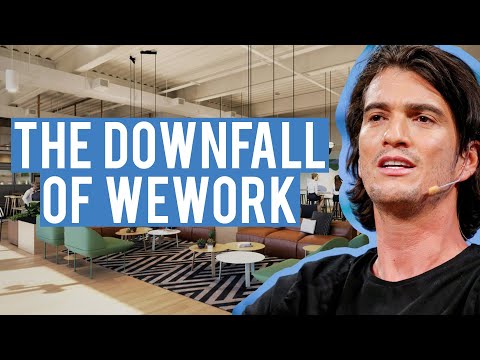
The Catastrophic Story Of WeWork | Reeves Wiedeman | Modern Wisdom Podcast 238
Reeves Wiedeman (guest), Chris Williamson (host)
In this episode of Modern Wisdom, featuring Reeves Wiedeman and Chris Williamson, The Catastrophic Story Of WeWork | Reeves Wiedeman | Modern Wisdom Podcast 238 explores weWork’s Wild Rise, Cult Leader CEO, And Spectacular Unicorn Collapse Journalist Reeves Wiedeman discusses the meteoric rise and implosion of WeWork, tracing how a very old-school real-estate arbitrage business was sold as a world‑changing tech unicorn.
WeWork’s Wild Rise, Cult Leader CEO, And Spectacular Unicorn Collapse
Journalist Reeves Wiedeman discusses the meteoric rise and implosion of WeWork, tracing how a very old-school real-estate arbitrage business was sold as a world‑changing tech unicorn.
He profiles founder Adam Neumann as a hyper-charismatic, risk-addicted leader whose vision, personality, and storytelling attracted billions in capital and enabled unprecedented physical expansion.
The conversation highlights SoftBank’s massive, fast‑judgment investments, the dangers of growth-at-all-costs, and how public markets ultimately rejected WeWork’s story once its numbers and governance were exposed.
Wiedeman and Williamson connect WeWork to broader patterns seen in Theranos, Fyre Festival, and other unicorns, arguing that charisma, hype, and social-media-fueled cults of personality can mask weak fundamentals—until reality asserts itself.
Key Takeaways
A traditional business dressed up as tech can fool private markets—until public scrutiny arrives.
WeWork’s core model was simple rent arbitrage (long leases, short subleases) in nicely branded offices, but it was packaged as a tech and “community” company, which private investors accepted; once its S‑1 revealed huge losses and basic real-estate risk, public investors balked.
Get the full analysis with uListen AI
Charismatic founders are powerful fundraisers, but they’re also a governance risk.
Adam Neumann’s height, charm, and visionary rhetoric convinced VCs, landlords, and employees to believe in “elevating the world’s consciousness,” yet that same unchecked aura allowed him to pursue side projects, self‑dealing, and whimsical expansions with minimal internal resistance.
Get the full analysis with uListen AI
Excessive capital can destabilize a company rather than strengthen it.
SoftBank’s multi‑billion‑dollar injections acted as jet fuel, forcing WeWork to scale at a pace that was almost impossible to manage prudently—illustrating how too much money, too fast, can turn into a poison chalice that hastens a fragile model’s collapse.
Get the full analysis with uListen AI
Physical-world startups can’t ignore regulation and local ecosystems.
Scooter companies, Uber, and WeWork show that tech-style ‘move fast’ tactics clash with city councils, safety issues, and real-estate cycles; founders must plan for politics, regulation, and downturns, not just software-like growth curves.
Get the full analysis with uListen AI
Markets eventually reassert discipline over hype and narrative.
However persuasive a story about community, consciousness, or disruption may be, public markets ultimately ask whether cash flows and unit economics make sense—WeWork’s aborted IPO became a symbolic victory for supply-and-demand discipline over charisma.
Get the full analysis with uListen AI
Information silos and weak boards enable delusion at scale.
Both WeWork and Theranos kept teams compartmentalized and had boards missing critical domain experts, making it easy for a small inner circle to maintain unrealistic narratives while employees and investors assumed “someone else” was doing the hard diligence.
Get the full analysis with uListen AI
We need better skepticism about the line between visionary and charlatan.
The episode argues that in a social-media era that rewards personality and confidence, investors, employees, and the public must develop a sharper radar for distinguishing genuine innovation from charisma-driven overpromising.
Get the full analysis with uListen AI
Notable Quotes
“Adam's either going to be a millionaire or he's going to jail. Those are the two options.”
— Reeves Wiedeman (quoting Adam Neumann’s driving instructor)
“We dedicate this to the energy of we, greater than any of us, but inside each of us.”
— Reeves Wiedeman (reading from WeWork’s S‑1 filing)
“He built it out of a recession. It wouldn’t have worked if he had started it at another point.”
— Reeves Wiedeman
“Hyperbole, autocratic leadership, and a disconnect from reality were suddenly assets on the path to power.”
— Chris Williamson (paraphrasing a line from Wiedeman’s book)
“There’s a very thin line between the kinds of risks that pay off and the ones that end up with you collapsing.”
— Reeves Wiedeman
Questions Answered in This Episode
At what specific point could WeWork’s board or major investors have intervened to change the company’s trajectory—and why didn’t they?
Journalist Reeves Wiedeman discusses the meteoric rise and implosion of WeWork, tracing how a very old-school real-estate arbitrage business was sold as a world‑changing tech unicorn.
Get the full analysis with uListen AI
How can investors and employees practically distinguish between a visionary founder and a charisma-fueled charlatan before damage is done?
He profiles founder Adam Neumann as a hyper-charismatic, risk-addicted leader whose vision, personality, and storytelling attracted billions in capital and enabled unprecedented physical expansion.
Get the full analysis with uListen AI
What structural changes in venture capital and governance would reduce the likelihood of another WeWork‑style hypergrowth implosion?
The conversation highlights SoftBank’s massive, fast‑judgment investments, the dangers of growth-at-all-costs, and how public markets ultimately rejected WeWork’s story once its numbers and governance were exposed.
Get the full analysis with uListen AI
To what extent are companies like WeWork symptoms of deeper flaws in late-stage capitalism versus just outlier excesses?
Wiedeman and Williamson connect WeWork to broader patterns seen in Theranos, Fyre Festival, and other unicorns, arguing that charisma, hype, and social-media-fueled cults of personality can mask weak fundamentals—until reality asserts itself.
Get the full analysis with uListen AI
How should we evaluate mission-driven rhetoric (“elevating the world’s consciousness”) when it comes from profit-seeking, venture-backed startups?
Get the full analysis with uListen AI
Transcript Preview
Some of this just comes down to temperament, and we start the book with a quote from Adam Neumann's high school driving instructor. Adam's either going to be a millionaire or he's going to jail. Those are the two options. There's no, like, nice steady Adam Neumann work his way up the ranks at, at some job. He was ... He was a go big kind of person, and the question was going to be whether he, he, (laughs) he ended up, uh, being successful with that risk or, or falling on his face.
Or both.
Or both.
(wind blows) What have you spent the last couple of years researching?
Well, I've spent about the last year and a half researching WeWork, the company, and, and the last few years researching sort of the world of, I guess, high-growth unicorn startups, um, is, is one way of, of, uh, putting it, some of which, um, have flamed out in one way or another, or ... and some of which are, are still with us, so.
Is WeWork classed as one of those unicorns? And what, what is a unicorn? For people that don't live in Silicon Valley, what's a unicorn?
Sure, sure. Well, there's, there's, there's unicorns, there's zebras, there's all kinds of different species now, but it ... But a unicorn very, um, simply is a, is a company that, according to private valuations set by private investors, is worth more than a billion dollars. Um, and, you know, there, there are now, um, certainly more than 100 of, of these, um, uh, k- kinds of companies, and, and WeWork, uh, despite all its troubles, remains one of those.
Those companies that are unicorns, are they still private or have some of those transitioned to now be traded?
Yeah. The, the, the typical way it's sort of looked at is, is these are, um ... You know, they are magical creatures. They exist outside of the way the, the markets traditionally treat these companies. So, so unicorns are, are generally companies that are, that are private before, um, before they hit the stock market, which-
And then you ... Are you no longer a unicorn once you do?
I ... You a- ... You're not. I don't know, like, what you transform into exactly in, like, the Silicon Valley nomenclature.
Oh.
But, but you, you, you ... Yeah. It's, it's sort of like caterpillar/butterfly thing, but I don't know what the next, like, transformation is.
Got you. If anyone understands the Pokemon game that is Silicon Valley sufficiently well-
(laughs)
... what does the unicorn evolve ... It's Charizard, isn't it? Charizard-
Charizard, exactly.
And then you get the shiny one, and then that's ... Everyone at school wants you cards.
Well, you're, you're joking, I, I think, but, but tru-
(laughs)
Truthfully, there, there is, there is another group called a decacorn. And a decacorn is a ... is an even rarer breed of company, um, that has a private valuation above $10 billion. And WeWork was, was, um, uh, was one of those. I guess that is actually a qualification that the company has, has now lost, um, in, in-
Install uListen to search the full transcript and get AI-powered insights
Get Full TranscriptGet more from every podcast
AI summaries, searchable transcripts, and fact-checking. Free forever.
Add to Chrome