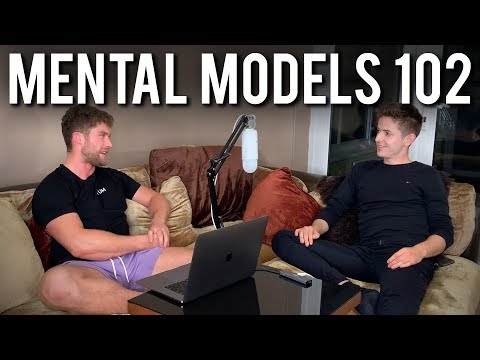
Mental Models 102 - The Decision Strikes Back | George Mack
George Mack (guest), Chris Williamson (host), Narrator
In this episode of Modern Wisdom, featuring George Mack and Chris Williamson, Mental Models 102 - The Decision Strikes Back | George Mack explores mental Models 102: Extreme Ownership, Antifragility, And Designing Luck Chris Williamson and George Mack expand on mental models that shape better decision-making, focusing on extreme ownership, antifragility, and how environment silently drives behavior.
Mental Models 102: Extreme Ownership, Antifragility, And Designing Luck
Chris Williamson and George Mack expand on mental models that shape better decision-making, focusing on extreme ownership, antifragility, and how environment silently drives behavior.
They explore concepts like unforced errors, availability bias, orthogonal thinking, and ‘MacGill’s Razor’—always choosing the option that creates the most luck.
Throughout, they link abstract ideas to vivid stories: Navy SEALs in combat, elite athletes under stress, social media addiction, parenting, friendships, and modern dating.
The conversation emphasizes seeing life as a “Roy score” video game: using mental models to deliberately design your habits, relationships, and opportunities instead of drifting.
Key Takeaways
Minimize unforced errors by taking extreme ownership.
Treat avoidable mistakes—being late, texting while driving, poor prep—as your full responsibility. ...
Get the full analysis with uListen AI
Become antifragile by training under suboptimal conditions.
Your body and mind can get stronger from stress if you dose it right: train when tired, embrace bad weather, or lean into unexpected disruptions. ...
Get the full analysis with uListen AI
Design your environment to beat availability bias, not your willpower.
What’s visible and easy—digestive biscuits, sensational news, echo-chamber content—is what you’ll consume. ...
Get the full analysis with uListen AI
Use MacGill’s Razor: choose the option that creates the most luck.
When facing two paths, ask which one has higher upside and asymmetric payoff: going to the event, messaging the stranger, complimenting someone, or taking a small risk. ...
Get the full analysis with uListen AI
Curate your tribe intentionally; proximity shapes your trajectory.
The people you’re randomly thrown next to (halls at uni, old friends, colleagues) often end up defining your mindset and standards by accident. ...
Get the full analysis with uListen AI
Exploit cognitive biases instead of trying to eliminate them.
Rather than pretending you’re immune to social pressure or identity, deliberately use them: call yourself a “positive person,” share your goals publicly, or compete in habit-tracking apps so your social brain pushes you to follow through.
Get the full analysis with uListen AI
Optimize beginnings and endings; final impressions heavily color memories.
Like the endoscopy study and stand-up comedy sets, how an experience ends often dictates how it’s remembered. ...
Get the full analysis with uListen AI
Notable Quotes
“Everything that can go wrong is ultimately my fault. And even when it’s not, it sometimes still helps to think that.”
— George Mack
“The sliding doors are invisible when you go through them, but completely visible when you look back.”
— George Mack
“Society is the dying man on the street, and you are the person standing over them holding a penknife in a desperate attempt to try and bring them back to life. All that society is concerned about is what you can produce.”
— Chris Williamson (paraphrasing David Wong)
“You know it’s contrarian when everybody looks at you like you’re an absolute weirdo.”
— George Mack
“Realistically, this is just a video game. What we’re playing is just a game of Roy.”
— George Mack
Questions Answered in This Episode
How would your daily decisions change if you truly adopted “extreme ownership” for a month?
Chris Williamson and George Mack expand on mental models that shape better decision-making, focusing on extreme ownership, antifragility, and how environment silently drives behavior.
Get the full analysis with uListen AI
Where in your life could you deliberately add controlled discomfort to become more antifragile instead of just more stressed?
They explore concepts like unforced errors, availability bias, orthogonal thinking, and ‘MacGill’s Razor’—always choosing the option that creates the most luck.
Get the full analysis with uListen AI
If you applied MacGill’s Razor today, which “lucky” action would you take that you’ve been putting off?
Throughout, they link abstract ideas to vivid stories: Navy SEALs in combat, elite athletes under stress, social media addiction, parenting, friendships, and modern dating.
Get the full analysis with uListen AI
Looking at your current environment—home, phone, friends—what’s silently shaping your behavior in ways you don’t actually want?
The conversation emphasizes seeing life as a “Roy score” video game: using mental models to deliberately design your habits, relationships, and opportunities instead of drifting.
Get the full analysis with uListen AI
What belief do you hold that almost everyone around you disagrees with, and how might it be your own version of an orthogonal, potentially valuable insight?
Get the full analysis with uListen AI
Transcript Preview
70 to 80 years ago, we would've been in a world war. Li- could you imagine telling someone in the trenches, "Oh, I'm addicted to Insta- shut the..." You know what I mean? Part of me is like, we go back to extreme ownership and personal responsibility, log off.
So-
Sign out.
I get it.
Delete the app. You end up at a random uni, and then the people who happen to be placed near you in halls-
(laughs)
... it's literally Susan on a Excel spreadsheet who randomly decides this.
Yeah (laughs) .
And it's mad to think the amount of Susans or Dereks that have decided people's best friends forever (snaps fingers) .
Next one, availability bias.
I was chatting to, uh, one of the (laughs) guys from work, and there's some digestive biscuits in the kitchen. And none of us like digestive biscuits, but we're eating digestive biscuits every single day, 'cause they just are there in the-
Yeah.
... in the jar. And yet, whatever's available to you, you've got to almost instill willpower to avoid it.
Mm-hmm.
Which means that given enough time, given enough lack of sleep, given enough XYZ, you're probably gonna give in at some point.
Mm-hmm.
So yeah, design the environment is key.
The internet goes wild for George McGill back on Modern Wisdom. It's been a long time, man. Thank you so much for coming back on.
It's good to, it's good to be back. You brought me out my cave. It's good.
I have indeed.
Yeah.
A lot has changed since we were last here.
Yeah, a lot, a lot has changed from, f- for, uh, both parties, I imagine.
Yeah.
Always changing.
You're down in London now. You were in Manchester last time we saw each other.
Yeah, down in London, uh, bit more expensive, but-
(laughs)
... you get what you pay for.
Yeah, you do, a lot of opportunities.
Yeah, it's, um, it's certainly very, very different. There's a, a really good Paul Graham essay, uh, called Cities and Ambition.
Uh-huh?
Have you ever heard of it?
No.
It's one of, one of my favorite ones of his, one of the reasons why I moved, and he says that every city sort of whispers something to you, um, whether it's the sort of conversations that you overhear or, um, the people that you're around or the cars that drive past or the buildings that you see. You're constantly getting whispered to, and you, you don't, you don't consciously notice it, but you pick up on it. And, um, 'cause I've found that e- Paul, Paul, Paul Graham says that in, like, New York, it's the, the constant whispering is, "Make more money."
Mm-hmm.
Um, and that's 'cause ev- ev- every conversation you overhear is like, "How much money you make, you know, I made this, this month." Uh, whereas in LA it's, "Be more famous," is what it's constantly whispering to you.
Install uListen to search the full transcript and get AI-powered insights
Get Full TranscriptGet more from every podcast
AI summaries, searchable transcripts, and fact-checking. Free forever.
Add to Chrome