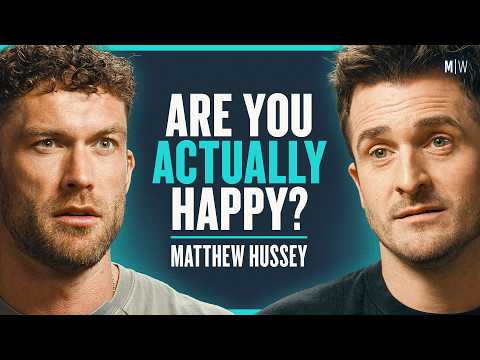
Uncertain About Your Relationship? You Need This… - Matthew Hussey (4K)
Chris Williamson (host), Matthew Hussey (guest)
In this episode of Modern Wisdom, featuring Chris Williamson and Matthew Hussey, Uncertain About Your Relationship? You Need This… - Matthew Hussey (4K) explores knowing when to leave, and why we stay too long The conversation focuses on the gap between realizing a relationship is wrong and having the “activation energy” to leave, highlighting how status quo bias, sunk cost fallacy, fear, and ego keep people stuck.
Knowing when to leave, and why we stay too long
The conversation focuses on the gap between realizing a relationship is wrong and having the “activation energy” to leave, highlighting how status quo bias, sunk cost fallacy, fear, and ego keep people stuck.
They discuss why chaotic, intermittent affection can feel like chemistry (trauma bonding/variable reward), and why calmer, secure love can initially feel “boring” when your nervous system is conditioned to intensity.
They offer practical diagnostic questions for relationship clarity, plus a reframing: don’t compare your partner to hypothetical “someone better,” compare the relationship to the happiness you can create without them.
The episode expands into emotional shame, vulnerability as strength, advice that lands unevenly on “hyper-responders,” and how online echo chambers turn personal pain (“the wall”) into sweeping beliefs about the opposite sex.
Key Takeaways
Awareness that it’s over isn’t the same as readiness to leave.
Hussey notes people can “know” for months or years but still not act because leaving demands high activation energy (heartbreak, logistical untangling, social explanations), while staying is the lower-effort default.
Get the full analysis with uListen AI
Don’t wait for the “real cliff edge”—create urgency before regret compounds.
He uses the cliff-edge metaphor to emphasize acting before irreversible damage occurs (lost years, financial fallout, isolation from friends), even if that means setting an earlier “deadline” for yourself.
Get the full analysis with uListen AI
Stop evaluating a breakup based on whether you can ‘do better.’
“Could I do better? ...
Get the full analysis with uListen AI
Chaos can feel like love when your nervous system is hooked on relief.
Intermittent affection after mistreatment creates euphoria as relief (“the gun is taken away—briefly”), mirroring slot-machine rewards; this is a core mechanism of trauma bonding that can keep people stuck for years.
Get the full analysis with uListen AI
A strong early ‘spark’ can be a marketing trick, not compatibility.
They warn against overvaluing first-date intensity: some people are “sparky with everyone,” like a drink optimized for the “first sip” but sickly over time; character, integrity, and consistency reveal long-term value.
Get the full analysis with uListen AI
Fear of losing yourself can keep you in the relationship that’s erasing you.
People delay leaving because they’ve been reshaped by the relationship and doubt they can rebuild; the reframe offered is to see the relationship as revealing existing wounds/patterns you can now address—reducing the ex’s “angel/demon” power.
Get the full analysis with uListen AI
Use structured questions to cut through rationalization and pedestal thinking.
Questions include whether being like your partner is a compliment, whether you’re fulfilled vs less lonely, whether you can be unapologetically yourself, whether you love who they are now vs their potential, and whether you’d want a child to date/ be raised solely by them.
Get the full analysis with uListen AI
Intuition and instincts are different—instincts can be your bad conditioning.
Intuition might say “this isn’t right,” while instincts may scream “try harder” or cling under threat; Hussey likens it to riptides and boxing—instincts often lead to danger without learned strategy.
Get the full analysis with uListen AI
The ‘leading edge’ of growth is often the opposite of your default strength.
High-achievers may misapply grit to love, tolerating unacceptable pain as “resilience”; for them, growth may be grace, rest, boundaries, and emotional honesty—not more endurance.
Get the full analysis with uListen AI
Vulnerability is a form of strength that opens doors suppression can’t.
Chris argues shutting down isn’t resilience but avoidance rebranded (“toxic stoicism”); Hussey adds that attractive “unique pairings” (strength + sensitivity) create deeper intimacy and can be a competitive advantage in life and relationships.
Get the full analysis with uListen AI
Compatibility isn’t just hobbies—it includes emotional capacity and response.
If opening up leads to disgust or withdrawal, that’s often a mismatch: the partner may not be able to hold your emotional reality; seeking someone emotionally skilled (“black belts”) is part of choosing well.
Get the full analysis with uListen AI
Beware turning a painful ‘wall’ into a worldview via online echo chambers.
They describe how algorithms gather people with the same grievance, reinforcing it until it feels like a universal law (“the wall becomes the world”), fueling polarized beliefs about men/women and trapping people in avoidance.
Get the full analysis with uListen AI
Notable Quotes
““You’ve already given me so many reasons why you shouldn’t be there—but I can’t make you leave.””
— Matthew Hussey
““You can’t compare it with if you think something better is coming. You have to compare it with the happy that you can be without this person.””
— Matthew Hussey
““The chase is a perpetual chase… I never feel safe. I never feel like they’re as into me as I am into them.””
— Matthew Hussey
““The nightmare was being back.””
— Matthew Hussey
““Your intuition might be telling you something’s not right… Your instincts… will get you killed.””
— Matthew Hussey
Questions Answered in This Episode
You distinguish intuition from instincts—what are concrete signs someone is hearing intuition versus acting from anxious ‘try harder’ instincts?
The conversation focuses on the gap between realizing a relationship is wrong and having the “activation energy” to leave, highlighting how status quo bias, sunk cost fallacy, fear, and ego keep people stuck.
Get the full analysis with uListen AI
How would you advise someone to set a ‘fake cliff edge’ (a deadline/boundary) without turning it into an ultimatum game or manipulation?
They discuss why chaotic, intermittent affection can feel like chemistry (trauma bonding/variable reward), and why calmer, secure love can initially feel “boring” when your nervous system is conditioned to intensity.
Get the full analysis with uListen AI
In practice, how can someone tell the difference between healthy “slow-release” love and genuine incompatibility that will feel dull forever?
They offer practical diagnostic questions for relationship clarity, plus a reframing: don’t compare your partner to hypothetical “someone better,” compare the relationship to the happiness you can create without them.
Get the full analysis with uListen AI
What are the most common “variable reward” patterns you see that create trauma bonds, and what specific steps break that loop safely?
The episode expands into emotional shame, vulnerability as strength, advice that lands unevenly on “hyper-responders,” and how online echo chambers turn personal pain (“the wall”) into sweeping beliefs about the opposite sex.
Get the full analysis with uListen AI
Among the five relationship questions, which one do you think is the most diagnostic—and what answers usually signal ‘leave now’?
Get the full analysis with uListen AI
Transcript Preview
Valentine's Day is coming up, and whether you want to more deeply connect with your partner or work out whether or not you should break up, I've got the fix for you. I have put together a list of 50 of the most viral and science-backed ways to connect with your partner more deeply, and 25 questions that will help you work out whether or not you should break up. And they're all available right now at the Modern Wisdom Valentine's Review, and it's completely free. You can get it by going to chriswillx.com/valentines. That's chriswillx.com/valentines. One of the most common issues that I'm seeing online at the moment, and people talk about a lot, is working out when to end things.
Hmm.
How do you come to think about advising people on knowing when to leave a relationship?
[exhaling] Oh, man. I, I coached-- I, there's someone I was coaching recently who had given me all sorts of reasons why they should already be gone. And I, I sat in front of her, and I was-- she was like: "What do you think I should do?" Like, and I was like: "You've already given me so many reasons why you shouldn't be there-
Hmm.
-but I can't make you leave." Like, I sometimes think of... I think this is a-- I, I don't love this metaphor because I believe in renewal and sort of rebirth, but I sometimes think it helps to think of things like a cliff edge. And at a certain point, you kind of go over the cliff edge, and then you're in free fall, and there's, like, a lot of damage that gets done. Or maybe the cliff edge is, you know, your life blows up financially because you put off doing something sooner. Or maybe the cliff edge is that, you know, there's a certain amount of time that's passed that you can never get back. But-
[clears throat]
... that idea of going off the cliff edge is, in some ways, has been important to me because I see part of what I do as, can I get someone to act now? Can I almost even create a fake cliff edge now-
Hmm
... that stops them from getting to the real cliff edge, where there's gonna be so much time passed that they're now gonna have deep regret about having spent that long with that person?
Hmm.
Or there's gonna be such chaos in their lives, or they will have lost so many other relationships because of this relationship. And I said to this, to this woman I was coaching, um, "I can't make you leave, and the reality is, the really tough reality is, you might need to experience a lot more pain yet before you leave. I can't say-- I can't determine for you how much pain you need-
Hmm
... in order to leave."
Hmm.
We all have our threshold, and the scary thing... And I, I'm kind of, in a way, talking about a certain kind of breakup here because there's some truly toxic and dangerous relationships that people get into. And I don't mean just dangerous physically, but just dangerous in the sense that they're with someone that really robs them of their soul, [chuckles] their identity, their, you know, confidence, everything. There was a, a Beth Macy, I think it's Beth Macy, who wrote about the opioid crisis sh- in America. She said the scary thing about opioids is that, you know, the cliché about drugs is that, you know, someone will hit rock bottom, and it's at that point that they'll ricochet back up again. And she said: "No, no, no. With opioids, people hit rock bottom, and then they realize rock bottom has a basement, and that basement has a trapdoor." [laughing]
Install uListen to search the full transcript and get AI-powered insights
Get Full TranscriptGet more from every podcast
AI summaries, searchable transcripts, and fact-checking. Free forever.
Add to Chrome