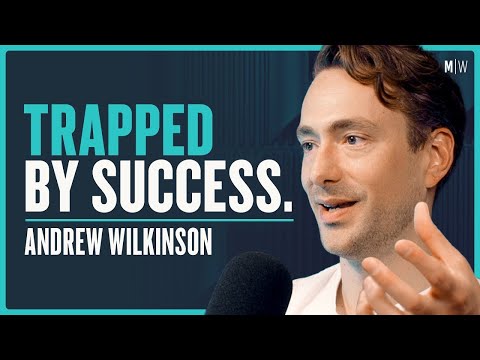
The Glory & Perils Of Becoming A Billionaire - Andrew Wilkinson
Chris Williamson (host), Andrew Wilkinson (guest), Chris Williamson (host)
In this episode of Modern Wisdom, featuring Chris Williamson and Andrew Wilkinson, The Glory & Perils Of Becoming A Billionaire - Andrew Wilkinson explores billionaire Andrew Wilkinson Dissects Money, Anxiety, Ambition And ‘Enough’ Andrew Wilkinson unpacks how chronic anxiety and childhood money scarcity drove him to build a billion‑dollar portfolio, and why crossing that threshold didn’t fix the internal void. He describes using tools like SSRIs, strict information diets, and delegation to turn crippling hypervigilance into sustainable entrepreneurship. The conversation contrasts craftsman vs. empire‑builder paths, warns against copying others’ life or business blueprints, and argues for designing life by eliminating what you hate rather than chasing what you love. Wilkinson also explores the psychological burdens of wealth and fame, the hedonic treadmill at billionaire levels, and his plan to give most of his fortune away.
Billionaire Andrew Wilkinson Dissects Money, Anxiety, Ambition And ‘Enough’
Andrew Wilkinson unpacks how chronic anxiety and childhood money scarcity drove him to build a billion‑dollar portfolio, and why crossing that threshold didn’t fix the internal void. He describes using tools like SSRIs, strict information diets, and delegation to turn crippling hypervigilance into sustainable entrepreneurship. The conversation contrasts craftsman vs. empire‑builder paths, warns against copying others’ life or business blueprints, and argues for designing life by eliminating what you hate rather than chasing what you love. Wilkinson also explores the psychological burdens of wealth and fame, the hedonic treadmill at billionaire levels, and his plan to give most of his fortune away.
Key Takeaways
Chronic anxiety can power success while quietly destroying quality of life.
Wilkinson describes being “a dust bowl farmer inside my head,” constantly scanning for problems and tying self-worth to achievement; it made him an effective entrepreneur but a miserable person until he addressed it directly.
Get the full analysis with uListen AI
Mental health fundamentals matter, but some issues are biochemical.
After maxing out lifestyle tools (exercise, strict diet, 45‑minute daily meditation), he only found real relief with an SSRI (vortioxetine/Trintellix), which turned down the volume on obsessive thoughts without changing his drive.
Get the full analysis with uListen AI
Stop trying to copy other people’s playbooks; your context is different.
He likens advice to “here’s the number I used to win the lottery” — what worked for Warren Buffett or a different-era entrepreneur won’t map cleanly onto today’s markets, your personality, or your circumstances.
Get the full analysis with uListen AI
Design your life by eliminating what you hate, not chasing vague passions.
Wilkinson and his partner listed everything that made them miserable (constant travel, morning meetings, heavy scheduling) and systematically removed those, finding far more happiness than from chasing an abstract future ‘arrival’ point.
Get the full analysis with uListen AI
Great entrepreneurship is ‘productive laziness’ and building machines, not heroics.
He argues your ultimate job is to fire yourself: delegate everything you’re not uniquely good at, hire people who love what you hate, and build systems so the business runs without your constant effort.
Get the full analysis with uListen AI
Hiring senior leaders is about alignment, not potential you hope to reshape.
For CEOs, he looks for someone who has already run a similar business at 2x the scale and who naturally proposes the same strategy he believes in; trying to change a leader’s ‘elephant’ rarely works.
Get the full analysis with uListen AI
‘Enough’ is a moving target; comparison sustains the treadmill at any net worth.
Wilkinson notes that people at every level want roughly 2–3× more, including billionaires envious of Bezos’ yacht; he aims to cap his own game by defining a sufficient income, giving the rest away, and focusing on relationships and meaning.
Get the full analysis with uListen AI
Notable Quotes
“Most successful people are just a walking anxiety disorder harnessed for productivity.”
— Andrew Wilkinson
“The problem with moving to Bali is that your brain comes with you.”
— Andrew Wilkinson
“People don’t change. They need to hit rock bottom first, and only once they hit rock bottom do they change.”
— Andrew Wilkinson
“You want to make sure you’re playing a game where you would naturally play it either way.”
— Andrew Wilkinson
“My goal is to have as few tickers in my life as possible.”
— Andrew Wilkinson
Questions Answered in This Episode
If money and external success don’t resolve underlying anxiety or emptiness, how should ambitious people redefine what they’re really optimizing for?
Andrew Wilkinson unpacks how chronic anxiety and childhood money scarcity drove him to build a billion‑dollar portfolio, and why crossing that threshold didn’t fix the internal void. ...
Get the full analysis with uListen AI
How can someone practically build an ‘anti-goal’ list for their own life and career, and what tradeoffs should they expect when they start enforcing it?
Get the full analysis with uListen AI
Where is the line between ‘productive anxiety’ that drives achievement and pathology that demands medical or therapeutic intervention?
Get the full analysis with uListen AI
Given that most people can’t learn deeply from others’ pain, is there any way to shorten the trial‑and‑error cycle without losing the necessary lessons?
Get the full analysis with uListen AI
What would a realistic personal definition of ‘enough’ look like for you in terms of income, lifestyle, and status—and how would you enforce it once you reach it?
Get the full analysis with uListen AI
Transcript Preview
I'm indoors and some people may be noticing that I'm wearing sunglasses. Look at this. Uh, this is not a ad for Ray-Ban's Meta glasses, but my friend bought me these the other day and I can record you front on. So no one will ever usually get to see what this looks like from the other side. But this is my view. This is what it's like to-
Bizarre.
This is what it's like to be me. Anyway, you've got a quote that says, "Most successful people are just a walking anxiety disorder harnessed for productivity." Why do you say that?
So, um, all my life I've had this feeling that when I wake up, I need to do something. Um, I'm just constantly whipping myself. I basically feel like if I don't achieve, I'm a piece of shit. I don't know where it comes from, um, but I am just obsessed with solving problems and I'm hyper aware of problems. Like, at any given time, my brain is five steps ahead of all the things that could go wrong. And my, my game, if you will, is to try and prevent all the terrible things from happening. And I think that makes me a good entrepreneur, but it makes me kind of a miserable person.
How have you learned to balance those two, given that you want to maximize your effectiveness entrepreneurially, but presumably not do it at the price of your sanity?
Well, I think, um, you know, understanding when you're in a sprint and when to use that. I think, you know, an elite athlete would understand that if they run at a full sprint constantly, they're gonna get injured. And I think in my 20s, you know, when it really mattered, I embraced it. And in my 30s, I started realizing that I've achieved the goal I want, I've made enough money that I'm happy. And it's not that I wanna coast, but I just wanna turn the volume down on that stress a little bit, because I've learned how to achieve leverage using delegation and other people and buying businesses and all those other things. And so, um, I think one of the problems with the way people think is that they imagine that when X, then I'll feel good, right? So you often hear people say, "You know, I just wanna leave it all behind and move to Bali. Forget it all." The problem with moving to Bali is that your brain comes with you, and your brain is anxious. If you're programmed in the way that I am, it doesn't matter where in the world I am, I'm just thinking about problems. And so for me, actually, it's been chemical. I started taking a SSRI about three years ago, and I remember about a week after I started to take it, I would hear the anxious voice and all the concern start to creep in. And it was just a little bit quieter, a little bit more distant. So for me, the, you know, meditation, exercise, being in a healthy relationship, all those, those, you know, form the groundwork, but actually it was a chemical problem to some degree.
Install uListen to search the full transcript and get AI-powered insights
Get Full TranscriptGet more from every podcast
AI summaries, searchable transcripts, and fact-checking. Free forever.
Add to Chrome