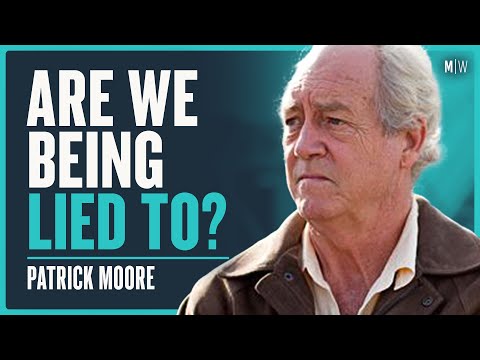
Greenpeace's Ex-President - Is Climate Change Fake? - Patrick Moore | Modern Wisdom Podcast 373
Patrick Moore (guest), Chris Williamson (host)
In this episode of Modern Wisdom, featuring Patrick Moore and Chris Williamson, Greenpeace's Ex-President - Is Climate Change Fake? - Patrick Moore | Modern Wisdom Podcast 373 explores greenpeace Co-Founder Denounces Climate Emergency As Politicized Pseudoscience Patrick Moore, co-founder and former president of Greenpeace, recounts his journey from early environmental activism to becoming a vocal critic of the modern green movement. He argues that environmentalism has been hijacked by the political left, turning from pro-human peace activism into an anti-human, fear-based ideology. Moore rejects the idea of a climate emergency, disputing mainstream claims about CO₂-driven warming, extinction risks, and iconic narratives around polar bears, plastics, and the Amazon. He advocates for nuclear power, a more balanced view of fossil fuels, and a science-based, pro-human environmental ethic rather than one rooted in fear and guilt.
Greenpeace Co-Founder Denounces Climate Emergency As Politicized Pseudoscience
Patrick Moore, co-founder and former president of Greenpeace, recounts his journey from early environmental activism to becoming a vocal critic of the modern green movement. He argues that environmentalism has been hijacked by the political left, turning from pro-human peace activism into an anti-human, fear-based ideology. Moore rejects the idea of a climate emergency, disputing mainstream claims about CO₂-driven warming, extinction risks, and iconic narratives around polar bears, plastics, and the Amazon. He advocates for nuclear power, a more balanced view of fossil fuels, and a science-based, pro-human environmental ethic rather than one rooted in fear and guilt.
Key Takeaways
Understand that early Greenpeace was pro-peace and pro-human, not anti-human.
Moore emphasizes that the original Greenpeace campaigns targeted nuclear testing and whaling, driven by humanitarian and ecological concerns; he left when the organization began treating humans as the ‘enemy of nature’ and adopted scientifically indefensible positions like banning chlorine worldwide.
Get the full analysis with uListen AI
Question claims of overwhelming scientific consensus and climate ‘emergency’ rhetoric.
He argues that oft-cited figures such as ‘97% of scientists agree’ are based on flawed or misleading studies, and that very few climate scientists explicitly predict catastrophe; he frames ‘climate emergency’ as a modern doomsday narrative used for political control.
Get the full analysis with uListen AI
Separate correlation from causation in discussions of CO₂ and temperature.
Moore notes that temperature has been rising since around 1700, before industrial CO₂ emissions, and says no rigorous demonstration shows that modern warming is primarily driven by human CO₂ rather than natural cycles; he uses analogies like ice cream sales and shark attacks to illustrate spurious correlations.
Get the full analysis with uListen AI
Recognize CO₂ as plant food that is currently at geologically low levels.
He stresses that CO₂ is essential for photosynthesis, claims the planet historically had much higher CO₂ levels, and cites satellite data showing a ‘greening of the Earth,’ arguing that more CO₂ boosts plant growth and water-use efficiency, especially in dry regions.
Get the full analysis with uListen AI
Scrutinize iconic environmental images and stories for staging or omission.
Moore contends that photos of massive ‘garbage patches,’ plastic-filled bird carcasses, inbreeding polar bears, and suicidal walruses are selectively framed or outright staged; he urges viewers to look for context (e. ...
Get the full analysis with uListen AI
Consider nuclear power as a key tool for reducing fossil fuel use responsibly.
He argues that fossil fuels are valuable, finite resources best conserved for hard-to-electrify uses like aviation, and that modern nuclear power can reliably replace large portions of fossil electricity with minimal deaths compared to coal or even major nuclear accidents.
Get the full analysis with uListen AI
Be wary of fear and guilt as tools of mass persuasion in environmental debates.
Moore frames public messaging around SUVs, flights, and personal carbon footprints as a deliberate combination of ‘fear and guilt’ that leads people to loathe their own species and accept extreme policies, rather than engage in balanced, evidence-based tradeoff analysis.
Get the full analysis with uListen AI
Notable Quotes
“No scientist who actually wanted to retain any credibility would claim that the correlation between rising CO₂ and rising temperature at this very tiny piece of time is proof of causation.”
— Patrick Moore
“The environmental movement, now controlled largely by the political Left, had basically changed the tune to ‘humans are the enemies of the Earth.’”
— Patrick Moore
“CO₂ is actually the main food for all life on Earth. Why they can't get that, I don't know.”
— Patrick Moore
“We are not in a climate emergency. People say, ‘All you have to do is look outside.’ I’m looking outside and I see a beautiful green mountain with a glacier on top of it.”
— Patrick Moore
“Because they're idiots, and they're brainwashed… I have nothing but contempt for people who just reject nuclear energy.”
— Patrick Moore
Questions Answered in This Episode
Which of Moore’s claims about CO₂, temperature records, and ice core data align or conflict with the mainstream peer‑reviewed climate science literature?
Patrick Moore, co-founder and former president of Greenpeace, recounts his journey from early environmental activism to becoming a vocal critic of the modern green movement. ...
Get the full analysis with uListen AI
How can a layperson distinguish between legitimate scientific consensus and politicized or selectively presented research in environmental debates?
Get the full analysis with uListen AI
What would a pro-human, pro-environment policy framework actually look like if we took both Moore’s critiques and mainstream climate risks seriously?
Get the full analysis with uListen AI
To what extent are iconic environmental images and narratives (e.g., plastics, polar bears, Amazon deforestation) accurate, exaggerated, or staged, and who benefits from each framing?
Get the full analysis with uListen AI
If nuclear power is as safe and effective as Moore argues, what are the real barriers—technical, economic, psychological, or political—to large-scale nuclear deployment?
Get the full analysis with uListen AI
Transcript Preview
No scientist who actually wanted to retain any credibility would claim that the correlation between rising CO₂ and rising temperature at this very tiny piece of time is proof of causation. Correlation is not proof of causation. (wind blows)
Patrick Moore, welcome to the show.
Nice to be with you, Chris.
What is your background? How did you come to be involved in the environmental discussion?
Well, rather checkered, I have to admit. Uh, I grew up on a floating village on the north end of Vancouver Island with no road to that area. It was a, a West Coast inlet. So we were like outlanders there. And everything was by boat. The freight came on a boat once a week, uh, to a village of about 100 people. And in 1965, when the road came finally, a 75-kilometer gravel road from Port Hardy, on the other side of the North Island, uh... V- Vancouver Island is the largest island on the West Coast of the Americas, from Alaska to Argentina. So it's a 300-mile-long island. Uh, and I was born on it and still live on it in a slightly more civilized part now. But I have a home on the beach where I grew up, so I'm really lucky that way. And, uh, when the road came, we thought, "Wow, now this place is just gonna explode." Half the people used the road to get out. So we learned something of human nature that day. And, uh, I then ended up being sent to boarding school 'cause the one-room school I went to till grade eight only went to grade eight. (computer chimes) So I was sent to Vancouver to St. George's School, which is mo- modeled after the English public school. And, uh, there I excelled in science, and particularly life science. W- went to the University of British Columbia in an honors Bachelor of Science in Biology and Forestry, which is the industry I grew up in. And it's what we have almost on the entire province is trees, and much of which is in parks and much of which is in places where you're allowed to cut them and make lumber and paper. And so, uh, I then discovered the word ecology before it had been in the popular press and realized it was an obscure branch of science going back to the late 1800s, which basically dealt initially with soil-forming processes. And when you un- when you understand soil science, you understand that all life emanates from soil, on the land, that is, not e- not in the ocean, of course. But, uh, it, it then led me to realize that ecology was about the interrelationships among all the factors on Earth, especially with relation to life. But life is made of rocks and air and water, so it includes those two and all those factors that come into effect. So it's almost like infinity, the number of interrelationships there are. And infinity is kind of a spiritual concept because none of us can actually fathom it. And so as an agnostic in my family, uh, my whole family was not particularly religiously oriented, I suddenly discovered religion in a, uh, non-religious sense, in a way, in science. I, I discovered the i- the wonder of the infinity of life and the universe and realized it was unfathomable at a certain level, but that we could know more about it, uh, by studying it. And that's where I got my beginnings. And then I learned about... While doing my PhD, I learned about this little group that was beginning to meet in the basement of the Unitarian Church in Vancouver to plan a protest voyage against US hydrogen bomb testing in Alaska, taking on the world's most powerful organization at that time, a bunch of hippies. And, uh, but we were actually all professionals of one sort or another. It's just that, of course, we looked like hippies 'cause it was the hippie era in the early '70s. And we sailed on that boat, uh, 12 of us, and, uh, John Cormack and his 12 disciples, as we called ourselves, and, uh, we caused quite a ruckus and got on Walter Cronkite's Evening News in the United States and helped change the course of nuclear weapons, uh, development. It was the cusp of the Cold War when they stopped increasing the number of nuclear weapons, and we stopped those nuclear tests on Amchitka Island in the Aleutians, then went on to campaign against French atmospheric nuclear testing. France was still detonating hydrogen and atomic bombs in the air in the Southern Hemisphere, in French Polynesia. And the French people didn't even know this was happening 'cause France controlled all the media, including Le Monde. And we got in- we got this issue in Le Monde for the first time in France, and the campaign against that began domestically as well as internationally. And, uh, oh, just the rest is history. We stopped the killing of 30,000 whales per year in the North Pacific when we turned from the nuclear issue, having won two major victories. Uh, and then three, four years of campaigning against the o- o- ocean killing of whales by big factory fleets. It took that long, but we ended that, uh, by 1981. Uh, deep sea whaling was banned in all the oceans of the world by the International Whaling Commission, which is a branch of the UN. And so we lobbied at the UN and we went out on the ocean and got in front of the harpoons, so we had footage of people actually trying to save the whale from being killed by a harpoon. That's what made, made it, and that made us famous and then we started making a lot of money, and then we hired a lot of people, and then we had a payroll to meet, and then...As time went on, the left sort of, I guess, realized that there was money and power in this new environmental movement that we had helped create along with many other groups. But we were the only ones that knew how to boat up the coast-
Install uListen to search the full transcript and get AI-powered insights
Get Full TranscriptGet more from every podcast
AI summaries, searchable transcripts, and fact-checking. Free forever.
Add to Chrome