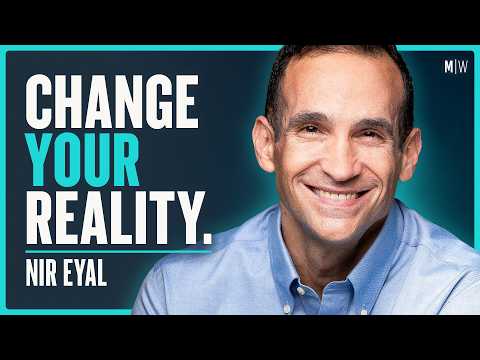
A Masterclass in Changing Your Limiting Beliefs - Nir Eyal
Chris Williamson (host), Nir Eyal (guest)
In this episode of Modern Wisdom, featuring Chris Williamson and Nir Eyal, A Masterclass in Changing Your Limiting Beliefs - Nir Eyal explores nir Eyal explains beliefs as tools shaping perception, agency, health Beliefs act as a predictive lens that filters reality, influencing perception, emotion, and behavior far more than most productivity frameworks acknowledge.
Nir Eyal explains beliefs as tools shaping perception, agency, health
Beliefs act as a predictive lens that filters reality, influencing perception, emotion, and behavior far more than most productivity frameworks acknowledge.
Eyal distinguishes facts, faith, and beliefs, arguing beliefs are revisable “tools” that can be tested and replaced when they stop serving us.
Placebo and nocebo effects demonstrate that expectations can measurably change pain, symptoms, and performance—even when people know a treatment is a placebo.
Agency is strengthened by cultivating an internal locus of control and by practicing persistence intelligently via checkpoints, learning signals, and “does persistence matter here?” tests.
Rituals like prayer can offer secular benefits (gratitude, reflection, community, resilience) when used as structured practices rather than supernatural claims.
Key Takeaways
Treat beliefs as instruments, not immutable truths.
Eyal’s core heuristic is “beliefs are tools, not truths”—use the belief that improves actions and outcomes, and replace it when it stops helping (like a carpenter switching tools).
Get the full analysis with uListen AI
Most “reality” you experience is prediction, not direct observation.
Because conscious processing is tiny relative to incoming data, the brain relies on priors; this explains why different people can interpret the same stimulus differently and why changing priors (beliefs) changes lived experience.
Get the full analysis with uListen AI
Motivation fails when belief is missing from the system.
Eyal frames motivation as a triangle: behavior, benefit, and belief; if you don’t believe the outcome will happen (or you don’t believe you can do the behavior), persistence collapses even with clear incentives.
Get the full analysis with uListen AI
Use “turnarounds” to loosen a stuck narrative and reclaim options.
His practical method: write the belief, ask whether it’s true/absolutely true, examine who you are with it, who you’d be without it, then test opposites (and self-directed versions) as experiments—illustrated with his conflict about his mother being “too judgmental.”
Get the full analysis with uListen AI
Rumination feels like problem-solving but often functions as avoidance.
Because rumination fixates on the past and repeats the same loop, it can become a soothing “pacifier” that displaces action; scheduling explicit “worry time” reduces the urge and often reveals the worry wasn’t important.
Get the full analysis with uListen AI
Quit based on criteria, not discomfort or failure alone.
Failure is often part of successful iteration; Eyal recommends (1) set a checkpoint before evaluating, (2) continue while you’re still learning, and (3) persist only when persistence can realistically change outcomes (e. ...
Get the full analysis with uListen AI
Placebos and nocebos prove expectations can drive real physiology.
Examples include open-label placebos helping IBS and nocebo cases like psychosomatic outbreaks and a trial participant (Mr. ...
Get the full analysis with uListen AI
For chronic symptoms, reduce fear to reduce suffering.
Drawing on pain reprocessing therapy, Eyal emphasizes breaking the fear–pain–fear loop by reframing pain as information (after ruling out physical causes), stopping the urgent “fix it now” stance, and repeatedly proving safety to the brain.
Get the full analysis with uListen AI
Agency is protective—even when circumstances aren’t ideal.
Internal locus of control correlates with better health and wellbeing; Eyal suggests applying it to yourself (what can I do? ...
Get the full analysis with uListen AI
Prayer can be used as a secular ritual for gratitude, reflection, and community.
He adopts prayer without requiring full doctrinal certainty, focusing on virtues (patience, gratitude) and structured contemplation; he also argues community is a major hidden mechanism behind religion’s mental-health benefits.
Get the full analysis with uListen AI
Notable Quotes
““Beliefs are tools, not truths.””
— Nir Eyal
““You’re already delusional… we all live in our own simulation inside our own heads.””
— Nir Eyal
““Venting does not work… it just makes [beliefs] more vivid.””
— Nir Eyal
““Unsuccessful people are not those that fail more… unsuccessful people are those who fail less.””
— Nir Eyal
““The number one cause of insomnia is worrying about insomnia.””
— Nir Eyal
Questions Answered in This Episode
How would you operationally tell the difference between a useful belief-as-tool and self-deception that will backfire later?
Beliefs act as a predictive lens that filters reality, influencing perception, emotion, and behavior far more than most productivity frameworks acknowledge.
Get the full analysis with uListen AI
In your motivation triangle, what’s the fastest way to diagnose whether someone lacks belief in the outcome versus belief in themselves?
Eyal distinguishes facts, faith, and beliefs, arguing beliefs are revisable “tools” that can be tested and replaced when they stop serving us.
Get the full analysis with uListen AI
Your “turnaround” exercise resembles CBT-style reframing—what’s distinct about your four questions and the three turnarounds, and when does it fail?
Placebo and nocebo effects demonstrate that expectations can measurably change pain, symptoms, and performance—even when people know a treatment is a placebo.
Get the full analysis with uListen AI
Open-label placebos worked for IBS in Kaptchuk’s studies—what boundary conditions matter most (symptom type, relationship with practitioner, ritual strength)?
Agency is strengthened by cultivating an internal locus of control and by practicing persistence intelligently via checkpoints, learning signals, and “does persistence matter here? ...
Get the full analysis with uListen AI
The Serena Williams story relies on a coach’s lie; is it ethically acceptable to ‘engineer belief’ with falsehoods if outcomes improve? Where’s the line?
Rituals like prayer can offer secular benefits (gratitude, reflection, community, resilience) when used as structured practices rather than supernatural claims.
Get the full analysis with uListen AI
Transcript Preview
Nir Eyal, welcome to the show.
Thanks, Chris. Great to be back.
Dude, 2019, episode 104 all the way to now.
I'm gonna take credit for all your success since then.
[laughs] It was, it was built-
Is that okay? Was I the lucky charm?
It w- it was built on a foundation of you and Indistractable, that's exactly correct.
[laughs]
Uh, new one, all about belief. Why is belief so important?
Okay, so beliefs, uh, turns out to be the lens with which we see the world, and I had no idea how profound this research that's been coming out over the past several years has on our day-to-day lives, how beliefs shape what we see, literally shape what we see. I can show the same exact image to two different people, and they will see completely different things. It's called the Koffka illusion. You can look at this piece of paper, and I can show you it to one person based on where they grew up and, and their priors, their beliefs, and they'll see circles. I can show it to somebody else based on where they grew up, they'll see rectangles. It's incredible. Uh, beliefs not only shape what you see, like not, not just figuratively, but they actually shape reality that you see. They shape what you feel, your internal state, and most importantly, they affect what you do. And so everything comes upstream from these beliefs, and so you better get these beliefs right if they're going to run your life.
What-- I think one of the challenges people have when they hear the word belief is it gets perilously close to Rhonda Byrne, "The Secret" manifestation. You know, you've come from a productivity background, same as me, uh, kind of hardcore, quite sterile almost in a way, very sort of-
Mm.
Uh, frameworks, rigid structures. Um, belief sounds very w- almost whimsical as-
Mm.
A topic to get into.
You know, that, that is a great point because, uh, there is a lot of bullshit out there. [laughs] And so part of what I wanted to do with this, uh, research that I've done over the past six years for "Beyond Belief" was to really separate what works and what doesn't. And a lot of it, frankly, I'll, I'll give that crowd some credit. A lot of it works, but not for the reasons they say it does.
[laughs]
[laughs] That, that like-
Yeah.
You know, I hate to burst anybody's bubble, but no, nothing is m- is, is vibrating and quantum whatevering, and like the universe really doesn't give a shit. [laughs] It is not, you know, the, the, the, all the, the manifesting stuff. It, it, it can work kind of, and, and I, I do dive into some research around how turns out positive thinking can have a very negative effect if you don't do it properly. Uh, so I kinda wanted to dispel some of those myths, and yet I've changed my mind a lot a- about a lot of stuff that I didn't used to do, and I used to kind of... You know, I'm, I'm very science-backed. You know, all my books have pages and pages of citations to peer-reviewed studies. I have to see the study, not just it worked for me. But I need to see the peer-reviewed studies that show that it worked for others in a controlled study. Uh, and so there's, there's, there's a lot of mythology out there, even in the academic community, to be honest. There's a lot of studies that I look through that I thought were kind of, you know, gold standard studies, and you kind of dig into how they were done mythologic- methodologically, and you realize, ugh, they're kinda crappy studies too. So it was a lot of sorting through the, the, the wheat from the chaff to figure out what we can actually practically apply to our lives. The good news is there's a lot of unbelievable research that has come out over the past several years that just absolutely blew my mind. For example, one thing is that we now know that placebos work even when you know they're a placebo, which we didn't used to know before, right? We used to think that placebos had to have some kind of deception effect, right? That you had to t- you, you, you, both people, the, the person prescribing the medication in a double-blind control study, had to not know who was receiving the placebo, and the person, of course, receiving it couldn't know if it was a placebo. Turns out that's not true, that you can get amazing effects. Ted Kaptchuk at Harvard showed this with IBS patients. He gave people a, a, a, a pill bottle that said "placebos" on it. By the way, you can go on Amazon today and buy placebo pills with five-star reviews that say, "Amazing how fast-acting this placebo was." It's incredible.
Install uListen to search the full transcript and get AI-powered insights
Get Full TranscriptGet more from every podcast
AI summaries, searchable transcripts, and fact-checking. Free forever.
Add to Chrome