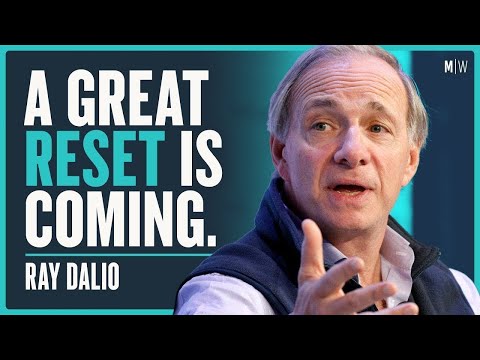
The Economic Collapse No One Wants To Talk About - Ray Dalio
Ray Dalio (guest), Chris Williamson (host)
In this episode of Modern Wisdom, featuring Ray Dalio and Chris Williamson, The Economic Collapse No One Wants To Talk About - Ray Dalio explores ray Dalio Warns Of Cyclical Crisis And How To Survive It Ray Dalio argues that today’s world is replaying a familiar historical script: high debt and money printing, deep internal polarization, and rising great‑power conflict, particularly between the U.S. and China. Drawing on 500 years of cycles, he explains why he expects a difficult, stagflationary few years marked by falling dominoes in credit and banking rather than a smooth economic 'soft landing.'
Ray Dalio Warns Of Cyclical Crisis And How To Survive It
Ray Dalio argues that today’s world is replaying a familiar historical script: high debt and money printing, deep internal polarization, and rising great‑power conflict, particularly between the U.S. and China. Drawing on 500 years of cycles, he explains why he expects a difficult, stagflationary few years marked by falling dominoes in credit and banking rather than a smooth economic 'soft landing.'
He outlines how excess debt, reduced foreign appetite for dollar‑denominated assets, and geopolitical supply‑chain shifts are undermining currencies and raising inflation, while populism and institutional breakdown increase political risk. Dalio also highlights demographic burdens, technological disruption, and widening wealth gaps as self‑reinforcing forces behind social instability.
For individuals, he stresses building a well‑diversified, inflation‑aware 'safety' portfolio across different economic environments, limiting speculative bets like crypto, and focusing on adaptability, learning, and understanding where we are in long‑term cycles. Ultimately, he suggests redefining success away from money and status toward community, simplicity, and psychological resilience amid volatility.
Key Takeaways
Study long‑term cycles to understand today’s risks.
Dalio contends that our era mirrors 1930–45: extreme debt and money printing, deep internal conflicts, and rising great‑power tensions. ...
Get the full analysis with uListen AI
Expect a difficult, stagflationary environment rather than a clean soft landing.
After massive monetary tightening on top of record debt, he expects 'dominoes' to fall across banks, commercial real estate, and leveraged borrowers, forcing either higher rates or more money printing, both of which point toward low growth with persistent inflation.
Get the full analysis with uListen AI
Build a diversified, inflation‑aware safety portfolio first.
Individuals should prioritize a core portfolio designed to preserve purchasing power across four environments—rising/falling growth and rising/falling inflation—using a balance of bonds, stocks, inflation‑hedging assets (e. ...
Get the full analysis with uListen AI
Treat cash and fixed income in real (inflation‑adjusted) terms.
Holding low‑yielding cash or bonds when inflation is higher locks in a loss of purchasing power. ...
Get the full analysis with uListen AI
Be cautious with crypto; gold is a more established hedge.
Dalio sees Bitcoin as small, highly sentiment‑driven, easily surveilled, and politically vulnerable, whereas gold is a long‑standing, widely held reserve asset favored by central banks. ...
Get the full analysis with uListen AI
Wealth gaps and broken education systems drive instability.
He links rising inequality to structurally underfunded schools, family breakdown, drugs, and disengaged populations (e. ...
Get the full analysis with uListen AI
Redefine success around community and resilience, not money and status.
Beyond basic needs, more money doesn’t reliably increase happiness. ...
Get the full analysis with uListen AI
Notable Quotes
“It's like watching the movie over and over again.”
— Ray Dalio
“Them losing doesn't make us winning. Everybody loses in wars.”
— Ray Dalio
“You're in the part of the cycle where you've had the tightening and the dominoes are beginning to fall.”
— Ray Dalio
“Pain plus reflection equals progress.”
— Ray Dalio
“This idea of success being measured in the amount of money and status you have is really screwed up.”
— Ray Dalio
Questions Answered in This Episode
If the U.S. and other major economies are trapped in high‑debt, high‑inflation cycles, what realistic policy steps could actually change that trajectory?
Ray Dalio argues that today’s world is replaying a familiar historical script: high debt and money printing, deep internal polarization, and rising great‑power conflict, particularly between the U. ...
Get the full analysis with uListen AI
How can ordinary investors implement Dalio’s four‑quadrant, all‑weather approach in simple, practical terms with mainstream products?
He outlines how excess debt, reduced foreign appetite for dollar‑denominated assets, and geopolitical supply‑chain shifts are undermining currencies and raising inflation, while populism and institutional breakdown increase political risk. ...
Get the full analysis with uListen AI
Given the rise of AI and robotics, what social or policy frameworks could prevent an extreme concentration of wealth and mass disengagement from work?
For individuals, he stresses building a well‑diversified, inflation‑aware 'safety' portfolio across different economic environments, limiting speculative bets like crypto, and focusing on adaptability, learning, and understanding where we are in long‑term cycles. ...
Get the full analysis with uListen AI
Are there historical examples where societies successfully reversed growing populism and polarization before sliding into authoritarianism or conflict?
Get the full analysis with uListen AI
How should a young person balance preparing for macroeconomic turbulence with building a fulfilling life that’s not dominated by financial anxiety?
Get the full analysis with uListen AI
Transcript Preview
We're on the brink of war with China for various reasons. I hope we make it to 2050. The demographics is as I describe it, and by the way, them losing doesn't make us winning. So I think you're in the part of the cycle where you've had the tightening and the dominoes are beginning to fall, and I think that that's going to produce more problems. The most important thing is to have this basic well-diversified portfolio is important.
Two years ago, you made some predictions about the future for America and the global economy. How accurate do you think you've been?
Uncomfortably accurate given the whole picture, you know. Um, it's like watching the movie (laughs) for over and over again. Um, maybe I should explain. Uh, for about 55 years I've been a global macro investor and I learned that many of the things that surprised me never happened in my lifetime before, so when I would see certain things happen that were like that, I would go back in history and study, uh, prior periods. Uh, studying, for example, the Great Depression allowed us to anticipate the financial crisis in 2008. Anyway, there are three big things that I observed happening, uh, that didn't happen in our lifetimes but happened during the 1930 to '45 period, and they are the creation of enormous amounts of debt and the printing of money to pay for those debts, and it having its economic effects on inflation and growth. The second is internal conflicts, um, over the largest wealth gaps we had since then, uh, values gaps, um, and the rise of populism of the right and the left, um, those conflicts, again, largest since that 1930 to '45 period. And then the rise of a great power, uh, producing a great powers conflict internationally, um, with the rise of China as a great power, uh, challenging the United States and, uh, with Russia, so the great power conflict. That also is the, uh, most that that's happened since the, the Great Depression. So because those three things are happening now and, um, I didn't study them, um, I went back and I needed to study the cycles, these, what's happened over longer periods of time. So I studied, hmm, the last 500 years because these big cycles, uh, take about 75 years, uh, give or take about 50, so. Um, and, um, you know, like the rise and decline of the British Empire, the rise and decline of the debt... and that dynamic I shared, um, in the book and I also shared it in an animated video, uh, which is called The Changing World Order, um, and that creates a, uh, path. Now it's not just because they repeat in this way, but one can see the cause-effect relationships that are happening and, um, so that has pretty much transpired according to script. We can get into those pieces, but I'd say those are the three main ones. There were two others that, um, had big effect that I paid more attention to, um, that I'll mention. One was, um, acts of nature in the form of droughts, floods and pandemics. Uh, they were very disruptive when they happened, killed more people and, uh, toppled more empires and, or orders than others. And then also, of course, over a period of time, there's learning and producing new technologies that raises living standards, you know, it's raised per capita income, life expectancy and so o- and so... But those five fla- factors transpire, um, in ways that we've seen before to create this big cycle and it's, uh, if we can look at the cause-effect relationships, um, that's what I wanna pass along 'cause I'm 74 years old and I'm in a phase in my life that I want to pass along the things that are of value, and I think this is an important thing. But yes, it's transpiring according to script.
Install uListen to search the full transcript and get AI-powered insights
Get Full TranscriptGet more from every podcast
AI summaries, searchable transcripts, and fact-checking. Free forever.
Add to Chrome