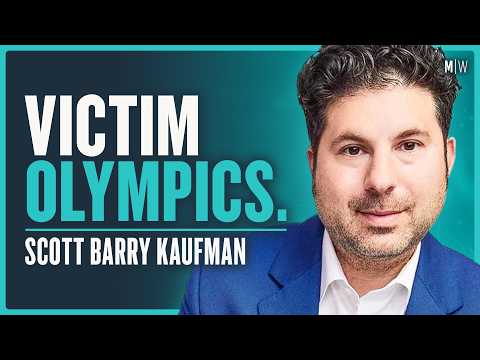
How To Not Let Your Past Define You - Scott Barry Kaufman
Chris Williamson (host), Scott Barry Kaufman (guest)
In this episode of Modern Wisdom, featuring Chris Williamson and Scott Barry Kaufman, How To Not Let Your Past Define You - Scott Barry Kaufman explores stop Worshipping Your Wounds: Scott Barry Kaufman On Rising Above Scott Barry Kaufman and Chris Williamson explore how to stop letting the past and a victim mindset define your identity and future. They critique over-pathologizing, trauma-only lenses in psychotherapy, and the social incentives that reward performative victimhood, especially online. Kaufman contrasts therapy with coaching, emphasizes learned hope and agency, and explains how traits like high sensitivity, neuroticism, and attachment styles interact with genes and environment. Throughout, he argues for an “empowerment mindset” that validates real suffering while insisting on your capacity to grow, act on your values, and build a hopeful future.
Stop Worshipping Your Wounds: Scott Barry Kaufman On Rising Above
Scott Barry Kaufman and Chris Williamson explore how to stop letting the past and a victim mindset define your identity and future. They critique over-pathologizing, trauma-only lenses in psychotherapy, and the social incentives that reward performative victimhood, especially online. Kaufman contrasts therapy with coaching, emphasizes learned hope and agency, and explains how traits like high sensitivity, neuroticism, and attachment styles interact with genes and environment. Throughout, he argues for an “empowerment mindset” that validates real suffering while insisting on your capacity to grow, act on your values, and build a hopeful future.
Key Takeaways
Stop trying to fix your past; redirect that energy into your future.
Endlessly ruminating on what should have happened keeps you stuck in fantasy control over something immutable; once you accept the past is unchangeable, you can invest attention in actions that actually move your life forward.
Get the full analysis with uListen AI
Recognize and interrupt a victim mindset before it becomes your identity.
A victim mindset blames all problems on external forces, justifies bad behavior via past pain, and fixates on revenge instead of solutions; noticing when you personalize neutral events or assume malevolent intent (e. ...
Get the full analysis with uListen AI
Use therapy to understand your story, but don’t let it reduce you to your wounds.
Talking about trauma can be illuminating, but if you’re seen only as a victim—by yourself or by practitioners—your potential and future-focused growth (coaching, goal-setting, values) take a back seat to endless excavation of pain.
Get the full analysis with uListen AI
Genes and sensitivity shape you, but they don’t doom you.
Traits like neuroticism, attachment style, and high sensitivity are partly heritable and can be intensified by environment and epigenetics, yet they are also levers you can work with; understanding your disposition lets you design environments, relationships, and habits that harness it rather than be ruled by it.
Get the full analysis with uListen AI
High sensitivity can be a creative superpower—if you stop using it as a shield.
Highly sensitive people process more information and feel social and aesthetic nuances deeply, which boosts creativity, empathy, and appreciation of beauty, but treating HSP status as a reason to demand constant special treatment turns it into a victim identity instead of a strength.
Get the full analysis with uListen AI
Practice psychological flexibility: act from your values, not from momentary feelings.
Approaches like Acceptance and Commitment Therapy (ACT) teach you to notice emotions (anxiety, fear, cravings) without obeying them, and to take value-aligned actions (e. ...
Get the full analysis with uListen AI
Adopt a “Yes, and…” empowerment mindset toward your suffering.
The optimal stance is not denial or total identification with pain, but: “Yes, this hard thing happened to me, and I still have deep reservoirs of resilience and the ability to pursue meaning and purpose,” holding validation and belief in your potential at the same time.
Get the full analysis with uListen AI
Notable Quotes
““Sooner or later, you have to give up all hope for a better past.””
— Irvin Yalom (quoted by Scott Barry Kaufman)
“If we only view you through the lens of your victimhood, your potential takes a back seat to your pain.”
— Scott Barry Kaufman
“When you blame all your problems on someone else, you are stripping yourself of your agency.”
— Scott Barry Kaufman
“Learned helplessness is the default state in humans. What we have to learn is hope.”
— Scott Barry Kaufman
“Suffering is not a competition.”
— Scott Barry Kaufman
Questions Answered in This Episode
In what areas of my life do I subtly outsource responsibility by telling a victim story, and what would an empowerment story look like instead?
Scott Barry Kaufman and Chris Williamson explore how to stop letting the past and a victim mindset define your identity and future. ...
Get the full analysis with uListen AI
How might my genetic dispositions (e.g., sensitivity, neuroticism) be shaping my narrative about “trauma,” and where am I possibly over-pathologizing my experience?
Get the full analysis with uListen AI
If I’m highly sensitive, what specific contexts or habits could help me turn that trait into creative output and deeper relationships instead of overwhelm?
Get the full analysis with uListen AI
When do I treat my emotions as unquestionable facts rather than passing signals, and how could I practice ACT-style psychological flexibility in those moments?
Get the full analysis with uListen AI
How can I honor real past hurts—my own or others’—while still actively communicating belief in our capacity to grow, change, and rise above them?
Get the full analysis with uListen AI
Transcript Preview
"Sooner or later, you have to give up all hope for a better past." What's up with that?
Yes. Isn't that a great quote? It's- it's probably my favorite quote, out of all quotes (laughs) in the history of the world. Um, the, uh, psychotherapist Irving Yalom talked a lot about that, um, and the importance of taking that existential perspective with his, with his patients, and I think for all of us, it's really important to recognize that, um, we shouldn't be prisoners of our past, um, as much as we keep ruminating over and over again that we wish something was different, that's not gonna change the thing. No matter how many times we ruminate about it, it's not gonna change it. So, what I really wanna do is help people practically, um, and hopefully move forward with their lives.
I think it's a great point that you ... I- if you're kind of railing against something that happened in your past, hoping that you can enact some kind of control over it, or- or- or alter what it was that occurred, you are fighting a losing battle. So, it's just not gonna happen.
Yeah. That's- that's exactly right, and, um, I think for a lot of us, we get stuck on a certain frequency, um, and- and- and- and, uh, I think sometimes therapy is not helpful with that, you know? And that- that shouldn't be a controversial thing to say at all, you know? Um, if- if I had to choose, I would choose Irving Yalom (laughs) as my psychotherapist.
Who?
'Cause, uh, Irving Yalom is the psychotherapist who has that quote, "Sooner or later, you have to give up all hope for a better past." Yeah. Yeah.
Talk to me about the intersection of psychotherapy and identifying with our pasts.
Well, there are a lot of different orientations out there for psychotherapy. Um, there's an orientation called trauma-informed therapy that I criticize a little bit, um, because a lot of therapy is going and talking about your past, and I think that it's possible that if you're viewed only through the lens of your trauma, you s- you can- you can forget that you have other things that you can provide to the world. You forget that you c- you're allowed to- you're allowed to have a future, you know? You're allowed to have a great future. So, I mean, there's ... Not all, and not all trauma-informed therapy is bad. Of course, there's nuance here. But I think, you know, a big part of what I wanted to, the message I wanna give this book is that if we only view you through the lens of your victimhood, um, your pain, you know, your potential takes a back- a back seat to your pain.
I have to say, I- I did twice weekly psychotherapy for about a year, and-
What was it like?
Fascinating. It- it- it told me more about myself than 1,500 to 2,000 sessions of meditation.
Install uListen to search the full transcript and get AI-powered insights
Get Full TranscriptGet more from every podcast
AI summaries, searchable transcripts, and fact-checking. Free forever.
Add to Chrome