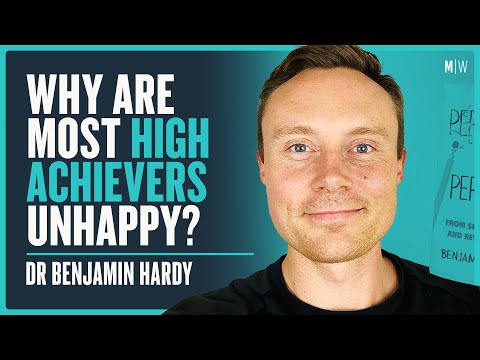
A High Achievers' Guide To Happiness - Dr Benjamin Hardy | Modern Wisdom Podcast 397
Dr Benjamin Hardy (guest), Chris Williamson (host)
In this episode of Modern Wisdom, featuring Dr Benjamin Hardy and Chris Williamson, A High Achievers' Guide To Happiness - Dr Benjamin Hardy | Modern Wisdom Podcast 397 explores escape The Hedonic Treadmill: Redefining Success For Lasting Happiness Chris Williamson and Dr. Benjamin Hardy explore why so many high achievers are unhappy despite impressive accomplishments, centering on Hardy and Dan Sullivan’s framework of “The Gap and The Gain.”
Escape The Hedonic Treadmill: Redefining Success For Lasting Happiness
Chris Williamson and Dr. Benjamin Hardy explore why so many high achievers are unhappy despite impressive accomplishments, centering on Hardy and Dan Sullivan’s framework of “The Gap and The Gain.”
Living in the Gap means constantly measuring yourself against moving ideals, external status markers, and other people, which devalues your real progress and keeps happiness perpetually out of reach.
Living in the Gain means measuring only against your former self, extracting lessons from past experiences (even traumas), and pursuing goals from genuine desire rather than psychological need.
They connect this mindset to intrinsic motivation, long-term future planning, reframing past experiences, and building confidence, arguing that happiness is both the measure and fuel of meaningful achievement—not the reward at the end.
Key Takeaways
Measure yourself against your former self, not impossible ideals.
“The Gap” is comparing your current self to a moving horizon (ideals, other people, status), which guarantees feeling behind; “The Gain” is comparing your current self only to where you were before, which builds gratitude, confidence, and motivation.
Get the full analysis with uListen
Pursue goals because you’re already happy, not to become happy.
Treat happiness as an internal state and measuring tool, not a prize after achievement; when you stop needing outcomes to feel worthy, you can set ambitious goals from genuine desire instead of desperation.
Get the full analysis with uListen
Shift from obsessive passion to harmonious passion.
Obsessive passion means you need the goal to feel okay and it owns you; harmonious passion is full commitment without emotional dependence—if it disappeared, you’d still be fundamentally fine, which is far healthier and more sustainable.
Get the full analysis with uListen
Create your own value system and success criteria.
Rather than inheriting society’s metrics (money, titles, followers), define what success means to you, translate that into principles and measurable projects, and judge your progress against those self-chosen standards.
Get the full analysis with uListen
Use a long-term future self to upgrade your daily decisions.
Most people are driven only by immediate fires and short-term needs; clearly imagining a 10–20 year future self leads to different choices today and prevents the “a lot of activity, no real progress” trap.
Get the full analysis with uListen
Deliberately reframe painful past experiences into gains.
Your past is partly a story you construct; by approaching difficult events (via journaling, therapy, or deliberate rumination) and extracting lessons, strengths, and clarity from them, you convert trauma into fuel for growth instead of a permanent wound.
Get the full analysis with uListen
Build simple daily habits to train your brain toward gains.
Hardy recommends ending each day by writing three wins from today (even if the day ‘failed’ your original plan) and three priorities for tomorrow, which systematically conditions you to see progress and maintain momentum without living in the Gap.
Get the full analysis with uListen
Notable Quotes
“Your current position doesn’t change whether you’re in the Gap or the Gain, but how you feel about your current position fundamentally changes.”
— Dr. Benjamin Hardy
“You don’t actually set goals to be happy. You should set goals because you’re already happy.”
— Dr. Benjamin Hardy
“If you feel like you’re attached to something, then it owns you. You don’t own it.”
— Dr. Benjamin Hardy
“What’s the point of achieving all of this success that you’re chasing after if you’re miserable along the way?”
— Chris Williamson
“The only person whose opinion of my progress that matters is me.”
— Dr. Benjamin Hardy
Questions Answered in This Episode
In which areas of my life am I most stuck in the Gap, and how would my emotional state change if I measured only against my former self?
Chris Williamson and Dr. ...
Get the full analysis with uListen AI
What goals am I pursuing from a place of ‘need’ or insecurity rather than genuine desire—and what would it look like to pursue them harmoniously?
Living in the Gap means constantly measuring yourself against moving ideals, external status markers, and other people, which devalues your real progress and keeps happiness perpetually out of reach.
Get the full analysis with uListen AI
If I defined success entirely on my own terms, without social comparison, what concrete criteria and values would I use?
Living in the Gain means measuring only against your former self, extracting lessons from past experiences (even traumas), and pursuing goals from genuine desire rather than psychological need.
Get the full analysis with uListen AI
How might my daily decisions change if I took my 10–20 year future self seriously and treated each action as an investment in that person?
They connect this mindset to intrinsic motivation, long-term future planning, reframing past experiences, and building confidence, arguing that happiness is both the measure and fuel of meaningful achievement—not the reward at the end.
Get the full analysis with uListen AI
Which painful past experience could I deliberately reframe into a Gain this month, and what specific lessons or strengths could I extract from it?
Get the full analysis with uListen AI
Transcript Preview
There's a difference between what's called harmonious passion and obsessive passion. Obsessive passion means that you feel like you need this thing, and if you can't have it, you're never gonna be happy. Whereas harmonious passion means you just do what you want. It's way more intrinsic. It's way healthier. If you feel like you're attached to something, then it owns you. You don't o- own it. And that's really what obsessive passion is, is where this thing owns you, and it's actually driving the ship. And that's not what goals are for.
Benjamin Hardy, welcome to the show.
Yes, Chris, always.
(laughs)
Happy to be with you.
Welcome back, man. It's been a while.
Yeah, it's been a... I think it wa- it must, it must have been during the pandemic because, you know... Yeah, it was during the pandemic, so it ha- it, we're, we're not pre- you know, it hasn't been that long.
Yeah, I know. Yeah, we still haven't ventured out, outside of a pandemic since we've been mates. But, uh ...
(laughs) .
First, one of the things that you talk about a lot is to do with, um, high achievers and performing goals and managing to achieve stuff. Why do you think it is that most high achievers are quite unhappy?
(inhales deeply) It's the, uh, hedonic treadmill that we talked about. So basically, and this is kind of a Dan Sullivan concept of the gap and the gain, but (clicks tongue) the gap is where you're measuring yourself against your ideals, and your ideals are like the horizon in the desert. So you're... It doesn't matter how many steps you're taking towards the horizon, the horizon keeps moving with you, and so it doesn't matter how successful you are compared to your former self. If you're always measuring yourself against the horizon in front of you, you're always gonna feel like trash. Um, and so that's what we would call the gap, is you're always measuring yourself against where you wish you were, and you then devalue where you currently are when where you currently are is fundamentally enormously further along than your former self. You may be living beyond the dreams of your former self, but if you're always measuring yourself against that moving horizon, then, then you're always feeling like you're behind the eight-ball. And that's, that's what high achievers do. It doesn't matter what they've accomplished, they're always measuring themselves against where they wish they were, and then therefore devaluing where they currently are.
Yeah, you say that happiness can be a burden. What do you mean by that?
Well, happiness is a burden if you, uh, if you think you have to go get it. So if you think, "I have to go and accomplish this thing in order to become happy. I need to be a millionaire. I need to have that book published. I need that New York..." If you feel like you need to go out and get happiness, then you make it a burden for yourself. You know, it's, it's not some, it... Happiness is not something you pursue. Happiness is not something you chase. It's not something that's outside of yourself. That's actually one of the fundamental realities is, is it's not outside of you. If you're actually chasing happiness outside of you, it's because you're, you've got some emptiness inside of you that you're trying to fill with external accomplishment, and you're never gonna actually be able to, to find it. (laughs) Like, it's a, it's a real, it's an endless chase to nowhere because the, the hole is inside of you, it's not outside of you.
Install uListen to search the full transcript and get AI-powered insights
Get Full TranscriptGet more from every podcast
AI summaries, searchable transcripts, and fact-checking. Free forever.
Add to Chrome