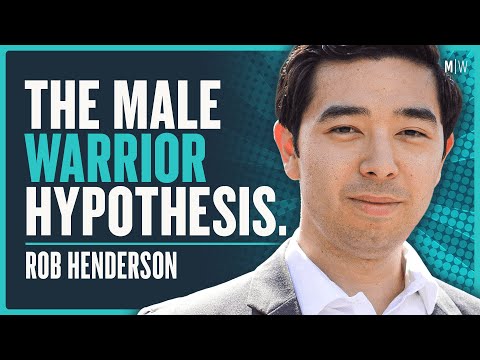
How Men Compete For Status - Rob Henderson
Rob Henderson (guest), Chris Williamson (host), Narrator
In this episode of Modern Wisdom, featuring Rob Henderson and Chris Williamson, How Men Compete For Status - Rob Henderson explores how Male Status, Strength, And Threat Shape Sex, Morals, Violence Rob Henderson and Chris Williamson explore how male status and physical formidability, rather than pure attractiveness, drive sexual success, social hierarchy, and even moral judgment. Drawing on evolutionary psychology, Henderson explains his PhD thesis that physical and social threats make people’s moral judgments stricter, and how age, sex, and vulnerability shape disgust and morality. They examine the Male Warrior Hypothesis, sex differences in direct vs. indirect aggression, and how cooperation and extreme violence are two sides of the same human coin. The conversation also covers dad bods, preselection in mating, secondary sex characteristics as signals to other men, and ritualized male conflict like the “male monkey dance” that governs when and how men fight.
How Male Status, Strength, And Threat Shape Sex, Morals, Violence
Rob Henderson and Chris Williamson explore how male status and physical formidability, rather than pure attractiveness, drive sexual success, social hierarchy, and even moral judgment. Drawing on evolutionary psychology, Henderson explains his PhD thesis that physical and social threats make people’s moral judgments stricter, and how age, sex, and vulnerability shape disgust and morality. They examine the Male Warrior Hypothesis, sex differences in direct vs. indirect aggression, and how cooperation and extreme violence are two sides of the same human coin. The conversation also covers dad bods, preselection in mating, secondary sex characteristics as signals to other men, and ritualized male conflict like the “male monkey dance” that governs when and how men fight.
Key Takeaways
Perceived male toughness by men predicts sexual success better than female-rated attractiveness.
In a key study, women’s ratings of men’s sexual attractiveness had zero correlation with the men’s later number of partners, while other men’s ratings of how likely each man was to win a fight strongly predicted sexual partner count over 18 months.
Get the full analysis with uListen AI
Threat and vulnerability intensify moral judgment across domains, not just disease.
People more worried about COVID—and older people generally—judge a wide range of moral violations more harshly, from contamination to betrayal and theft, suggesting that feeling vulnerable heightens moral strictness beyond health-related issues.
Get the full analysis with uListen AI
Men evolved to be both more overtly aggressive and more cooperatively warlike.
The Male Warrior Hypothesis proposes that men show more direct, within-group hostility but also more readily suppress it when facing an external male out-group, enabling warfare, resource raiding, and coordinated defense.
Get the full analysis with uListen AI
Women often weaponize indirect aggression while maintaining hostility even against out-groups.
Women tend to use rumor, ostracism, and social exclusion more than overt violence, and female athletes report maintaining these intra-team behaviors even when competing against other teams, unlike men who shift hostility outward.
Get the full analysis with uListen AI
Male secondary sex traits signal formidability to men more than beauty to women.
Features like muscularity, deep voices, beards, and robust builds function more like antlers than peacocks’ tails—deterring rivals and winning male-male contests—which in turn yields status and mating opportunities that women then respond to.
Get the full analysis with uListen AI
Comfort and mate-retention concerns help explain some women’s preference for ‘dad bods.’
A less “threateningly” attractive physique can signal lower odds of partner defection and more resource investment in the relationship and children, which increases comfort and can paradoxically enhance attraction for some women.
Get the full analysis with uListen AI
Male violence is constrained by implicit norms of a ‘fair fight’ and the ‘male monkey dance.’
Men often escalate conflicts through predictable ritual steps—staring, verbal challenge, chest-bumping, then striking—and avoid unfair tactics because both observers and combatants want a clean signal of true fighting ability that confers status and prestige.
Get the full analysis with uListen AI
Notable Quotes
“How tough a guy looks to men is a stronger predictor of his sexual success than how attractive he looks to women.”
— Rob Henderson
“: "As people grow older, their moral judgments become stricter, and it’s not just about politics—it’s something about vulnerability and risk perception changing with age."”
— Rob Henderson
“Men are simultaneously more hostile and more cooperative; when an out-group appears, they can suddenly let those tensions go and come together.”
— Rob Henderson
“You can’t get the kind of high levels of cooperation humans show without high levels of competition as well.”
— Rob Henderson
“In order to pull off a genocide, you actually have to be an extremely cooperative species—that’s the irony.”
— Rob Henderson (paraphrasing Richard Wrangham’s perspective)
Questions Answered in This Episode
If men’s perceived formidability to other men predicts sexual success, what does that imply for how young men should or shouldn’t prioritize physical training and status-seeking?
Rob Henderson and Chris Williamson explore how male status and physical formidability, rather than pure attractiveness, drive sexual success, social hierarchy, and even moral judgment. ...
Get the full analysis with uListen AI
How should societies think about moral responsibility when we know that feelings of threat and vulnerability systematically harden people’s moral judgments?
Get the full analysis with uListen AI
To what extent are modern online status games—like gaming or social media clout—just new arenas for the same evolved male warrior and prestige dynamics?
Get the full analysis with uListen AI
Could encouraging more female-style indirect aggression or male-style direct cooperation in the other sex backfire, given these apparent evolutionary specializations?
Get the full analysis with uListen AI
How might an awareness of the ‘male monkey dance’ and fair-fight norms change how men manage conflict in bars, schools, or workplaces to reduce violence without losing status?
Get the full analysis with uListen AI
Transcript Preview
There was one study, they showed a series of women videos of men, and then at the end, they asked these women, "How sexually attractive is this man?" Then they showed a group of men the same videos of these same guys and asked them, "How likely is it that this man would win a physical fight with another man?" Then the researchers tracked those men in those videos and had them return 18 months later and asked them a bunch of questions, including, "How many sexual partners have you had over the last 18 months?" The correlation between how sexually attractive the women found these men and how many partners they had was zero, but there was a strong and significant correlation between how intimidating or formidable men rated them and how many sexual partners they recounted over the last 18 months. And so essentially, how tough a guy looks to men is a stronger predictor of his sexual success than how attractive he looks to women. (air whooshing)
You just defended your PhD thesis. What's that mean?
That's right. So a PhD thesis, it's called a dissertation in the US. They call it a thesis here in the UK. It's just a, it's a culmination of the work you do throughout your years of study in a doctoral program. So at least within the field of psychology, typically, you write, uh, you know, a handful of papers, maybe three or four papers, and it's all supposed to build towards some overarching, uh, hypothesis, some kind of framework, and you run a series of empirical studies and, you know, hopefully you get the results you're looking for. And then that sort of, you know, it sort of builds towards, you know, here's, here's what all, all of this means. Here's how it contributes to the research, to the literature more broadly. And, uh, it's supposed to be this sort of original piece of scholarship. It doesn't necessarily have to be empirical either. Sometimes it can be theoretical. Uh, and I'm s- sure there's, like, a whole other set of, uh, criteria for the humanities, but yeah, it's a, it's a huge relief. I mean, when people say, uh, "Oh, when you finish your PhD thesis, you're gonna be so happy, you're gonna be so thrilled," and I was just, like, relieved, you know? Afterwards, I was just like, "Oh, thank God it's over." Like, "It's done." It's, you know, even though it went well, you know, I got the outcome I wanted, uh, it was still just, um, you know, it was still more just like this burden is lifted rather than just feeling, uh, elated or something, you know?
What's the thesis?
So the title of my PhD thesis is Physical and Social Threats Fortify Moral Judgments, and I got really interested in this, uh, when I was in undergrad. So I was taking, uh, classes by this experimental philosopher, Josh Knobe, who, uh, that's where basically I learned that you can use the tools of empirical psychology and social science to test people's moral intuitions. And morality generally has been kind of the wheelhouse of philosophy, you know, armchair philosophers, you know, pondering, what is morality? You know, what does it mean to be a moral person? What is moral character? And with, you know, some, some of the, uh, the instruments in psychology, you can come along and say like, "Well, what do people actually think about morality? What does the average person think about it?" And, you know, maybe some of your listeners will know about, you know, like, administering the, the trolley problem to people. Would people flip the switch? Would they not? That kind of thing. And I was taking classes with, with Paul Bloom too, uh, when I was in undergrad and learned about the sort of developmental origins of morality, and while I was there, I learned about this interesting link between disgust and morality. And many people think of disgust as this emotion that people experience, uh, in response to, uh, you know, contamination, illness, infection. But there's a lot of interesting work indicating that it overlaps with our moral, uh, judgments as well, that people who are very sensitive to disgust also tend to condemn wrongdoers more harshly. Uh, if you induce disgust in people, show them some disgusting images or, uh, get them to smell some repulsive, uh, odors, subsequently their moral judgments become intensified. And so I was, I thought to myself, you know, when I was reading all of this and when I came to Cambridge, I was wondering, is there, (clicks tongue) you know, are there other forms of threat beyond contamination? You know, contamination is a threat to your survival. It's a, it's an evolutionary threat. Are there other kinds of evolutionary threats, challenges to your survival and, and potentially your reproduction, um, (clicks tongue) that could also, uh, intensify your moral judgments? So I did some stuff on, you know, people who were worried about COVID in 2020 were also, uh, stricter in their moral judgments for a variety of different kinds of, uh, moral violations. Not just things like... You know, I, some of the items I used were, uh, (clicks tongue) you know, using a stranger's toothbrush. How wrong do you think that is? And of course, like, of course, people who are worried about COVID will also say, like, "Using a toothbrush that doesn't belong to you is, you know, that's, that's horrible." But it was also things like, uh, you know, betraying a family member or stealing from a store. You know, kind of deception, betrayal, subversion, things that are unrelated to contamination. People who were worried about COVID were, uh, stricter with those kinds of violations. Similar to social threat as well. Similar to age. The age one was the most interesting to me. Um, (clicks tongue) I'm, I'm working on, on this paper, trying to get it published. I think you and I might have talked about this offline before too. Uh, that essentially, uh, there's an, there's a, a direct association between as people grow older, their moral judgments become stricter, and this is controlling for, uh, political orientation, it's controlling for income, for education, you know, so these kind of demographic variables that you would assume. You know, oh, when older people, you know, as they, as they age, they become more politically conservative and that's why they ha- adopt these sort of moralistic attitudes. But even when you control for that, uh, there's something going on here about a- the aging process, and I suggest it has something to do with vulnerability, risk perception. As you grow older, um, the threats around you appear, uh, to be especially formidable, and I suggest this is also potentially why, um, (clicks tongue) there are these interesting moral judgment differences between men and women, such that women are more, uh, strict in their moral judgments relative to men. And some of that can be explained with, um, just the reproductive, uh, differences between men and women. Women have historically been, uh, more at ri- you know, more at risk, uh, for when they're pregnant, when they're carrying young children. They should just be extra alert to potential dangers. Uh, but I also suggest that if you control for certain things like muscularity, uh, height, BMI, all of these other kinds of things, I would bet that the moral judgment differences and disgust sensitivity would actually shrink. I just think that if you're a sort of a, a strong, young, robust, and healthy person, the world just looks less dangerous to you. And, and this includes moral wrongdoers. You think like, "Oh, that guy's doing something bad, but I can, I can take him." Uh, this is sort of the, the, the, the punchline of, of what my thesis is about.
Install uListen to search the full transcript and get AI-powered insights
Get Full TranscriptGet more from every podcast
AI summaries, searchable transcripts, and fact-checking. Free forever.
Add to Chrome