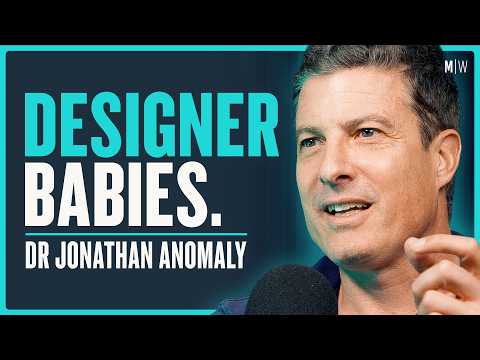
What Embryo Selection Means for Humanity - Dr Jonathan Anomaly
Chris Williamson (host), Jonathan Anomaly (guest)
In this episode of Modern Wisdom, featuring Chris Williamson and Jonathan Anomaly, What Embryo Selection Means for Humanity - Dr Jonathan Anomaly explores embryo Selection, Genetics, And The Future Of Human Reproduction Explained Chris Williamson and Dr. Jonathan Anomaly discuss embryo selection using polygenic risk scores, clarifying how it differs from gene editing and traditional IVF embryo grading. They explore public fears around 'eugenics', the ethics of selecting for disease vs. intelligence, and how World War II taboos still shape Western attitudes to genetics. Anomaly explains the science and validation of polygenic scores, his company HeraCyte’s approach to democratizing the technology, and concerns about inequality, government coercion, and professional gatekeeping by doctors and regulators. The conversation also tackles deeper issues of personhood, determinism, parental guilt, social norms, and how different cultures and countries are likely to adopt or resist these technologies.
Embryo Selection, Genetics, And The Future Of Human Reproduction Explained
Chris Williamson and Dr. Jonathan Anomaly discuss embryo selection using polygenic risk scores, clarifying how it differs from gene editing and traditional IVF embryo grading. They explore public fears around 'eugenics', the ethics of selecting for disease vs. intelligence, and how World War II taboos still shape Western attitudes to genetics. Anomaly explains the science and validation of polygenic scores, his company HeraCyte’s approach to democratizing the technology, and concerns about inequality, government coercion, and professional gatekeeping by doctors and regulators. The conversation also tackles deeper issues of personhood, determinism, parental guilt, social norms, and how different cultures and countries are likely to adopt or resist these technologies.
Key Takeaways
Embryo selection reveals existing genetic variation; it does not edit genes.
Anomaly stresses that HeraCyte’s process only scores and compares embryos already created during IVF, akin to replacing a doctor’s eyeballing of morphology with far richer genetic information, not adding or changing DNA.
Get the full analysis with uListen AI
Most people already accept genetic screening for disease, but balk at intelligence.
Survey data show ~70–75% of Americans support screening for disease versus ~40% for intelligence, reflecting deep moral taboos around mental traits and perceived judgments about person-worth, especially in Western post-war cultures.
Get the full analysis with uListen AI
All medicine is probabilistic, and polygenic scores are just another probability tool.
Doctors already make risk-based decisions on incomplete information; polygenic scores formalize and quantify genetic risk (e. ...
Get the full analysis with uListen AI
Good polygenic prediction must be transparently validated and ancestry-aware.
Anomaly argues any serious company should show how its scores are derived, how much variance they explain, and how accuracy changes across ancestries; otherwise patients risk making life-shaping decisions on “astrology-level” data.
Get the full analysis with uListen AI
Selecting against one disease often reduces several others due to shared genetics.
Their pleiotropy analysis suggests most genetic overlaps between traits are positive: e. ...
Get the full analysis with uListen AI
Government control is more dangerous than unequal early access.
Anomaly would rather tolerate some initial rich–poor genetic access gap than have states or insurers coercively fund, mandate, or centrally plan reproduction, which he sees as the real path back to coercive eugenics.
Get the full analysis with uListen AI
Personhood and ‘wrongful life’ show selection changes who exists, not just their traits.
Using Parfit’s non-identity problem and examples like fetal alcohol syndrome, they argue embryo selection replaces one potential person with another; you’re not ‘harming’ the unchosen embryo, but choosing which possible life comes into being.
Get the full analysis with uListen AI
Notable Quotes
“What we’re doing is revealing more information about the natural genetic variation that exists in your embryos and letting you choose which one to implant.”
— Dr. Jonathan Anomaly
“Most people don’t think that someone who is healthier is morally superior to someone who’s less healthy.”
— Dr. Jonathan Anomaly
“All of medicine is probabilistic, and indeed all of life is.”
— Dr. Jonathan Anomaly
“Either you think that God is creating this condition where your body is just constantly aborting embryos, and that’s okay, but what God is not doing is allowing you to do the same thing before it’s even implanted.”
— Dr. Jonathan Anomaly
“We’re replacing chance with choice to some extent, and that’s not necessarily a bad thing.”
— Dr. Jonathan Anomaly
Questions Answered in This Episode
If embryo selection became cheap and ubiquitous, should it be considered a moral obligation for parents with known severe hereditary risks?
Chris Williamson and Dr. ...
Get the full analysis with uListen AI
Where should society draw the line between acceptable selection (e.g., against Tay-Sachs) and controversial enhancement (e.g., for higher intelligence or specific personality traits)?
Get the full analysis with uListen AI
How should regulators force transparency from polygenic-score companies without drifting into coercive control over reproductive choices?
Get the full analysis with uListen AI
Does making genetic influences on behavior more visible push us toward greater compassion and reform of the criminal justice system, or could it backfire into new forms of stigma?
Get the full analysis with uListen AI
In a world where some countries aggressively subsidize embryo selection and others ban it, how might global power dynamics and migration patterns change over the next 50 years?
Get the full analysis with uListen AI
Transcript Preview
I've been advising you guys now for ages, and I think I became convinced that this could be a technology for good probably ever since our first conversation, which was a few years ago now.
A few years ago, yeah.
Why do a lot of people still have such an issue with embryo selection, do you think?
Um, let's see. There's probably a few issues. One is it's still a new technology. Any new technology that hasn't been fully explained to the public, even to doctors, is gonna have some, I think, justifiable skepticism. Um, another reason is people worry about tinkering with the human genome, which we're not doing, but people, um, often, I suppose, confuse embryo selection with gene editing, right? So what we're doing, um, the company Herecyte, is when women do IVF, they, they can already get a bunch of different genetic tests. They could test for, uh, Down syndrome, that's called aneuploidy. They can test for single gene disorders, that's PGT-M, pre-implantation genetic testing for monogenic conditions. We're just doing polygenic conditions. All we're doing is revealing more information about the, the natural genetic variation that exists in your embryos and letting you choose which one to implant. But when we explain that to people, sometimes they think that what you're doing is you're adding new genes or editing the existing genes, and so I think they worry about that. So what's going on? How much do we know about the genome? Um, what are you doing to tinker with it? But in fact, we're not tinkering with anything, so that's probably the main reason people worry about it.
Scott Alexander did a great blog post on this. He had this wonderful example. He says, "A woman goes in for IVF. She produces 10 embryos. The usual technique for deciding which of these 10 embryos to implant is for a doctor to look them over and see which one looks generally the most normally shaped and healthiest." Is this right?
It is, and, uh, i- it's not that there's no correlation whatsoever between, let's say, the morphology or the shape of the embryo and its viability, but there's probably not a huge correlation. (laughs)
Right.
Yeah.
But my, my point here is that there is alread- if you're doing IVF, and I think between sort of 1 and 3% of babies in the US are born through IVF at the moment? Is that right?
Yeah, I think it's at least a few percent.
Okay.
In Denmark, it's 10%, so.
Right. So, you're going through IVF, and currently, if you do IVF, you have this batch of, let's say, maybe 10 fertilized embryos. Somebody's already eyeballing them using some kind of scrutinous ... Like, is, is it eugenics to look at the one that looks the roundest or has the-
The healthiest, the ... Yeah.
Yeah, that has the fewest, and, uh, he sort of finishes the example off, and he says, "This time, the doctor tells the intern to make a decision. The intern chooses embryo number five, but a few hours later, the doctor gets nervous, decides to double-check, disagrees with the intern's assessment, and picks embryo number seven. Embryo seven gets implanted, and the woman gives birth to a healthy baby child." Like, that is what we're talking about here, but just with way less information.
Install uListen to search the full transcript and get AI-powered insights
Get Full TranscriptGet more from every podcast
AI summaries, searchable transcripts, and fact-checking. Free forever.
Add to Chrome