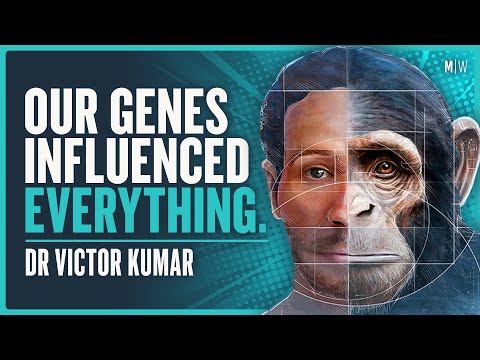
How Did Human Morality Evolve? - Victor Kumar
Victor Kumar (guest), Chris Williamson (host)
In this episode of Modern Wisdom, featuring Victor Kumar and Chris Williamson, How Did Human Morality Evolve? - Victor Kumar explores how Evolution, Culture, And Religion Shaped The Human Moral Mind Victor Kumar explains morality as a product of gene–culture co‑evolution, where biological dispositions and cultural norms co-develop to enable complex human cooperation.
How Evolution, Culture, And Religion Shaped The Human Moral Mind
Victor Kumar explains morality as a product of gene–culture co‑evolution, where biological dispositions and cultural norms co-develop to enable complex human cooperation.
He distinguishes core components of the “moral mind”: moral emotions (like sympathy, respect, shame), social norms (harm, fairness, reciprocity, autonomy), and our unique capacity for moral reasoning by consistency rather than abstract principles.
Examples such as alcohol aversion, lactose tolerance, honor cultures, and religion illustrate how cultural practices feed back into genetic selection and institutional structures to expand or constrain our moral circles.
Kumar argues we’re unlikely to find a single true moral theory, but we can objectively study historical moral progress (e.g., abolition of slavery, reduced prejudice) and the mechanisms that produced it, while warning against overextending cosmopolitan morality at the expense of close personal bonds.
Key Takeaways
Morality is an evolved biocultural system, not a pure invention of reason.
Human morality arises from an interaction between genetic predispositions (e. ...
Get the full analysis with uListen AI
Gene–culture co-evolution shows how practices can reshape our biology.
Cases like alcohol aversion (“Asian flush”) and adult lactose tolerance demonstrate that long-standing cultural practices (brewing rice alcohol, dairying) can generate selection pressures that change gene frequencies in populations.
Get the full analysis with uListen AI
Core moral emotions and norms co-evolved to support complex cooperation.
Emotions such as sympathy, trust, mutual respect, shame, anger, and disgust align with norm domains (harm, fairness, reciprocity, autonomy), creating an integrated system that motivates helping, punishes cheating, and stabilizes group cooperation.
Get the full analysis with uListen AI
Mutual respect and egalitarianism distinguish human cooperation from our ape relatives.
Unlike chimpanzees, where respect flows only upward to dominants, humans evolved more egalitarian relationships because high-stakes cooperative activities (e. ...
Get the full analysis with uListen AI
Some cultural inputs are optional for individuals but non-optional for species survival.
Practices like intensive early caregiving and social learning from slightly older peers are culturally mediated, yet indispensable for normal psychological development and effective survival, challenging the idea that ‘cultural’ automatically means easily changeable.
Get the full analysis with uListen AI
Religion historically expanded moral circles and scaled up cooperation.
Religious institutions helped people treat co-religionists as extended kin, enabling larger cooperative tribes, richer cultural learning (“collective brains”), and the spread of technologies and social complexity beyond small bands.
Get the full analysis with uListen AI
Objective morality may lie in understanding mechanisms of moral progress, not timeless principles.
Given persistent disagreement on foundational theories (e. ...
Get the full analysis with uListen AI
Notable Quotes
“We didn’t create morality from scratch; we inherited it from our ancestors.”
— Victor Kumar
“Morality is adaptive in that it enables cooperation.”
— Victor Kumar
“Just because a trait is cultural does not mean that it is optional.”
— Victor Kumar
“The best hope for an objective moral philosophy is to think about how and why these progressive changes happened, and whether those mechanisms can be exploited in the future.”
— Victor Kumar
“New options doesn’t mean we should devalue the old ones.”
— Victor Kumar
Questions Answered in This Episode
If morality is deeply tied to evolutionary and cultural history, how much freedom do we really have to reshape it deliberately in the future?
Victor Kumar explains morality as a product of gene–culture co‑evolution, where biological dispositions and cultural norms co-develop to enable complex human cooperation.
Get the full analysis with uListen AI
How can modern societies reduce performative virtue signaling and better track genuine moral character and action at large scale?
He distinguishes core components of the “moral mind”: moral emotions (like sympathy, respect, shame), social norms (harm, fairness, reciprocity, autonomy), and our unique capacity for moral reasoning by consistency rather than abstract principles.
Get the full analysis with uListen AI
What kinds of new, non-religious institutions or rituals might realistically replace the communal and existential functions that religions historically fulfilled?
Examples such as alcohol aversion, lactose tolerance, honor cultures, and religion illustrate how cultural practices feed back into genetic selection and institutional structures to expand or constrain our moral circles.
Get the full analysis with uListen AI
Where should we draw the line between expanding our moral concern to distant strangers and preserving special duties to family and close communities?
Kumar argues we’re unlikely to find a single true moral theory, but we can objectively study historical moral progress (e. ...
Get the full analysis with uListen AI
Which current moral debates (e.g., climate justice, animal welfare, trans rights) most closely resemble past cases of clear moral progress, and what mechanisms could we leverage to accelerate similar shifts?
Get the full analysis with uListen AI
Transcript Preview
I think the best hope for finding some kind of objective moral philosophy is to think about how and why these progressive changes happened, and to think about the psychological and cultural mechanisms behind them, and whether those mechanisms can be exploited in the future. We're not gonna figure out whether utilitarianism is true or not, but we might be able to figure out how we made progress in ways that we all agree are progress, and how to build on those, and to find agreement about other pressing problems that we haven't solved yet.
Why would evolutionary theory at all be involved in a conversation when studying morality?
It's a pleasure to be on the show. Uh, the reason is because we are evolved beings. We are, uh, we didn't create morality from scratch, we inherited it from our ancestors. We have similar capacities for morality that are shared with other animals, like chimpanzees. And so the first step to understanding morality is to understand where it came from.
Okay. Does morality not just come out of culture? Is this not just something that humans create out of the wishy-washy nowhere of interacting with each other?
I mean, it comes out of culture too, because culture evolved. Uh, so culture evolves just like our genes do. We have information, we pass it on. Information that allows us to, um, succeed in our environment is more likely to be transmitted to the next generation. So when we think of morality as being evolved, it's not just genetic capacities to, uh, feel pro-social emotions and care about other creatures. It's also a culturally evolved system of norms and institutions. And all of these things combine to produce human morality.
So you call that gene-culture co-evolution?
That's right, yeah. There's been a huge literature over the past couple of decades trying to explain how it's not just that genes evolve and culture evolve, but they co-evolve together. They influence each other's evolution.
Okay. So, could you give me an example of how culture has influenced genes?
Yeah, that's a great question. So one of my favorite examples of this has to do with the gene that creates alcohol aversion. So there are some populations in different parts of the world that, uh, are averse to alcohol. That is, when they drink it, their face blushes, they get kind of sick, and, uh, nauseous.
Asian flush, Asian flush. My business partner-
That's right, that's right. (laughs)
... my business partner's got it, yeah.
That's right. And the reason for that is that the, those populations in Asia were among the first people to take domesticated rice crops and turn them into alcohol. And so there was, um, this evolved cultural practice of domesticating rice, turning it into alcohol, and that created a selection pressure on our genes. That is, individuals who were averse to alcohol were less likely to become alcoholics and get drunk and ruin their own lives and those of their family, and so they were more likely to pass along their genes to the next generation.
Install uListen to search the full transcript and get AI-powered insights
Get Full TranscriptGet more from every podcast
AI summaries, searchable transcripts, and fact-checking. Free forever.
Add to Chrome