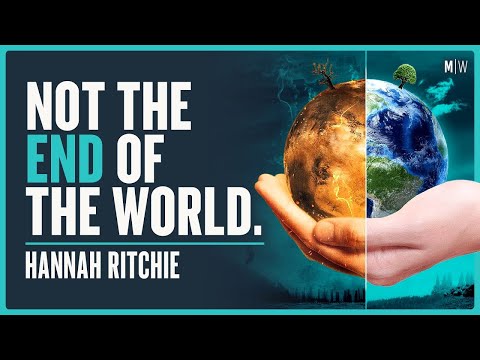
A Closer Look At The Climate Change Statistics - Hannah Ritchie
Chris Williamson (host), Hannah Ritchie (guest)
In this episode of Modern Wisdom, featuring Chris Williamson and Hannah Ritchie, A Closer Look At The Climate Change Statistics - Hannah Ritchie explores climate Crisis Reality: Urgent, Serious, But Far From Hopeless Hannah Ritchie argues that while climate change and environmental degradation are serious, urgent problems, they are not inevitable civilization-ending catastrophes, and framing them as such is both scientifically inaccurate and psychologically harmful. She explains that key concepts like temperature targets and tipping points are often misunderstood as hard doomsday thresholds, when in reality risk increases along a spectrum and remains highly contingent on human choices. Ritchie highlights areas of real concern—heat exposure, food security, biodiversity loss, air pollution—alongside important progress in clean energy, ozone recovery, and air quality in rich countries. Throughout, she emphasizes data-driven optimism: focusing on technological substitution, better incentives, and pragmatic policies rather than fear-based messaging or politically unrealistic solutions like global de-growth.
Climate Crisis Reality: Urgent, Serious, But Far From Hopeless
Hannah Ritchie argues that while climate change and environmental degradation are serious, urgent problems, they are not inevitable civilization-ending catastrophes, and framing them as such is both scientifically inaccurate and psychologically harmful. She explains that key concepts like temperature targets and tipping points are often misunderstood as hard doomsday thresholds, when in reality risk increases along a spectrum and remains highly contingent on human choices. Ritchie highlights areas of real concern—heat exposure, food security, biodiversity loss, air pollution—alongside important progress in clean energy, ozone recovery, and air quality in rich countries. Throughout, she emphasizes data-driven optimism: focusing on technological substitution, better incentives, and pragmatic policies rather than fear-based messaging or politically unrealistic solutions like global de-growth.
Key Takeaways
Avoid framing 1.5°C as a hard apocalypse threshold.
Climate risk increases gradually and sometimes nonlinearly with warming; passing 1. ...
Get the full analysis with uListen AI
Doom-laden climate messaging undermines both mental health and progress.
Telling young people their future is hopeless discourages education, planning, and activism, and also hands climate deniers easy ammunition by making the science look exaggerated or absurd.
Get the full analysis with uListen AI
Leverage falling clean-tech costs to make climate action a ‘no-brainer’.
Solar, wind, batteries, and EVs have become dramatically cheaper and often outcompete fossil fuels, turning decarbonization from a sacrifice-based agenda into a substitution and economic opportunity story.
Get the full analysis with uListen AI
Focus on tractable, high-impact risks: heat and food systems.
Extreme heat and climate impacts on agriculture—especially in poorer, hotter regions—pose some of the most direct threats to lives and livelihoods, so adaptation, heat protection, and yield-boosting innovation are critical.
Get the full analysis with uListen AI
Abandon global de-growth as a primary climate strategy.
Shrinking the world economy would entrench poverty for billions and is politically non-viable; a more realistic path is decoupling growth from emissions via clean energy and efficiency, especially led by rich countries.
Get the full analysis with uListen AI
Use evidence of past environmental wins to guide current policy.
Successes like the Montreal Protocol (ozone), acid rain reduction, and major cuts in urban air pollution show that coordinated policy, standards, and technology can solve large-scale problems when incentives align.
Get the full analysis with uListen AI
Tailor climate communication to audience incentives, not just ideals.
People who don’t resonate with ‘climate’ will often support ‘clean energy’, jobs, and cheaper bills; emphasizing co-benefits and using the right language increases buy-in across political and cultural divides.
Get the full analysis with uListen AI
Notable Quotes
“There’s a really broad spectrum between ‘climate change is not a problem’ and ‘we’re all doomed and there’s nothing we can do about it.’”
— Hannah Ritchie
“Once you frame 1.5 degrees as the point of no return, you breed a lot of apocalyptic thinking.”
— Hannah Ritchie
“If we’re doomed, then what’s the point in actually taking action?”
— Hannah Ritchie
“You cannot do de-growth at a global level because you would leave billions of people in poverty, and that’s, to me, just morally unacceptable.”
— Hannah Ritchie
“Often the best way to get someone to do exactly what you don’t want them to do is to try to force them to do it.”
— Hannah Ritchie
Questions Answered in This Episode
How should climate targets like 1.5°C be reframed so they motivate action without inducing fatalism or complacency?
Hannah Ritchie argues that while climate change and environmental degradation are serious, urgent problems, they are not inevitable civilization-ending catastrophes, and framing them as such is both scientifically inaccurate and psychologically harmful. ...
Get the full analysis with uListen AI
What specific policies or investments would most quickly reduce heat and food-related climate risks in low-income, equatorial countries?
Get the full analysis with uListen AI
How can rich nations practically balance rapid decarbonization at home with supporting clean development and innovation in poorer countries?
Get the full analysis with uListen AI
Given the pessimistic trends in biodiversity, what would an ambitious but realistic global strategy to avert a sixth mass extinction actually look like?
Get the full analysis with uListen AI
How can communicators decide when to emphasize ‘climate change’ versus ‘clean energy and health’ to different audiences without being misleading or manipulative?
Get the full analysis with uListen AI
Transcript Preview
Why do you think that there's so many people who believe the world's doomed?
I think because we're facing a pretty broad range of what are potentially existential or very catastrophic problems. So, like from my domain, the big one is, is climate change, and that's what I write about most of all. But there's also other ones. There's nuclear war. There's the rise of AI. I think there's now a host of problems that in the past might not have seemed existential, but to many people today seem very existential.
If you are knee-deep in the data, why aren't you in agreement?
So I can't speak on AI or, or nuclear war, but my background's environment and, and climate change. Um, and I think actually probably I was in the similar position, you know, a decade ago, or so ago, um, where I did really feel like in the depths of there's no way that we're gonna solve this problem. This is an existential problem. We are all kind of doomed. Um, and I think that was a lot of the, the message that was coming through. My perspective on that has changed. Not that climate change isn't a big problem. It is. That's why I study it. But th- there's a really broad spectrum between climate change is not a problem and we're all doomed and there's nothing we can do about it.
(laughs)
I think there's a big space in the middle, and that big space in the middle is determined by what we do about it. So I think, like my stance on it is it's a big problem and it's an urgent problem, but there actually are things that we can do about it, and there are ways that we can adapt to a changing climate.
When it comes to climate change in particular, why are more people pessimistic about the world than the data suggests that they maybe should be?
I think one of the key unders- misunderstandings on climate is that, you know, we've kind of set these climate targets that we want to keep temperature rise below 1.5 degrees if we can, and especially below two degrees. And I think some of the message that's come out of that is that, you know, 1.5 degrees is this tipping point where once we're past 1.5 degrees, there's this kind of the point of no return and we're doomed. And that's, that's definitely not the case. Climate change is more of a spectrum than an immediate tipping point. So 1.5 degrees, the impacts are worse, and at 1.6 they're worse again, and 1.7. And you can get escalating risks where the, the change is not necessarily linear with every 0.1% degree, but there's nothing particularly special about 1.5 degrees. So I think, I think it's very clear that we probably, we are gonna pass 1.5 degrees, but if your mindset is that once we're past 1.5 degrees, there's nothing we can do and it's kind of eternal tipping point, then I think that breeds a lot of this kind of apocalyptic thinking.
Install uListen to search the full transcript and get AI-powered insights
Get Full TranscriptGet more from every podcast
AI summaries, searchable transcripts, and fact-checking. Free forever.
Add to Chrome