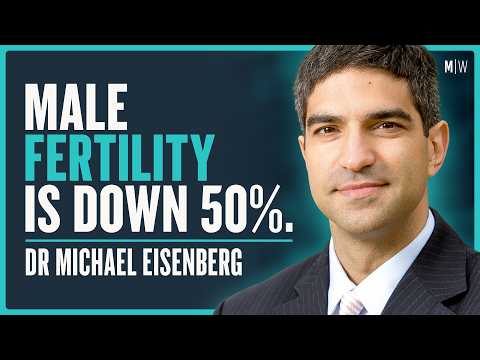
Why Is Male Fertility Crashing Globally? - Dr Michael Eisenberg
Chris Williamson (host), Dr Michael Eisenberg (guest)
In this episode of Modern Wisdom, featuring Chris Williamson and Dr Michael Eisenberg, Why Is Male Fertility Crashing Globally? - Dr Michael Eisenberg explores global male fertility crisis: causes, consequences, and what men control Dr. Michael Eisenberg explains that global sperm counts have dropped over 50% in 40 years, with convincing evidence showing an accelerating decline of around 2% per year recently.
Global male fertility crisis: causes, consequences, and what men control
Dr. Michael Eisenberg explains that global sperm counts have dropped over 50% in 40 years, with convincing evidence showing an accelerating decline of around 2% per year recently.
He links male fertility closely to overall health and environmental exposures, highlighting factors like obesity, chemicals, microplastics, pesticides, and endocrine disruptors, alongside lifestyle habits such as diet, exercise, sleep, and stress.
The conversation covers diagnostic basics (what a semen analysis measures), common treatable issues like varicoceles and hormone imbalances, and the expanding role of assisted reproductive technologies such as IUI, IVF, and ICSI.
Eisenberg also discusses broader trends—falling testosterone, paternal age effects, erectile dysfunction, porn and psychogenic factors—and offers a practical checklist for men to protect reproductive and sexual health.
Key Takeaways
Measure your baseline fertility and hormones early, not only when trying to conceive.
A simple semen analysis and testosterone test while you feel healthy establishes your personal baseline; later declines or problems are easier to interpret and treat when you know where you started.
Get the full analysis with uListen AI
Treat male fertility as a health vital sign linked to future disease risk.
Lower semen quality correlates with higher risks of testicular and prostate cancer, heart disease, diabetes, and even earlier mortality, making sperm a powerful biomarker of overall male health.
Get the full analysis with uListen AI
Prioritize heart‑healthy habits to protect sperm and testosterone.
Diet (whole grains, fruits, vegetables), regular exercise, maintaining healthy weight, not smoking, moderating alcohol, adequate sleep, and stress management all support both cardiovascular and reproductive function.
Get the full analysis with uListen AI
Reduce avoidable chemical exposures where practical without becoming obsessive.
Use fewer plastic bottles, favor organic produce (especially high‑pesticide items like strawberries), check personal care products for endocrine disruptors, and consider mineral over some chemical sunscreens—while avoiding anxiety that itself can harm fertility.
Get the full analysis with uListen AI
Get a proper urologic evaluation; many male factors are detectable and treatable.
Conditions like varicoceles, hormonal imbalances, prior testosterone use, medications, or blockages often emerge only when a specialist examines history, hormones, anatomy, and semen data, and many respond well to surgery or medical optimization.
Get the full analysis with uListen AI
Take erectile problems seriously as both a treatable issue and possible warning sign.
Most erectile dysfunction is vascular rather than purely psychological; medications like sildenafil/tadalafil help, but ED can precede heart disease, so it’s a cue to screen for blood pressure, diabetes, and cholesterol issues.
Get the full analysis with uListen AI
Be cautious with testosterone therapy and self‑medication for performance.
Exogenous testosterone is effectively male birth control and can sharply reduce sperm counts; agents like hCG or clomiphene should only be used under medical supervision when indicated by hormone testing.
Get the full analysis with uListen AI
Notable Quotes
“Anything that's good for your heart is good for fertility.”
— Dr. Michael Eisenberg
“Semen quality is actually correlated with later health too… even death is correlated with it.”
— Dr. Michael Eisenberg
“As long as you have a penis, we can always make it hard.”
— Dr. Michael Eisenberg
“Over the last 50 years, maybe it's about 1% [sperm decline]… but over the last 10, 20 years, it's accelerated to about 2%.”
— Dr. Michael Eisenberg
“It's much easier to prevent a problem from occurring than to fix it once it does.”
— Dr. Michael Eisenberg
Questions Answered in This Episode
If semen quality is such a strong health biomarker, should routine semen analysis be part of standard male health screening?
Dr. ...
Get the full analysis with uListen AI
How far should individuals go in changing their environment and consumer products to reduce microplastic and endocrine disruptor exposure without creating counterproductive anxiety?
He links male fertility closely to overall health and environmental exposures, highlighting factors like obesity, chemicals, microplastics, pesticides, and endocrine disruptors, alongside lifestyle habits such as diet, exercise, sleep, and stress.
Get the full analysis with uListen AI
What ethical boundaries should society set around embryo selection and future technologies like in vitro gametogenesis?
The conversation covers diagnostic basics (what a semen analysis measures), common treatable issues like varicoceles and hormone imbalances, and the expanding role of assisted reproductive technologies such as IUI, IVF, and ICSI.
Get the full analysis with uListen AI
Given the strong links between metabolic health and fertility, how should fertility clinics and primary care better coordinate care for men with poor semen parameters?
Eisenberg also discusses broader trends—falling testosterone, paternal age effects, erectile dysfunction, porn and psychogenic factors—and offers a practical checklist for men to protect reproductive and sexual health.
Get the full analysis with uListen AI
What practical steps can younger men take now to mitigate the fertility impacts of delayed parenthood and rising paternal age?
Get the full analysis with uListen AI
Transcript Preview
Global sperm counts have declined by over 50% in the last 40 years. Is that true?
(laughs) You know, it really is. I think, you know, in the last few years, there's been a lot of consensus around that. Uh, you know, one of the most famous studies that looked at this was published in the '90s, um, and, you know, when it was released, I've talked to some of the authors about it, there was a lot of fanfare around it. You know, they had it in a big, um, media hall. There were television cameras. Uh, but since then, there was a lot of controversy around it, um, you know, for a few reasons. You know, there is... You know, there are differences in semen quality around the world, like for example, there's a study in the United States that showed that, if you can believe it, sperm quality is higher in New York than in the Midwest. And I think reasons for that are not certain, you know, whether it's lifestyle, you know, activity levels. There may be differences in, you know, just sort of race/ethnicity composition. I think the reasons are not known, but, you know, in the US we see that, but around the world we see that too, and so there were some concerns about how all that was incorporated into some of these studies. Um, you can imagine over 40 years some of the methodology for testing sperm has probably improved a little bit. And even our, you know, statistical methodologies compu- computational abilities have improved. So, you know, initially in the '90s, I think it was somewhat controversial. Even some of my mentors questioned this. But I would say over the last, you know, few years, there's another study in 2017 and even 2023 most recently, and it's really kind of solidified, and now there's consensus in the field that we're seeing this decline. You know, over the last 50 years, maybe it's called about 1%, so maybe about one million less sperm per year on average every year. But over the last, you know, 10, 20 years, it's accelerated actually about 2%, uh, decline. And so, I think it's... You know, now that there's a little more, um, you know, again sort of consensus around it, I think it's really up to us to understand why, 'cause, um, yeah, it's not- not a good thing. Existential, I think, in a lot of ways.
Okay. Why do we think that this is happening, uh, beyond the ability to detect statistical improvements physically? What- what- what's happening?
Yeah. I mean, I think that's the million-dollar question, or billion or trillion-dollar question really. Um, I think there could be a few reasons. You know, the pace of change is probably too quick for evolution. I don't think it's a genetic factor, you know, so I think people have really honed in on exposures, you know, whether it's, you know, lifestyle factors. I mean, I think that, you know, we're probably a little less sedentary than we used to be. You know, obesity was going up, although maybe with some of the new medications, we'll see a reversal of that trend. But I think there's a lot of concern about just some of our exposures, you know, some of the chemicals in the environment, microplastics, I think those sorts of things. You know, there're some endocrine-disrupting factors that are at play here that- that may be the culprits, but I think, you know, we need to really do more work to try and understand it, um, and I think that's kind of where we are.
Install uListen to search the full transcript and get AI-powered insights
Get Full TranscriptGet more from every podcast
AI summaries, searchable transcripts, and fact-checking. Free forever.
Add to Chrome