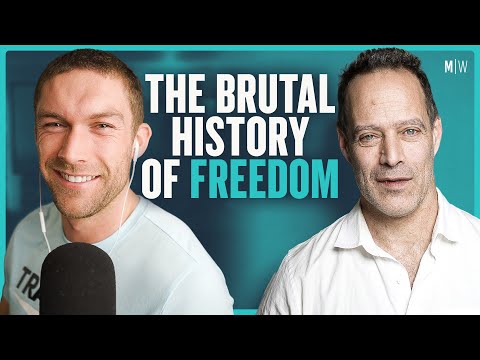
The Brutal History Of Freedom - Sebastian Junger | Modern Wisdom Podcast 396
Sebastian Junger (guest), Chris Williamson (host)
In this episode of Modern Wisdom, featuring Sebastian Junger and Chris Williamson, The Brutal History Of Freedom - Sebastian Junger | Modern Wisdom Podcast 396 explores sebastian Junger Redefines Freedom Through Near-Death, Tribe, And War Sebastian Junger recounts a recent near-death experience from a ruptured aneurysm that challenged his lifelong atheism and opened questions about consciousness, death, and reality. He and Chris Williamson explore how such threshold experiences—coma, psychedelics, religious ecstasy—hint at dimensions we don’t yet understand, even if they’re purely neurological. The conversation then pivots to Junger’s core thesis on freedom: it’s always traded against safety, community, and responsibility, and no one ever has all forms of freedom at once. Using history, anthropology, warfare, and modern politics, he argues that true freedom is collective, dependent on mutual obligation, ethical leadership, and the ability of smaller groups to resist larger powers by running, fighting, or outthinking them.
Sebastian Junger Redefines Freedom Through Near-Death, Tribe, And War
Sebastian Junger recounts a recent near-death experience from a ruptured aneurysm that challenged his lifelong atheism and opened questions about consciousness, death, and reality. He and Chris Williamson explore how such threshold experiences—coma, psychedelics, religious ecstasy—hint at dimensions we don’t yet understand, even if they’re purely neurological. The conversation then pivots to Junger’s core thesis on freedom: it’s always traded against safety, community, and responsibility, and no one ever has all forms of freedom at once. Using history, anthropology, warfare, and modern politics, he argues that true freedom is collective, dependent on mutual obligation, ethical leadership, and the ability of smaller groups to resist larger powers by running, fighting, or outthinking them.
Key Takeaways
Near-death experiences often feel real enough to destabilize rigid beliefs.
Junger’s vivid encounter with a ‘black pit’ and his deceased father, despite being a committed atheist, left him more open to the “great mystery” of consciousness and death, illustrating how such events can shift even strongly held worldviews without necessarily converting them into religious belief.
Get the full analysis with uListen AI
You can never possess all forms of freedom simultaneously; every gain is a trade.
Temporal freedom can be exchanged for economic freedom via a demanding job; wilderness freedom trades safety for autonomy; family life trades spontaneity for profound emotional freedom in love. ...
Get the full analysis with uListen AI
Real safety and freedom are collective achievements, not individual feats.
From hunter-gatherers to frontier settlers, humans only survive and stay ‘free’ because groups coordinate defense, divide labor, and enforce norms. ...
Get the full analysis with uListen AI
Underdogs stay free by outrunning, outfighting, or outthinking stronger powers.
Junger’s ‘run, fight, think’ framework shows how mobile Apache bands, Montenegrin fighters, labor movements, and Irish rebels maintained autonomy against empires by leveraging mobility, asymmetric combat, women’s lateral networks, and strategic sacrifice instead of matching raw power.
Get the full analysis with uListen AI
Legitimate leadership requires sharing risk and sacrifice, not just rewards.
From battlefield officers who eat last to business owners standing in the cold with staff, people grant real authority to leaders who visibly accept hardship and vulnerability alongside them. ...
Get the full analysis with uListen AI
Freedom originally meant ‘our people are safe from outside domination,’ not universal liberty.
The root of ‘freedom’ (friede dom, “beloved”) referred to the safety of one’s own community from enemies, even while that same community might enslave outsiders. ...
Get the full analysis with uListen AI
Labeling political opponents as existential enemies is a classic step toward fascism.
When parties frame half the country as enemies of the state rather than fellow citizens with different views, they erode democratic norms and prepare the ground for authoritarianism. ...
Get the full analysis with uListen AI
Notable Quotes
“You never get all forms of freedom at once.”
— Sebastian Junger
“I didn’t see God. I saw my father.”
— Sebastian Junger
“What happens to you happens to me—that’s what makes a tribe.”
— Sebastian Junger
“If the smaller group always lost, there would be no freedom in the human experience.”
— Sebastian Junger
“If you keep your year-end bonus and fire people, you’re not leading a company—you’re just running one.”
— Sebastian Junger
Questions Answered in This Episode
How should individuals decide which type of freedom—economic, temporal, emotional, or physical—they’re willing to sacrifice for another at different stages of life?
Sebastian Junger recounts a recent near-death experience from a ruptured aneurysm that challenged his lifelong atheism and opened questions about consciousness, death, and reality. ...
Get the full analysis with uListen AI
Do Junger’s near-death and coma stories suggest anything beyond brain chemistry, or simply reveal how powerful and adaptive the brain’s storytelling machinery is?
Get the full analysis with uListen AI
In a highly interconnected modern society, what would ‘tribe-like’ mutual obligation realistically look like without romanticizing the past?
Get the full analysis with uListen AI
How can citizens practically reward honest, self-sacrificing leaders and punish opportunistic ones within their own political or corporate ‘tribe’?
Get the full analysis with uListen AI
Are there constructive ways to resist the growing in-group/out-group polarization Junger describes without ignoring real conflicts of interest and values?
Get the full analysis with uListen AI
Transcript Preview
I mean, you can give up temporal freedom and get a high paying job and make a bunch of money, and then you have economic freedom. You can give up the sort of safety and stability and predictability of living in a modern society and go into the wilderness, and you have the freedom of that, but you're in a fair amount of danger. And if something happens to you, like you have a ruptured appendix, sorry guy, you're dead. You never get all forms of freedom at once. (wind blows)
A little while ago, you had a near death experience. What was the story behind that?
Yeah, I mean, you know, I'd been in a lot of combat as a journalist with American soldiers and, and, and, and otherwise around the world. And I thought all, you know, sort of danger was behind me. I'm in good health, I'm, I'm an athlete, I'm in good shape, I have- I got a heart rate of 60 and a blood pressure of 120 over 80. I had everything you could want at age 50, 58 last year. Uh, and I felt a sudden, uh, pain in my abdomen. And it was an undiagnosed aneurysm in my pancreatic artery, which is this, like, little artery that nobody thinks about. And it had an aneurysm, and it ruptured. And I started bleeding out into my own, into my own abdomen. And by the time they got me to the ER, I'd lost three quarters of my blood. Um, and, uh, you know, when women, often when women die in childbirth, which tragically still happens, they basically, they're dying the same way. They're bleeding to death and they can't find the, they can't find the, the, the bleed and they can't stop it, and they lose the woman. And that's basically what was happening to me, but it was the result of an an- of a ruptured aneurysm. And, um, you know, by, by the time they were, they were, they were cutting my neck open to put a line into my jugular to get enough blood into me fast enough to save me, by the time that was happening, uh, you know, I was, I was actively dying. And my, my, you know, I'm an atheist. I'm not religious. Uh, my dad was a physicist, but my dead father appeared above me, sort of welcoming me, which is some, an experience I'm still struggling to explain. And, uh, and a black pit opened up underneath me, and I was getting pulled into it. And, you know, it was the, uh, uh, I mean, I guess neurologically the black pit of unconsciousness. I don't know. But it was a very, uh, it's not like falling asleep, it's not like losing consciousness when you're having, about to have a medical procedure. I was getting pulled into a black hole and my dead father was there. And the last thing I said to the doctor was, "You gotta hurry. You're losing me right now." And, um, they, you know, they did their work, their amazing work, and they saved me. And, um, you know, it was touch and go for a while because I need- they needed another eight hours to find the leak inside me. And, um, you know, when you're transfused like that, I had 10 units of blood, and when you're transfused like that, you know, other problems happen. Like, you start to get, you run the risk of organ failure and, and, and things like that. And, and luckily I'm healthy and my body managed to stay alive for eight hours until they, they, they fixed the leak. And I'm very, very lucky to be here. Most people die from this, and I'm very lucky to be here.
Install uListen to search the full transcript and get AI-powered insights
Get Full TranscriptGet more from every podcast
AI summaries, searchable transcripts, and fact-checking. Free forever.
Add to Chrome