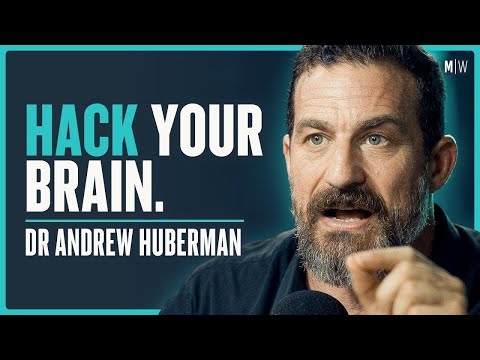
The Biology Of Focus, Success & Long-Term Energy - Dr Andrew Huberman (4K)
Chris Williamson (host), Andrew Huberman (guest), Narrator, Narrator
In this episode of Modern Wisdom, featuring Chris Williamson and Andrew Huberman, The Biology Of Focus, Success & Long-Term Energy - Dr Andrew Huberman (4K) explores huberman explains science-backed strategies for focus, energy, sleep, longevity, resilience Andrew Huberman dives deep into the biology of adenosine, caffeine, light, and circadian rhythms, outlining practical protocols to improve morning alertness, prevent afternoon crashes, and enhance sleep quality. He explains tools like delaying caffeine, morning and afternoon sunlight, exercise timing, and non-sleep deep rest (NSDR/yoga nidra) as zero-cost levers for energy and focus.
Huberman explains science-backed strategies for focus, energy, sleep, longevity, resilience
Andrew Huberman dives deep into the biology of adenosine, caffeine, light, and circadian rhythms, outlining practical protocols to improve morning alertness, prevent afternoon crashes, and enhance sleep quality. He explains tools like delaying caffeine, morning and afternoon sunlight, exercise timing, and non-sleep deep rest (NSDR/yoga nidra) as zero-cost levers for energy and focus.
The conversation expands into sleep need variability, genetic short-sleepers, snoring solutions, and how to shift between night-owl and morning-person schedules using four key zeitgebers: light, movement, caffeine/food, and social interaction. Huberman also touches on longevity interventions (rapamycin, NMN, NAD, BPC-157), emphasizing moderation and evidence thresholds.
In a more personal turn, Huberman discusses handling intense public scrutiny, the role of community support, prayer, and journaling in maintaining psychological health, and his evolving relationship with intuition versus rational analysis. He and Chris Williamson explore “lonely chapters” of personal growth, the importance of pruning bad paths, and the emerging power of podcasts and science communication.
Throughout, Huberman returns to a core theme: consistent fundamentals—sleep, sunlight, movement, stress dosing, social connection, and honest self-reflection—outperform exotic hacks for long-term focus, success, and vitality.
Key Takeaways
Delay caffeine 60–90 minutes after waking to reduce afternoon crashes.
Because adenosine is not fully cleared upon waking, immediate caffeine just blocks its receptors while more adenosine accumulates underneath, contributing to a midday slump; delaying caffeine allows natural clearance to continue, particularly in people prone to a 1–4 p. ...
Get the full analysis with uListen
Use sunlight and movement in the morning to lock in alertness and shift your clock.
Viewing bright outdoor light soon after waking (even on cloudy days) and adding light movement or exercise boosts the natural cortisol peak, counters residual melatonin and adenosine, and acts as a powerful zeitgeber to consolidate you as a morning and daytime person.
Get the full analysis with uListen
NSDR/yoga nidra can partially mimic sleep to restore energy and focus.
A 10–30 minute NSDR session upon waking or mid-day—body still, mind guided but relaxed—appears to clear residual adenosine, replenish dopamine in the basal ganglia, and subjectively leaves people feeling far more rested, making it a potent zero-cost recovery tool.
Get the full analysis with uListen
Stack four zeitgebers for rapid circadian shifts: light, exercise, caffeine/food, and social contact.
To become more of a morning person in ~3 days, Huberman recommends setting an early alarm and immediately combining bright light, movement, (optionally) early caffeine/food, and social interaction; the same elements, shifted later in the day, can deliberately phase-delay you toward a night-owl schedule.
Get the full analysis with uListen
Protect sleep by managing evening light—especially from screens—and use afternoon sun as a buffer.
Bright light between ~9:30 p. ...
Get the full analysis with uListen
Prioritize basics over extreme longevity interventions, and be cautious with experimental drugs/peptides.
Huberman is conservative about rapamycin, metformin, and widespread peptide use, noting limited human data and potential risks (e. ...
Get the full analysis with uListen
Build resilience to crises with strong relationships, clear inner guidance, and structured routines.
During intense media criticism, Huberman relied on a trusted “committee” of friends, family, and colleagues, continued working, used meditation, NSDR, exercise, and sleep tools, and leaned heavily on daily prayer to calibrate his decisions—illustrating a repeatable playbook for psychological stability under pressure.
Get the full analysis with uListen
Notable Quotes
“By delaying caffeine for the first 60 to 90 minutes after waking, you are clearing out the adenosine that is residual in your system.”
— Andrew Huberman
“Viewing bright light both increases the pro‑wakefulness systems in the brain and body and suppresses the anti‑wakefulness systems… Otherwise, you're sort of trying to drive with the emergency brake on.”
— Andrew Huberman
“You can be a morning person in three days. It’s three days of pain; the rest is easy.”
— Andrew Huberman
“Maybe the illusion is the pain. Maybe the mental anguish I feel… that's the illusion.”
— Andrew Huberman
“Avoiding catastrophe is significantly more profitable than trying to expedite success.”
— Chris Williamson
Questions Answered in This Episode
If you currently rely on early-morning caffeine, what would happen if you experimented with a 60–90 minute delay for a week—how might your afternoon energy change?
Andrew Huberman dives deep into the biology of adenosine, caffeine, light, and circadian rhythms, outlining practical protocols to improve morning alertness, prevent afternoon crashes, and enhance sleep quality. ...
Get the full analysis with uListen AI
How could you redesign your first hour after waking to stack sunlight, movement, hydration, and (optionally) social interaction to better anchor your circadian rhythm?
The conversation expands into sleep need variability, genetic short-sleepers, snoring solutions, and how to shift between night-owl and morning-person schedules using four key zeitgebers: light, movement, caffeine/food, and social interaction. ...
Get the full analysis with uListen AI
Is there a specific “lonely chapter” you’re in or avoiding right now, and what older habits, friendships, or environments might you need to prune to move through it?
In a more personal turn, Huberman discusses handling intense public scrutiny, the role of community support, prayer, and journaling in maintaining psychological health, and his evolving relationship with intuition versus rational analysis. ...
Get the full analysis with uListen AI
Which of Huberman’s low-cost tools—NSDR, afternoon sunlight, breathing exercises, or light management at night—feels like the most realistic first step for improving your sleep and focus?
Throughout, Huberman returns to a core theme: consistent fundamentals—sleep, sunlight, movement, stress dosing, social connection, and honest self-reflection—outperform exotic hacks for long-term focus, success, and vitality.
Get the full analysis with uListen AI
Where in your life do you override bodily intuition with overthinking, and how might practicing Martha Beck’s “perfect day” and contraction/expansion exercises help you listen to that inner signal more clearly?
Get the full analysis with uListen AI
Transcript Preview
There's been a lot of controversy over the last few months, and the internet's been ablaze with speculation. I think it's important to get it up top, what is happening with the state of the adenosine system research within the first 90 minutes of the day?
Adenosine is an incredibly interesting molecule. It exists in the brain and body. It accumulates with the number of hours that you're awake. So the longer you're awake, the more adenosine accumulates. It does many things in the brain and body. One of the most important things that it does is to give us the sur- subjective experience of feeling sleepy, and the objective feeling of our body being fatigued, of feeling literally heavier, requiring more energy to move ourselves. When we sleep and when we allow ourselves to go into states of deep rest that are similar to sleep, we can talk about this, the adenosine system is adjusted so that there's less effective adenosine circulating or bound to adenosine receptors. Okay? So this is sort of adenosine 101. There's a lot more to it, but that's sufficient for what we need to talk about for now. The drug, the most commonly used drug, the drug we're using now and that we're on right now, caffeine, which is consumed by it's estimated more than 90% of the world's adult population, effectively works by blocking the adenosine receptor. There's some nuance there, but we can think of it that way for simplicity's sake. And in doing so, it prevents the sleepiness inducing actions of adenosine. However, when caffeine wears off, the adenosine that was around trying to bind to those receptors is still around. In fact, it's accumulated even more, which at least partially explains the so-called caffeine crash or the dip in energy, the fatigue that is that we experience maybe three or four hours after consuming caffeine. Okay. As I mentioned before, when we go to sleep at night, adenosine is cleared from our system. There was a lot of debate over the years about why we sleep. In fact, the great Matt Walker wrote the book, Why We Sleep. And a lot of it has to do with the cell biology of regulating potassium and other ions that are in neurons, and for those that are interested in the cell biology, it's about readjusting the amount of potassium inside and outside the cells, which is happening on an ongoing basis. But you could think of the time that we sleep as doing many things, but one of the most important things is to bring those adenosine levels down. Whatever adenosine has accumulated, to bring it back down such that when we wake up in the morning, we feel alert. Okay? There are a lot of reasons why we feel alert. Some of them we can call pro-alertness mechanisms, like the release of cortisol. Some of them are about removing the brake on wakefulness, like reducing adenosine. Here we're talking about removing the brake on wakefulness by reducing adenosine. So let's say, like what time do you go to sleep at night typically? If you had your way.
Install uListen to search the full transcript and get AI-powered insights
Get Full TranscriptGet more from every podcast
AI summaries, searchable transcripts, and fact-checking. Free forever.
Add to Chrome