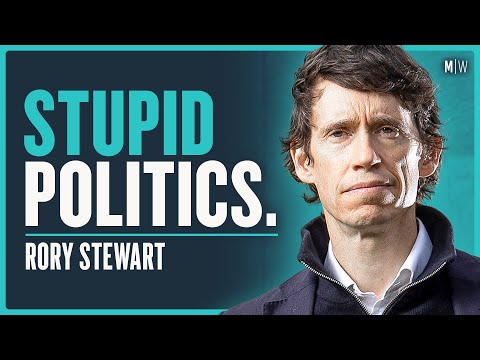
The Truth Behind The Fall Of The UK - Rory Stewart
Chris Williamson (host), Rory Stewart (guest), Narrator
In this episode of Modern Wisdom, featuring Chris Williamson and Rory Stewart, The Truth Behind The Fall Of The UK - Rory Stewart explores rory Stewart Dissects Political Failure, UK Unrest, and Global Poverty Solutions Rory Stewart discusses his recent return from Taliban-controlled Afghanistan, contrasting improved security with severe losses of freedom and women’s rights, and framing the 20-year Western intervention as a historic strategic failure. He then critiques the deep cultural dysfunction inside UK and US politics, linking institutional incompetence and performative leadership to populism, social unrest, and the UK’s current "end of days" atmosphere. The conversation moves from domestic issues like regional inequality, riots, immigration, and online extremism to global concerns such as regulated free speech on social media and the persistence of extreme poverty in Sub-Saharan Africa. Stewart closes by advocating direct cash transfers as a radically more effective, dignified model for aid than traditional, bureaucratic development projects.
Rory Stewart Dissects Political Failure, UK Unrest, and Global Poverty Solutions
Rory Stewart discusses his recent return from Taliban-controlled Afghanistan, contrasting improved security with severe losses of freedom and women’s rights, and framing the 20-year Western intervention as a historic strategic failure. He then critiques the deep cultural dysfunction inside UK and US politics, linking institutional incompetence and performative leadership to populism, social unrest, and the UK’s current "end of days" atmosphere. The conversation moves from domestic issues like regional inequality, riots, immigration, and online extremism to global concerns such as regulated free speech on social media and the persistence of extreme poverty in Sub-Saharan Africa. Stewart closes by advocating direct cash transfers as a radically more effective, dignified model for aid than traditional, bureaucratic development projects.
Key Takeaways
Western nation‑building in Afghanistan and Iraq is a ‘definitional failure’ that eroded public trust.
After spending trillions over two decades to remove the Taliban and build democracy, the West ultimately handed Afghanistan back to the Taliban, symbolizing elite overconfidence and incompetence and fueling disillusionment with liberal democracies.
Get the full analysis with uListen AI
Political systems repel earnest, competent people and reward marketing over performance.
Stewart describes politics as a demoralizing, cynical culture where policy discussion is mocked, promotion ignores competence (e. ...
Get the full analysis with uListen AI
Rising populism is rooted in repeated institutional failures and neglected communities.
From Afghanistan and COVID to UK regional decline and US rust-belt stagnation, communities that feel ignored and economically stranded become fertile ground for populists who offer seductive, simple certainties instead of complex, honest answers.
Get the full analysis with uListen AI
Online platforms amplify extremes, making nuance and seriousness structurally uncompetitive.
Algorithmic incentives favor inflammatory, simple, and funny content over careful analysis, inverting the real-world bell curve of opinion into an online U‑shape where extremes dominate attention and moderate voices are sidelined.
Get the full analysis with uListen AI
Existing laws can and should apply to online incitement, but disinformation is a harder frontier.
Stewart argues that inciting violence—whether via letters or tweets—has long been criminal, yet prosecuting people for spreading false stories is far less clear-cut, creating a flash point in debates over free speech, regulation, and platform responsibility.
Get the full analysis with uListen AI
Direct cash transfers often outperform traditional aid, delivering impact and dignity at low cost.
Programs like GiveDirectly show that giving poor households ~US$700–1,000 can rapidly improve housing, sanitation, food security, livestock ownership, and schooling, often achieving far more than heavily staffed projects that leak money into overhead and consulting.
Get the full analysis with uListen AI
Effective altruism’s scandals expose a cultural addiction to ‘genius’ billionaires and flashy solutions.
The Sam Bankman-Fried saga illustrates how celebrity, ego, and speculative wealth can masquerade as moral authority, distracting from sober, evidence-based philanthropy and fostering the illusion that being rich equals being right.
Get the full analysis with uListen AI
Notable Quotes
“You can't think of a bigger failure than to invade a country, get rid of the Taliban, spend 20 years there, and then hand it back to the Taliban again. It's just definitional failure.”
— Rory Stewart
“Politics is so rotten that people basically laugh at you if you try to be serious.”
— Rory Stewart
“London is the sixth-largest economy in the world, and we have a very rich city inside of a pretty poor country.”
— Chris Williamson
“We stole the money. We literally stole $38,000 out of $40,000 here.”
— Rory Stewart
“Cash falls like rain on a mountain landscape. It allows you to adjust to all these different things, house by house, individual by individual.”
— Rory Stewart
Questions Answered in This Episode
If political culture is as unserious and performative as Stewart describes, what concrete reforms—inside parties, parliaments, or electoral systems—could realistically shift incentives toward competence and outcomes?
Rory Stewart discusses his recent return from Taliban-controlled Afghanistan, contrasting improved security with severe losses of freedom and women’s rights, and framing the 20-year Western intervention as a historic strategic failure. ...
Get the full analysis with uListen AI
How should liberal democracies balance border control, demographic needs, and moral obligations to refugees in a way that is both electorally sustainable and ethically defensible?
Get the full analysis with uListen AI
Given the algorithmic bias toward outrage and simplicity, what regulatory or design changes to social media could preserve free expression while reducing the amplification of extremism and misinformation?
Get the full analysis with uListen AI
In global development, under what circumstances might traditional, structured aid projects still outperform direct cash transfers, and how should donors decide between the two approaches?
Get the full analysis with uListen AI
What lessons from the Sam Bankman-Fried and effective altruism fallout should guide how we evaluate and trust wealthy ‘philanthropist-innovators’ who claim to be solving global problems?
Get the full analysis with uListen AI
Transcript Preview
You've just come back from Afghanistan. What is the atmosphere like now after the last few years, since the Taliban took over? What's it actually like on the ground?
Well, I, I think the first thing, um, is just that it's surreal. So I was in Afghanistan first when the Taliban were in their last. So they, they ran the country in the late 1990s through to September the 11th. And it was a time when it was one of the most, I guess, sort of shocking governments on Earth. Th- there were public executions in the main stadiums. Kabul, the capital city, was a ghost town. There were very few people living there, very few vehicles, half the buildings were still in ruins from the civil war. And, uh, they were hanging televisions from trees. I mean, they were, they were on a campaign against any kind of image. So they were literally... You could see television kind of suspended from trees. Then we invaded Afghanistan, and I walked across Afghanistan just after the invasion, so I walked from the west to the east of the country. And I saw a country slowly emerging from the Taliban. I stayed in a lot of village houses along the way. The US and its allies then spent one and a half trillion dollars, that's $1.5 thousand billion, in Afghanistan trying to build a nation, build a democracy, and after almost exactly 20 years there, they pulled out. So having invaded to get rid of the Taliban, they pulled out and handed the country back to the Taliban again. So I turn up, uh, and I'm turning up at the airport that used to have kind of big pictures of Hamid Karzai, who was the, um, who was the US backed president. Now, of course, no such pr- pictures at all. Um, you suddenly see everybody's returned to wearing traditional dress, so you used to see a lot of people in T-shirts and jeans. Now they're mostly back in shalwar kameez. Very few women on the streets. Uh, the government is basically run by religious, religious leaders, by clerics, by priests. And, um... But security is much better. I mean, that's the thing that people don't talk about. It's much safer than it was for 20 years. So I was able to travel up into this... Because, well, partly the Taliban don't get any marks for this. It was partly 'cause they were doing the bombing and the fighting and the killing, and now they've taken over, there's no- not much reason for them to do that anymore. But you can now travel up and down the country from one end to the other safely, and that makes a huge difference to average Afghans because, you know, tens of thousands of people were killed during this war, killed not just by the Taliban, but killed by US troops, British troops, Afghan troops. So if you were in the front lines down in southern Afghanistan, it, it was a horror show. Your relatives were getting killed all the time by either side. It's a civil war. And now it's, now it's peaceful, and that, that shouldn't be underestimated. I mean, I think many Afghans will say, "Okay, we don't like the way the Taliban are behaving. We don't like the way they're treating women. We feel a real absence of freedom, but my goodness, we're grateful that we're not liable to be killed at any moment."
Install uListen to search the full transcript and get AI-powered insights
Get Full TranscriptGet more from every podcast
AI summaries, searchable transcripts, and fact-checking. Free forever.
Add to Chrome