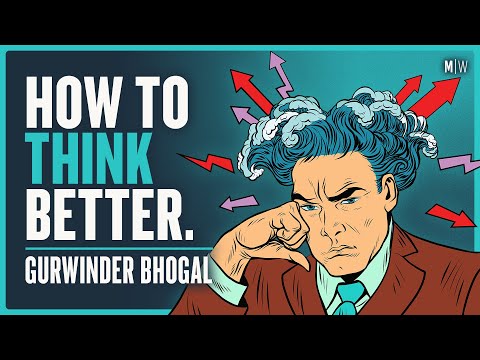
14 Uncomfortable Truths About Human Psychology - Gurwinder Bhogal
Chris Williamson (host), Gurwinder Bhogal (guest)
In this episode of Modern Wisdom, featuring Chris Williamson and Gurwinder Bhogal, 14 Uncomfortable Truths About Human Psychology - Gurwinder Bhogal explores fourteen Brutal Mind Traps Quietly Distorting How We See Reality Chris Williamson and Gurwinder Bhogal unpack a series of cognitive biases and psychological ‘uncomfortable truths’ that explain why our perceptions, decisions, and politics are so often flawed. They cover how we project ourselves onto others, drown in trivial choices, adopt tribal belief packages, and get manipulated by stories, propaganda, and media. The conversation blends research, memorable heuristics, and personal anecdotes to show how fiction, emotion, and social pressure shape our identities and judgments far more than we notice. Throughout, they emphasize practical ways to think more clearly: question your baseline, reduce decision fatigue, resist ideological conformity, and delay action when emotional.
Fourteen Brutal Mind Traps Quietly Distorting How We See Reality
Chris Williamson and Gurwinder Bhogal unpack a series of cognitive biases and psychological ‘uncomfortable truths’ that explain why our perceptions, decisions, and politics are so often flawed. They cover how we project ourselves onto others, drown in trivial choices, adopt tribal belief packages, and get manipulated by stories, propaganda, and media. The conversation blends research, memorable heuristics, and personal anecdotes to show how fiction, emotion, and social pressure shape our identities and judgments far more than we notice. Throughout, they emphasize practical ways to think more clearly: question your baseline, reduce decision fatigue, resist ideological conformity, and delay action when emotional.
Key Takeaways
Question whether the problem is “me or them” before judging others.
The false consensus effect and fundamental attribution error push us to see our own reactions as normal and others as defective. ...
Get the full analysis with uListen AI
Aggressively reduce trivial decisions to reclaim time, energy, and willpower.
Fridkin’s paradox shows we agonize most over least-important choices; hundreds of tiny yes/no’s drain cognitive resources. ...
Get the full analysis with uListen AI
Gauge self-centeredness by how often people inject themselves into non-personal topics.
Frequent use of “I/me” in conversations about abstract or general subjects often signals narcissism or solipsism. ...
Get the full analysis with uListen AI
Watch for hidden premises in rhetoric; the most effective propaganda is implied, not declared.
Enthymemes smuggle controversial assumptions in as if they were obvious background facts, making people infer the lie themselves. ...
Get the full analysis with uListen AI
Stories move us more than data—and they quietly program who we become.
Fiction lag and compassion fade reveal that we empathize with vivid individuals and characters, not statistics or abstractions. ...
Get the full analysis with uListen AI
Aim for the golden mean: moderate virtues instead of maximizing them.
Even good traits—compassion, drive, health-focus, confidence—become harmful in excess (e. ...
Get the full analysis with uListen AI
Don’t outsource your entire worldview to a tribe’s ‘belief package.’
If someone can predict your stance on guns, abortion, immigration, and economics from a single opinion, you’ve likely adopted a tribal bundle. ...
Get the full analysis with uListen AI
You probably underestimate your natural talents and overinvest in what doesn’t suit you.
Rothbard’s Law suggests we discount what comes easily and instead grind on harder, lower-yield skills. ...
Get the full analysis with uListen AI
Most wisdom about success comes from understanding how failures happen and avoiding them.
Winners rarely scrutinize why they won, while losers obsess over their mistakes, making them good teachers of what not to do. ...
Get the full analysis with uListen AI
Group diversity doesn’t automatically improve decisions if consensus flattens unique perspectives.
The common knowledge effect shows that in teams, only shared information tends to influence decisions, while unique insights are often ignored. ...
Get the full analysis with uListen AI
Notable Quotes
“A man who has lived in many places is not likely to be deceived by the local errors of his village: the scholar has lived in many times, and is therefore immune from the great cataract of nonsense that pours from the press of his own age.”
— C.S. Lewis (quoted by Gurwinder Bhogal)
“We develop our identities by copying others, and perhaps one reason we enjoy fiction is that it gives us ideas on who to be.”
— Gurwinder Bhogal
“An absurd ideological belief is as much a show of fealty to your own side and a threat display to the other as it is a philosophy you live by.”
— Chris Williamson (paraphrasing a prior discussion with Gurwinder)
“You won’t get read if you just tell the truth. You have to dress it up in a story—so the only way to tell the truth is by making it a little bit fake.”
— Gurwinder Bhogal
“If you can’t decide, the answer is no.”
— Gurwinder Bhogal
Questions Answered in This Episode
In your own life, where do you most clearly see the false consensus effect—assuming others think or feel as you do—and how could you systematically challenge that assumption?
Chris Williamson and Gurwinder Bhogal unpack a series of cognitive biases and psychological ‘uncomfortable truths’ that explain why our perceptions, decisions, and politics are so often flawed. ...
Get the full analysis with uListen AI
What trivial decisions are currently draining disproportionate time and energy from your day, and what simple heuristics or routines could you adopt to eliminate that decision fatigue?
Get the full analysis with uListen AI
Which fictional characters or media narratives do you suspect have shaped your identity or moral intuitions, and are they models you’d consciously choose if you saw their influence clearly?
Get the full analysis with uListen AI
On which issues do your views diverge most sharply from your ‘tribe’s’ default positions, and what costs—social or psychological—have you paid (or avoided) because of that?
Get the full analysis with uListen AI
If you examined your biggest past failures as rigorously as Gurwinder suggests, what repeatable mistakes or ‘multiplying-by-zero’ risks would you identify and design guardrails against?
Get the full analysis with uListen AI
Transcript Preview
You write these amazing mega threads. I love them. We're gonna go through as many of the concepts that we can get through today. The first one, false consensus effect. "Everyone driving slower than you is an idiot, and everyone driving faster than you is a maniac." George Carlin. Our model of the world assumes people are like us. We don't just do whatever we consider normal. We also consider normal whatever we do.
Yeah, so I think this is a very important point because we only know ourselves, and we kind of, because we're so familiar with ourselves, we tend to use ourselves as the baseline by which we judge everything else. And this can cause problems, because let's say, um, if you're somebody who is around somebody else, uh, you're- and you're inclined to find this person annoying because they're not like you. There's two ways you can look at this. Either you can look at it as, "That person is annoying," or, "I am easily annoyed." And what people tend to do is they almost always err on the side of considering the other person annoying. You know, so this is just one example, but this is pretty much what we do in our, in our lives, up and down, everywhere, like we do it all over the shop. And the reason why I think it's important is because if we start asking ourselves, "Well, hang on a second, maybe I'm the issue, maybe I'm seeing things differently because of my experiences," we can actually get a more grounded understanding of actually what's going on. I've started doing this in my life a lot more, where if I feel a certain way about someone, I ask myself, "Is it me or is it them?" You know, it's something that a lot of people don't do. They just assume that it's the other person that's the problem, or they assume that something in the world is wrong rather than their perception. So that's the reason I include it. I think it always helps, it's a good heuristic to just double-check, just to ask yourself if there's something askew in the world, is it really askew or is it your perception? Is it your experiences that have put you askew from the world?
Is this related to the fundamental attribution error?
Yeah, to an extent. I mean, so with the fundamental attribution error, people have a tendency to attribute the sort of, uh, the failures of an ally to external circumstances, and the failures of an, uh, an enemy or opponent, uh, to their character. So you know, if, if, if your friend is late, "Oh, you know, they just got held up by the bus. The bus was the problem." But if an opponent is late, "Oh, they're just a horrible person. They're lazy," you know, all this stuff. So it does tend to... That's more of a tribal thing, but it- it does have an element of this false consensus effect to it, because we tend to see things relative to ourselves in that sense. So-
Install uListen to search the full transcript and get AI-powered insights
Get Full TranscriptGet more from every podcast
AI summaries, searchable transcripts, and fact-checking. Free forever.
Add to Chrome