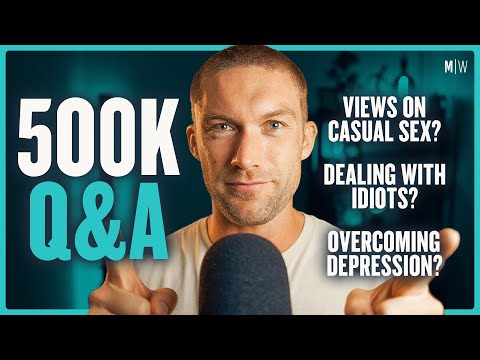
500k Q&A - Casual Sex, Political Idiots & Depression
Chris Williamson (host)
In this episode of Modern Wisdom, featuring Chris Williamson, 500k Q&A - Casual Sex, Political Idiots & Depression explores chris Williamson’s 500k Q&A: Men, Meaning, Media, and Modern Life Chris Williamson celebrates reaching 500,000 subscribers with a wide-ranging Q&A touching on sobriety, mental health, masculinity, dating, productivity, and the future of his podcast.
Chris Williamson’s 500k Q&A: Men, Meaning, Media, and Modern Life
Chris Williamson celebrates reaching 500,000 subscribers with a wide-ranging Q&A touching on sobriety, mental health, masculinity, dating, productivity, and the future of his podcast.
He shares candid reflections on quitting alcohol, dealing with low mood and loneliness, and how disciplined routines and physical health reshaped his life.
Chris critiques red/black pill manosphere ideology, casual sex culture, and sensationalist media, arguing for agency, responsibility, and collaborative relations between men and women.
He also discusses the behind-the-scenes realities of running Modern Wisdom, his evolving interests (especially evolutionary psychology), and how he thinks about guests, growth, and potential new formats.
Key Takeaways
Treat lifestyle fundamentals as non‑negotiable if you struggle with mood.
Williamson emphasizes that sleep regularity, sunlight exposure, exercise, sobriety, and basic nutrition dramatically influenced his depression-like periods, often more reliably than trying to 'think' his way out.
Get the full analysis with uListen AI
Sobriety can unlock consistency, time, and self-respect.
Quitting alcohol removed hangover cycles, restored stable routines, and freed up time and energy for reading, meditation, and starting his podcast—changes he frames as foundational to his later success.
Get the full analysis with uListen AI
Cull energy-draining relationships and curate your social environment.
He argues that friends who consistently leave you feeling angry, drained, or small are not really friends, and suggests intentionally seeking people (offline and online) who raise your standards and energy.
Get the full analysis with uListen AI
Discipline outperforms motivation for doing hard, worthwhile things.
Rather than waiting to feel motivated, he advocates deciding in advance what matters, then following through regardless of mood—seeing this as a core part of adult responsibility, especially for men.
Get the full analysis with uListen AI
Red/black pill worldviews can stunt real-world growth and relationships.
He sees much of the manosphere as vicarious experience masquerading as wisdom, encouraging young men to adopt adversarial, fatalistic views of women instead of learning through real-life relationships and self-improvement.
Get the full analysis with uListen AI
You can change your trajectory by proving to yourself you have agency.
Williamson describes shifting from believing he “wasn’t meant to be happy” to repeatedly taking small actions that improved his life, which in turn reinforced a belief that he could design, not just endure, his circumstances.
Get the full analysis with uListen AI
Pick systems and tools you’ll actually use, not ‘perfect’ ones.
In productivity and organization, he prefers frictionless, simple tools (Apple Notes, a straightforward todo app) over complex setups, arguing that even slightly clunky systems drain willpower and reduce consistency.
Get the full analysis with uListen AI
Notable Quotes
“Alcohol is the only drug where if you don't do it, people assume you have a problem.”
— Chris Williamson
“As soon as a substance stops affording you a benefit, it has now become a crutch that you are relying on.”
— Chris Williamson
“You don't need to live life by default; you can live it by design.”
— Chris Williamson
“If every time you leave someone you feel agitated or depressed, that person isn't your friend. That person is dragging you down.”
— Chris Williamson
“The harder you work, the luckier you get—and the more consistently you do good work, the easier life becomes.”
— Chris Williamson
Questions Answered in This Episode
How can young men practically differentiate between useful masculinity content and toxic red/black pill narratives online?
Chris Williamson celebrates reaching 500,000 subscribers with a wide-ranging Q&A touching on sobriety, mental health, masculinity, dating, productivity, and the future of his podcast.
Get the full analysis with uListen AI
What specific early indicators should someone look for to identify which habits or environments are driving their depressive cycles?
He shares candid reflections on quitting alcohol, dealing with low mood and loneliness, and how disciplined routines and physical health reshaped his life.
Get the full analysis with uListen AI
If university is losing value for many men, what alternative paths best build status, skills, and community?
Chris critiques red/black pill manosphere ideology, casual sex culture, and sensationalist media, arguing for agency, responsibility, and collaborative relations between men and women.
Get the full analysis with uListen AI
How might changing norms around casual sex and abortion access reshape men’s and women’s expectations in long-term relationships?
He also discusses the behind-the-scenes realities of running Modern Wisdom, his evolving interests (especially evolutionary psychology), and how he thinks about guests, growth, and potential new formats.
Get the full analysis with uListen AI
What would a ‘third-wave’ manosphere movement—neither pickup nor adversarial red pill—actually teach in practice?
Get the full analysis with uListen AI
Transcript Preview
Should we see our friends as a commodity that we should invest in or not? No, we shouldn't. And should we support friends even if they're going through a bad time? Yes, we absolutely should. But if this person, their personality just happens to be a (censored) , and as a byproduct of you being around them, you feel like a (censored) as well, that person isn't your friend. That person is dragging you down. Find people that make you feel good. Hello, everybody. Welcome back to the show. It is a half a million subscriber Q&A episode, which I... That's a lot of people that I- I do not know what to think about that many people subscribed to this channel. But thank you to everyone who has supported the show, who continues to share the episodes and tell your friends to tune in. Uh, and thank you for putting up with what feels like weekly Q&A episodes at the moment as well. But, you know, life's hard when you're flying high and rattling through subscribers so what can I say? Uh, as usual, I asked for questions from Twitter, YouTube, Locals, Instagram, and we got a lot. I'm going to try and get through as many as I can so here we go. Liz Willems, "Dear Chris, is it just me or does it always seem like you're always sitting at an angle?" Uh, so, yes, it does. I suppose it does seem like that, but I'm actually stood up. I'm standing up and because I have a little, uh, stool underneath this desk, I put one foot on it and stand to the side. Anyone that does use a standing desk, I highly recommend getting a little stool. You want it to be about sort of six inches or so, maybe tiny little bit more. If you stand with one foot on the floor and one foot on the stool, it'll alleviate a lot of the tension in your lower back. So, that's why. Very, very well noticed. Jcollin17, "I'm reading The Expectation Effect. Loving it. What should I read next?" So, I have a list of 100 books that you should read before you die, and you can get it here or if you go to chriswillx.com/books. It's books that I love. There's summaries and there's links so you can go and buy them, and there's explanations about why I enjoyed them, and there's fiction and non-fiction, and you should go and get it. I would recommend if you enjoyed The Expectation Effect by David Robson, who was an awesome guest on this podcast, you can go and listen to that. Uh, The Ape Who Understood the Universe by Steve Stuart-Williams will take your face off. Evolutionary psychology, understanding why we are the way we are, basis of human nature. If you enjoy the sort of human nature-y conversations on the channel, The Ape Who Understood the Universe will blow you away. But get the reading list 'cause it's in there, and then you'll just get a big list of them all. OmarKaram7, "Is Gary V on your radar for a podcast?" I'm not... I'm not massively familiar with Gary's work. I'm not a hu- not, like, a huge hater or anything, I'm just not a huge fan of his stuff. I- I don't really know what I'd talk to him about. I don't know what his new thing is. I knew he was into NFTs for a big while. Uh, maybe, I guess, but he's not... It's not someone that I'm actively seeking out. Sammy Dalio, "How many hours do you read a day?" So, I think a lot of people have this misconception that I spend a lot of time reading. I really struggle to find time to read apart from what I need to do for the show because the show is super aggressive at three episodes a week. Usually, sometimes even four if I need to play catch-up or do whatever. A lot of the time, I'm just blasting through the book of the guest that I've got that's coming on or I'm making notes or doing whatever. Um, what I have taken to doing a lot recently is reading more articles than books in my leisure time. Reason for that is that I find articles just cut to the chase of what it is they're trying to get to a lot of the time more quickly. Uh, Send to Kindle for Chrome is an extension that you can get, and it turns any web page into a Kindle-optimized document and then immediately sends it to your Kindle. So, instead of using a read later app like Pocket or Instapaper, you just press one button on the top corner of Google Chrome and whatever web page you're... New York Times post or something on Substack or Medium or whatever, and then it just appears on your Kindle. So, what I do is I press that on whenever someone sends me something that looks interesting, send it over, and then whenever I open my Kindle up, I've just got this backlog of, you know, five to 20-minute-long reads that I can go through whenever I want. It's on there, it's held in your Kindle library. It's an absolute game changer. Hours that I read per day, I would say, at maximum, one. Uh, but it's one quite intense hour, usually split up into, like, 10-minute sections. Dioteric, Dioterick, "What's your take on Andrew Tate's ban? While I don't want to silence people, isn't his rhetoric harmful?" Um, my take on his ban is that I'm not surprised. I texted him, I WhatsApp'd him the other day and basically said the same. Like, you fly too close to the sun and social media platforms will find a way to get rid of you. Uh, yeah, I mean, does he say stuff that could quite easily be seen as something that contravenes a particular type of community guideline across most of those platforms? Yeah, probably. Um, I don't know. I mean, the value judgment of whether or not he should be taken off is a much bigger conversation because it's around what, uh, what are the platform's rules? Should those rules be the rules? The bottom line, my take on Tate's ban is, it- it was always in the post. It- he was never going to be allowed to continue to grow and proliferate with that kind of message for that long. So, bottom line is I'm not surprised and it'll be interesting to see what he does next. JoeW245, "Lez fuckin go boy, can you talk about your approach to meditation please?" Yes. So, I've done about maybe a thousand sessions-ish of meditation, maybe 1,200. Uh, the first 500 that I ever did was a mix of... It pretty much was exclusively Headspace. Uh, Andy Puddicombe, from that, if you need an intro to meditation, it's great. I'm sure that there'll be free months that you can grab online and referrals and stuff like that. If you're a student in the UK, you can get Spotify... Your Spotify membership gets discounted and you get free Headspace for the year with it as well. Um, after that I switched to something called Shinzen Young's Five Ways to Know Yourself which, if you google that, uh, is a PDF and it is the most simple...... rationally written, science-based solution for how to meditate that I've ever read, and I followed that. I also got a coach, gr- a guy called Brian Maniscalco, uh, who is specializes in Five Ways, and he coached me through that. So, I did about 500 sessions of guided and then around about, whatever, 700 sessions of unguided, following Five Ways, 10 minutes to 20 minutes in the morning, mostly. I think my average session length on Insight Timer is about 13 minutes. Um, and I do it as a part of my morning routine. Get up, go for a walk, come back, sit down, journal, meditate, read a book, do some rehab, get up and do my day. That's the easiest way to do it. Just put it in as a part of your morning routine. And I enjoy it. I- it's a big part of my life. Deep Fried Films, "Seen you post some random comments alluding to (laughs) being autistic. True?" How do you navigate this? So, this is me playing a little bit fast and loose, I think, with that. Uh, e- everyone is, who is slightly socially awkward, I think kind of lazed at the feet of, "Oh, like, you can't- can't... I- I didn't mean to say that, bro. I didn't mean to offend you." (laughs) Like, "It's just the autism coming through." Um, I, maybe, maybe there is a smidge in there. I've never been diagnosed. I definitely don't want to appropriate, uh, autistic culture. That being said, I do believe... I tweeted this the other day, that microdosing autism is a performance enhancer because the, one of the biggest competitive advantages you can have in the modern world is to be a little bit obsessive over one narrow domain, to be, um, detail-focused and detail-oriented. This isn't for me to say (laughs) that we should be trying to find how to make people autistic. Uh, but my point is that I think there are a lot of traits... I- I- I see a lot of the guys that I'm... I'm in a degenerates, uh, degenerate autistics group chat, uh, of a bunch of people here in Austin, and all of these guys are absolute hitters. Like, they're all complete killers, they're all super successful at whatever they do. And I'm like, "Okay, well, there's something going on here." Uh, yeah, I don't- I don't know. Uh, with regards to me, I just, uh, try to get over the introversion that is innate. That's the biggest part of it, that and a bit of social awkwardness. But I think being an only child kind of just leans you toward that in any case 'cause you're under-socialized. So, is it autism or is it being an only child? Like... Or is it both? I don't know. Evan GD, "Can we get the video feed on Spotify?" Okay, so Spotify now supports, um, video. Rogan's is on there obviously. Lex Fridman does his on there. Um, I'm looking at moving hosting platform for what I use for the audio, uh, to something else. Nothing will change for all of the people that listen to the show. And actually, for everyone that's watching on YouTube, the episodes are available 10 hours earlier on audio. So, if you're subscribed on audio, you get, you get access to the episode 10 hours before. There's no mid-roll ads that you have to skip from YouTube or any of that sort of stuff. So, you can go and subscribe. There are links in the pinned comment below, and you can go and subscribe on Apple Podcasts or Spotify, a- and you'll get access, uh, super early. With regards to the video Spotify thing, it is going to be operationally a lot more difficult because that means I now need to have different types of files for different types of platforms. It means that whatever I upload stuff to for Spotify is going to need to be a different version for what I upload to Apple Podcasts, 'cause that doesn't support video. Basically, it's operationally super difficult. I would be interested to know in the comments how many people would prefer to watch video on Spotify versus YouTube. Um, I guess post if that's something that you're interested in, and I can start to look at it. Frankly, it's not going to be soon. Uh, mostly because we are still (laughs) , it's still me and Assistant Ben and Dean. Um, so if we were to add something in, it's w- one of us is just gonna start eating more shit on a daily basis. But, um, maybe. It's something that I would consider, I guess. Uh, Arj LFG, "Congrats mate. Was there ever a point you considered quitting podcasting? If so, what kept you going?" Not really, man. Uh, I mean, it's only been... I say only, it's only been four and a half years. Like, nearly f- m- approaching five, five in February now. So yeah, four and a half, I guess. I've never thought about stopping. Ever. Um, this is one of the wild things as well, that... Because I enjoyed it so much for so long and did it with basically no one watching, getting a little bit of positive feedback, or a lot of (laughs) half a million people's worth of positive feedback, um, now is just encouraging me to do something that I was already doing when no one was really watching. So yeah, I- I- I never considered. Um, I- I- I love doing this. I enjoy having the conversations. And as the show grows, I get more opportunities to do different things. I can push the cultural conversation in different ways. I can give platforms to people that r- a- amazing but haven't yet been discovered. Like, it's just everything's getting better. It's just, at the moment it's amazing, and in the past I didn't have a problem. So, fingers crossed I- I don't encounter any problems in motivation and I just continue to chew through. Femen Nists, "Will you explore different formats, e.g. co-hosts, panel discussions, live shows on stage, et cetera?" Um, so yeah. I- I've considered doing live shows. There's been a lot of requests for them and stuff. I've got a bit of imposter syndrome around that. Like, who, who am I to ask people to come to some show and then hear me speak on stage? What am I gonna talk about? I'm not really a specialist in anything other than asking other people questions, and I can't really ask myself questions (laughs) on stage, so. And I don't wanna talk about podcasting. I would not want to do a podcast about podcasting. I find that th- it's a... My least favorite type of conversation is when I go on a show and- and they want to ask me about the process of podcasting and asking questions and stuff like that. I would much sooner be treated as someone that just has opinions about a- a topic or an insight or whatever. Um, yes, I would love to, uh, co-host. I've still got Johnny and Yousef. They do the, um, Life Hacks episodes with me, and Zach Talander, my roommate, comes on pretty regularly. Panel discussions and live shows, potentially down the line. Uh, I- I don't know how big the audience is in America versus UK now. It's probably 50/50, maybe even slightly more skewing toward America, at least on YouTube. It's more UK on audio, a little bit, I think. Point being, uh, th- there's not one place that I could go and be like, "Yeah, there's definitely, you know, 500 people that would come to a show." But again, if people want a live show then...... uh, I'd be more than happy to do it. I would love to record one in VR. I really want to do a podcast in virtual reality so that you could put a headset on and you would sit there, and if you turned and looked to the left, you'd be able to see me. And if you turned and looked to the right, you would be able to see the guest. I think that would be really, really cool. So, I'm kind of speaking to some of the guys behind Rec Room, which is this VR organization, to see if they can facilitate that. But yeah, uh, wait and see. Uh, Nathaniel: "What are you more proud of, 500,000 subscribers or 500,000 through the doors? #CobbleWobble." Okay, so (laughs) , um, Cobble Wobble was something that I came up with, with my business partner when we were running a Saturday club night that had a huge, football pitch-sized cobbled, um, front to it. And girls that go out in Newcastle tend to wear quite high heels, and as you would see them... (laughs) Fucking hell, this was so funny. You would see them walking from a long way away, 150 yards away, you could see them, and they would hit these cobbles and it would just be them desperately trying to keep themselves up. So, we sort of called it the Cobble Wobble. And, um, uh, I mean, I've done a million, uh, entries through the doors across my career of club promoting, so I've actually got fewer subs than I do, uh, entries. And it's very different, right? All of the stuff that I did throughout my 20s with Darren at Voodoo, I'm just so proud of, and it, it set me up to, to do this moving forward. Um, I'm equally proud of both at the moment, but I've got a long way to go. I need to double the number of subs in order to meet the number of entries, so we'll see how I feel then. Nate McHugh: "At what point did it click and decided to stop drinking? At what point did it click and decided to stop drinking? What did you replace drinking with? Exercise? Reading? Love your podcast." Okay, so Andrew Huberman shared a tweet, uh, a clip, uh, quote of mine that is, "Alcohol is the only drug where if you don't do it, people assume you have a problem." And it went absolutely insane online. So, sobriety's been such a huge part of my life for a long time now that it, it almost feels like I, I, I can't remember what life was like before that. One of the big things that I do remember is I used to have this Friday afternoon itch, so it would get to maybe 2:00 or 3:00 PM on a Friday, and there'd be this... I don't know. It was, it's like being hungry, but it was for partying. I'd f- w- you know, I'd want to listen to some house music and, like, get the beers in with the boys and, and get ready to go out and stuff. Um, I wanted to make a change toward the end of my 20s. I knew that I needed more time, more money, more calories, more consistency if I wanted to do that. I kept on getting frustrated that every time I started a habit, I would break it. And I always used to think that my mood was all over and my sleep was all over, and the hangovers for me would knock me not just out of kilter for that one day, but then my routine, the amount of time it would take me to get back into that was just so, so disheartening. Uh, and as soon as I stopped, all of those problems went away. So, it clicked as soon as I started. As soon as I did my first month of focused sobriety, um, which was a part of a new year, uh, plan as well. So, a new training regime. Uh, I replaced it with more work basically. Uh, the podcast came into that after s- six months, I think, or maybe 12 months. Um, a lot of personal development. I got into reading, right? I got into meditation, I got into breathwork. I got into doing, uh, a morning routine with walking in and, and more consistent training and stuff. It just opened up all of the things that I wanted to do. And it was nothing flash or glamorous, you know? I wasn't going out wake surfing or something instead. I was still just doing the normal thing in Newcastle. But yeah, it's... If you're struggling and you need to make a big change, cutting out drinking is a very, very, very good place to start. Jerome Sanders: "Congrats. Question: whenever I see the news, it's all doom and gloom. How do you stay on top of current affairs and yet have a positive, optimistic outlook of the future?" I'm not convinced I've got a positive, optimistic outlook of the future. I am British and we are sort of perennially (laughs) , uh, uh, dour sometimes. I don't treat the current affairs with much personal investment. I don't believe most of the headlines. They are designed to limbically hijack you, not transmit information to you. So, you need to see them for what they are, which is like WWE characters made into words and put on screen. Um, not taking it too seriously, knowing that you only have control over the way that you behave and the immediate environment that you have, um, that you interact with, and focusing on that. Um, you know? You have got to this stage and you're absolutely fine. Everything, all of the worries, all the concerns, all of the late nights and the neuroses and the overthinking and the thought loops and everything. And yet, here you are listening to this podcast (laughs) . What gives you the sense that that's not going to continue? You have however many years you've been alive of evidence that any challenge that you face, you're fine with. And yet because of negativity bias, we're concerned about the future. Don't take it too seriously. We're all gonna die in any case. Uh, most of the news is bullshit created LARPing by m- a media class that doesn't care about you or transmitting information effectively. Uh, that's a good, a, a good panacea, I think. Alessandro Belli: "Congrats, Chris. Do you use any productivity or organizational software to run your podcast?" Okay, so my full, uh, productivity stack, um, is OmniFocus as my to-do list manager, Apple Notes for all of my note taking, Notion for a little bit of collaborative stuff between me and Assistant Ben, uh, Google Docs for, uh, collaborative stuff between me and Video Guy Dean, and Facebook Messenger for me (laughs) , me and Dean to go back and forth about edits and stuff like that. First off, I know that that is a lot of different platforms that I'm using. Secondly, I know that I'm using most of them...... for, uh, duplicate purposes and even with Messenger for purposes that it's not built for. Why am I not using Slack or something else? I went through a period, especially at the beginning of the podcast, you can go back and listen to episodes that were, like, really focused on dialing in productivity and different types of Pomodoro techniques and Peter C. Brown on Make It Stick and the science of interlevered, uh, space repetition and the Ebbinghaus Forgetting Curve and all this shit. And I think that it's important to dedicate yourself to a period of that so that you kind of understand the physics of how productivity works. But over time, I just settled back into a minimum effective dose and also the most frictionless way. If you use a platform which even takes 5 or 10% more willpower, or is a bit more clunky, or isn't as natural to you, you are going to be m- less efficient on that than a platform which is significantly more built for purpose but takes a ton more willpower to use. So, simply by (laughs) , uh, the process of emergence, I've landed on the particular stack that I've got. Uh, I would highly recommend using Apple Notes if you are looking for a note-taking app. Yeah, it doesn't have all of the tools and stuff that Notion does, but it is rapid. It's immediately across all of your devices. It's never once broken on me, which is super, super important. Um, OmniFocus is good. I'm actually going to switch to Things 3 when I get some time, um, so if you're looking for a to-do list manager, Things 3 or OmniFocus are both good. OmniFocus is very advanced. Uh, Things 3 is a little bit more, uh, normal to use. What else do I have? That's pretty much it. A lot of this stuff is kind of, uh, thrown into Apple Notes and then I, I, I just filter through stuff, notes for newsletter or notes for an episode or guest ideas or whatever. Just dump it in there and that's one o- other advantage. There's probably a better way for me to, you know, have a seamless capture process as part of my GTD method, but if I just put everything into Apple Notes, it, it ends up being found. JJ, "Love seeing the growth, man." Thank you. "Do you think we'll ever see a podcast with Hamza or First Man in the future? I think there's a lot of value in their content that many people need to see and you'd be able to help with that and add more insight to their ideas and ideals. Again, keep up the great work." Thank you, JJ. I did a podcast with Hamza. Uh, it will be linked up here and it will be in the show notes below for the people that want to check it out. Uh, Hamza is absolutely crushing it at the moment. I mean, I think when we both spoke back end of last year, we were on maybe 200-ish K each, 200 to 250, and this is 500 for me and I think he's on 700 now. He's absolutely crushing. We speak relatively infrequently over WhatsApp. He's the worst WhatsApp replier. Uh, sorry Hamza, I'm outing you here, but, uh, dude, you are terrible at replying on WhatsApp. Uh, that being said, I love what he's doing. I think that he really does... He accesses an area that I wouldn't be able to speak to s- specifically of sort of men, masculinity, that sort of pro-guy holistic self-improvement movement, uh, just 'cause he's a bit younger, uh, and also he's, he's really sort of leaned into that red pill/black pill manosphere culture and then repurposed it on its head to kind of show some of the ridiculous outcomes that people have there. I think the stuff that he's doing is, is really, really good, and he messaged me the other day saying that we might do a live stream soon on his YouTube. So, if that happens, just keep your eyes peeled on his channel. We'll probably have him back on at some point soon too. Josh Gonsalves, "Do you feel any different now than when you only had 50K or even 5K subs? I'm wondering how things have changed for you internally, externally, with new commitments and responsibilities." Yeah, so that's a good question. Um, do I feel any different? Not really, because the experience of doing this show has always been me in a room staring into a camera, right? It's (laughs) slightly nicer camera, slightly different mic, slightly better lighting, slightly different country, but it's always been the same thing and the numbers on the screen of how many people watch or listen or, or, or message or whatever, they don't have the same sort of impact as seeing it in real life. The, the, the biggest change is when I go out into the real world every so often and see people that listen to the show and they come up and b- bring up something that happened on an episode or, or ask me a question. That's wild. That feels, I don't know, like this computer game that I've been playing is actually affecting the real world somehow. So, remembering that is important. One of the other things that I'm thinking about more, I mentioned it earlier on, is there's an opportunity to guide the way that people think, the way that the culture moves, what people focus on, the sort of people that are given a platform, and, and that is so exciting to me. It's really, really, really exciting to think that some... I mean, Will Costello is a good example or Gwendolyn Bogle, right? Either of them are, are great examples. Fantastic, fascinating humans with tons and tons of value to add and not enough people know about them as far as I'm concerned. I enjoy speaking to them. I think their work's fascinating and because of work that I've put in in the past and the audience that has faith in what I've put out previously, this is now an opportunity for them to boost their exposure 'cause they're brilliant, they just haven't played the clickbait game sufficiently well or whatever the exposure, the online exposure game to get themselves an audience yet. Yeah, that's, that's the coolest thing. That's the biggest difference. Other than that, it's just the same, man. I send files to Dean. I research people that I'm interested in. I sit in my room and I read books or articles or listen to podcasts or speak to other podcasters or do whatever, and then I come in here and have a conversation. Like, i- it really is cool that the input hasn't changed, me to mic and, and camera, but the outcome on the other side is totally different. Uh, it would be a lot stranger if I know it was playing in front of a, a live audience or something. But yeah, uh, at the moment everything's nicely, uh, status quo-y. Sky King, "Where do you want to go for dinner?" So-Uh, where did we go last night? Flour Childe. We went to Flour Childe in Downtown Austin and then came back here and watched both episodes of Lord of the Rings. Um, that was where we went. He was asking me this on Twitter yesterday, but I missed it, so... He chose, it was good. Strady123, "How did you go about finding guests when you first started your podcast?" Exactly the same way that I do now. Do I see someone on the internet that I think is interesting? Have I read a book where I think that the author's got something cool to say? Have I noticed, uh, an article online? Have I listened to a podcast on someone else's show where this guy or girl's absolutely smashed it? That's it. It's just always me. It's, there's no one else that does my booking for me, it's always me, it's always been me. Um, I'm pretty sure that Rogan does all of his own booking as well, uh, which is wild. There are shows of my size, shows smaller than my size and definitely ones in between me and Rogan who have full-time guest bookers. So, the curation of people that are going onto their show is done by somebody else. And that's fine, if- if that's the sort of show that you want. But I feel like to be completely existentially connected with what you're putting out on the internet, one of the most important things is who comes on the show, why are they on there, what are the sort of questions that you ask, what's the sort of angle that you're going after? And if I was to find out that one of my favorite creators didn't choose the people that came on their show, I think I would feel a little bit disheartened because I hope that that person is like a museum curator, right? That I step into the hallowed halls of wherever it is that they're running their podcast today, and that they've selected all of the different things that are on the walls, all of the exhibits. And that's not the case for everybody, but I'm very glad that it's the case for me. Uh, Astrovert108, "When will you write a book?" Uh, good question (laughs) . There are, there are, um, some people who are waiting with bated breath for me to give them that answer. I don't know, man. Like, there's been book offers and they're very generous and incredibly flattering, and there's just something about... I don't know whether it's imposter syndrome maybe making me worried. There was something else about... I felt earlier on this year when there was really serious conversation happening about it, just like I should focus on the show more, uh, and keep on driving as good episodes as I can over a long period of time. And sure enough, it ended up paying off because I would have had to sacrifice a lot of stuff on the show in order to write the book, uh, or had to write a pretty half-assed book to have kept going with the level of output for the show. So, I think I'm gonna continue to focus on the show for a little while. Um, I would love to write a book that's kind of like the, um, lessons episodes I've done. I did I think one for number 400 and one for 500 as well. Um, I would love to condense that down, like a Broey 12 Rules for Life, I suppose, um, but taken from stuff that I've learned on the show. So it's a cross between Tools of Titans from Tim and, you know, a 12 Rules-y type thing. Uh, I would, I think that that would be pretty cool and I would love writing it and it would be a great development tool for me to recap all of the stuff that I've learned, and it would nicely round up my journey, I think, from, you know, whatever, five years ago until now. But right now, just full steam ahead on Modern Wisdom. Atilkar, "Are you a liberal or conservative?" I- I don't think that I would fall into either of those categories. I think that as soon as you start attaching labels to yourself like that, you are heading down a pretty dangerous road. I definitely have a lot of, uh, conservative values, uh, culturally, uh, but not necessarily when it comes to the hardcore policy and politics and stuff like that. Does that mean that you're a conservative? I don't know. Like, your cultural values are more important than your actual political affiliation. Now, you know, if you are, um, financially liberal and pro-choice, but don't believe and agree with progressive-y, woke-y agendas and that three-year-olds should be able to choose their own gender, uh, that means apparently that you're a conservative, which is kind of strange, right? Because conservatism and, uh, progressivism or, like, left and right were typically around about class. It was a distinction between class. But now it's not. It's a distinction between culture and whoever, which team you're thumb-fingering for more. Rowan Sharland, "Advice for surviving uni?" I did a video four years ago called How to Survive University. And you can search it, you can find it if you just put, "How to Survive University Chris Williamson," in, it'll come up. The main things were treat uni like a job. So do your 9:00 to 5:00. Get up, go to the library or lectures or do whatever, uh, and just treat it like a job. That's all you need to do. You don't need to do that many hours. You're gonna have tons of free periods. You can train during the middle of it. But just treat it like a job and nothing will go wrong. Other than that, um, find a group of friends that you really get on with. I would highly recommend that you (laughs) , uh, start working for a promotions company. Reason being that they'll give you a ready set group of friends who all care about you and are all, got similar interests as you. If you are going to Newcastle or Leeds or Birmingham or Manchester, I think that's pretty much it. Uh, just message voodooevents.co.uk, go on there, message them, say that I sent you, and they will interview you and have a look at you for a job. And they would be amazing to work for, especially if you're going to Newcastle, you have to go to work for Voodoo. Um, other than that, find a sports team that you can get involved in. One of the things that I regret from my time at uni is that I didn't take more advantage of doing stuff like ultimate frisbee or p- be a part of the golf society or the whatever society because I thought that was kind of lame. But what I realized was that it was...... a great... Uh, and it, those are the things now that I go out of my way to go and do. I'll ask a friend if he wants to go and play disc golf or if we can go and learn how to play pickleball or something like that. And there's probably a society at uni for it, so join societies liberally. Try and find a job, ideally a promotion company or something similar. Maybe working in a bar, though bars kind of suck compared with promo. Uh, treat uni like a job. Those would be three pieces of advice. George J Kennedy, "What is your relationship like with junk food?" Uh, interestingly, the last time that I did a... a, uh, a Q & A, I got lambasted for drinking diet Dr Pepper, uh, and also accused of being sponsored. I'm not sponsored by Dr Pepper but if you do want to sponsor me, I'll happily take your money. That being said, I've put much worse things in my body than a diet Dr Pepper. For the people who are concerned about my health, I appreciate your input but I was a club promoter for 15 years and if the worst thing that I've ever put into my body is a diet Dr Pepper, I'd be very surprised. Relationship with junk food, I tend to... I, I've been, I've been getting better a lot this year, uh, the last couple of years, um, I do like sweet things. I've got a sweet tooth. Uh, chocolate bars and like outright sweets and stuff like that, little bit less, but raspberry crumbles from Whole Foods or, you know, like granola, bowls of cereal. I usually finish most meals with something sweet, uh, which is probably a pretty bad habit for me to get into, but bulking bro, or something. I don't know what my excuse is there. I probably should be better with it, but I don't know. I, uh, I work very hard and use up, um, a good bit of effort on lots of other things, and I feel like the enjoyment that I get from letting go of that in other areas, specifically around like treats, uh, probably helps me to keep on working hard elsewhere. Fritz.dvl, "Your fan base now could easily become a nation state." Yes! Yes, the nation of modern wisdom. Could you imagine that? What would our flag look like? I don't know. I'll get someone to design a flag and then we can just become a nation state. Balaji was all about splitting off, what was it? The neck- network states. He's about that. We basically are a nation state, you know? You, you and your... The people that you follow online, you have a lot more in common with them than sometimes you do with your domestic culture. So, maybe there's an argument to be made that we already are. Gaz Mann, "What was Peter Thiel like in person? Do you think he will come on your show?" So, I did a live discussion, facilitated a live discussion between Peter Thiel and Alex Epstein in, uh, Lido Aisle in, uh, New Port- near Newport Beach, California. Peter's a cool guy. He is very smart. He is... He pays attention, which I very much appreciate. He gave me his attention as well after we'd finished up doing the discussion. I do think he'll probably come on the show, uh, at some point. I need to reach out and put a little pitch over to him, but I'll be very interested to speak to him. I mean, he's, you know, he's a formative guy. Whether you believe that he's the, the dark lord, gateway drug to the alt-right or whatever. Like, he's a, a, an influential figure and, and continues to be. So yes, I would, I would be interested to try and dig into that brain of his. Lump O'Cole, "Chris, I think you might be the greatest nightclub promoting anthropologist I've ever seen. (laughs) It's awesome to see you light up when you discuss human evolution and psychology." Well, thank you, Lump. Uh, yes, the evolutionary psychology stuff at the moment just blows my head off. I've got the next period that you're going to see will be a, probably quite heavy into human nature, uh, uncovering, um, intrasexual competition so, uh, female to female and male to male competition. More dating dynamics stuff, um, more human behavior stuff. I just adore it. I, I get endlessly fascinated uncovering this stuff and every time that I have a conversation, there is something that I re- l- I relish. It gives me a sense... You know, i- if you've ever played baseball or cricket and you hit the ball out of the middle of the bat, that's the same sort of satisfaction that I get when Robin Dunbar tells me about why it's so hard for women to get pregnant because it forced pairs to have sex more, which caused them to bond more, which meant that eventually when the woman did get pregnant, they had a better pair bond which meant that they would stay together to look after the kid. Just go, "That is so interesting." And yeah, the more that I get to talk about it, the better. LJ 22, "Excellent work. Congratulations." Thank you. "My question is, a new global government is installed and having heard your conversations about topics relating to men and masculinity, they appoint you as their first minister for men, the manister if you will." I'm, I'm right. The manister has to create a manifesto, yes, "Which details (laughs) the ideas and views of the new regime. What do you list as the three biggest issues facing men in today's society and what three actions would you advocate to improve their current situation?" So, easy for these three. Uh, first one, lowering levels of testosterone. Second one, uh, social isolation. Third one, lack of ability to find a partner. Uh, first one, uh, in terms of actions for this would be get every man, uh, conscripted to train. Every man has to train. Now, it doesn't have to be weight training. Uh, it could be any form of physical exercise, but there has to be some type of progressive overload. There has to be some type of external accountability/motivation in a group setting, uh, and they also have to learn the fundamentals of health and fitness. Like, the fact that people go through school and learn about algebra but don't understand how to diet down or what muscle building can do for you is just completely wild. Uh, what was the second one? Social isolation. Okay, so that would be fixed in part, at least by them having a group that they would s- go and train with. Uh, I think that more, uh, men's-... shed style, uh, communities, which is similar to what Max Dickens was talking about a couple of weeks ago, where you give men a, a project that they work on together and they end up bonding over that. It seems like men's friendships are predicated on working together on a task as opposed to kind of convenience or comfort or emotions and stuff. They bond through doing the task, through fixing the car or, or building the fence or whatever. Uh, and finally, in terms of dating, difficult one, I think that teaching men the fundamentals of evolutionary psychology is important. Uh, I think that teaching men how easy it is to raise your mate value, it's significantly easier for men to raise their mate value than women. Women are stuck with the bodies and the faces and the age that they have, and they get some cosmetic surgery or wear some makeup and kind of hope for the best. Guys can change their status, their money significantly easier. Empowering men to believe that that's the case and showing them just how little work it takes in order for them to get ahead, that would be important. Cole Campbell, "You've talked about doing work that doesn't always feel like work being a competitive advantage. What is an area of work where you can handle the pain better than those around you?" (sighs) That is a good question, Cole. Uh, and that's because Cole has a podcast himself. Um, I think being able to work on my own is a, a, a superpower of mine that I've got relative to most other people. There will be many people that can work more, but I can grind out on a project consistently over time pretty well. Uh, and doing things as a marathon, you know, running and night- nightlife stuff was really, really difficult, and it was every single week. I missed no Saturdays for 204 weeks in a row, 204 Saturdays without a single break. And the only time that I did have a break was because I'd got a, a chest infection or lung infection or something, and I was basically bedridden. Um, yeah, I think being able to work on your own, uh, the ability to be solitary and self-managed is a complete game changer for most people. Uh, having executive function where you can choose what you're going to do and then go and do it, like being both the, the organ grinder and the monkey, being both the boss and the employee of yourself is a, a, a really good skill to learn. Change My Mind podcast, "How can you defy the gravitational me- the gravitational pull of mediocrity that average creates?" That's also a good question. Um, so I understand what you mean that in any group of people, the most likely type of performer that you're going to have around you will be average, because the bell curve suggests that you're going to have, you're going to have a lot of those people near you. This kind of relates to the previous, uh, point, which is that you can choose to be a little bit of a lone ranger if you can cultivate that in yourself and if you can decide what the outcomes are that you want to have in life and then kind of begin to ruthlessly cull the things that don't contribute to that. So if you're around people and every time that you step away from this person, let's say you go for dinner with them or you catch up with them or whatever, you just find yourself feeling agitated or upset or depressed or angry or frustrated or whatever, that person isn't your friend. That person is dragging you down. Should we see our friends as a commodity that we should invest in or not? No, we shouldn't. And should we support friends even if they're going through a bad time? Yes, we absolutely should. But if this person, their personality just happens to be a dick and as a byproduct of you being around them, you feel like a dick as well, just don't spend any more time with them. Find people that make you feel good. Other things that you can do is f- follow online creators that speak to you. So this was the big change for me because 2016 or whatever, I start to see Sam Harris and Alain de Botton from The School of Life and Jordan Peterson and Rogan and all of these people having conversations that made me feel like my capacity, uh, maybe I had more agency, right, over the outcomes that I had in life. So I created a community of people around me virtually that weren't the average, that were genuine outliers and that were teaching me things that I really cared about. So you can do it by curating what you consume very carefully. But, you know, you can't get away from the fact that we need physical, in-person, uh, input from people. So cull the people that don't give you energy and find the people that do. Instaredza, "Have you got plans to hit a UT Longhorns game or ACL this year?" So yeah, I would, um, I would love to go to a Longhorns game. I haven't seen any sport except for one rugby match since I've been here and I adore going to live sport. So anyone that's in Austin that has suggestions for where I should go, let me know. ACL, I will be there. That's the start of October. I think I might actually try (laughs) and do a meetup in ACL. That would be pretty fun. We could do a little ravey meetup there. Uh, but yeah, Zach, my, uh, housemate, has got... I think he's g- even got some friends that may be playing, so we're definitely gonna be there. I'll see you at ACL. Robbo Clock, "Thoughts on young men and boys being indoctrinated by the red pill community." Hmm. So I understand why it is a seductive ideology to adhere to, to believe in, to consume as well. The red pill and the black pill to me are getting closer and closer together. Um, I'm seeing less and less in the red pill community of the agentic sovereign individual, pick yourself up by your bootstraps world and more of the, "I am an i- immutable, uh, human and the world must be mutable around me. So women need to fix the hypergamy, but I'm not going to date older women."...hang on a second, you're saying that they have to get past their biological predisposition, but you're not going to get past yours? That doesn't seem very right. The young men and boys being indoctrinated into it does concern me, because a lot of the time when you are young, you learn by experimenting and just doing things. So, you will find out what it's like to drive for an hour and a half to meet a chick and she doesn't turn up. Like, (laughs) that's a lesson that is kind of important for you to learn in person, not just read it on a Reddit post, right? Or, or, or hear a story about it on a podcast. It's important for you to feel like. It's also important for you to feel like what it's like to get into a relationship with a girl and you fall out of love with her, and then you have to work out, "Okay, so how do I break up with someone?" As opposed to reading it on the internet. Like, it is important for you to learn these things in the real world. If you look at most, most of the conclusions that people on red pill groups are talking about, it is a handful of people who've had genuine experience ventriloquizing groups of people who do not have experience and who have vicariously lived dating lives through their online creators. That is not the world that you're supposed to be in. In my experience, and I have met a lot of women throughout my time, right? I've met over half a million girls just stood on the front door of nightclubs. They are, for almost the entire part, warm, caring, lovely. Uh, some of them are immature, some of them are mature. Some of them you would want to date, some of them you definitely wouldn't want to date. But they're just, they're normal humans, and then you read this stuff online that makes them sound like an army of robots ready to try and take down any man that goes near them. And the same thing for women to men. Like, you know, the women's view of men is, I would say maybe... in fact, it is worse. You know, men are viewed as worse agents by women than women are viewed by men. But even in the red pill world, uh, yeah, there, there's a lot of work that needs to be done. I'm concerned by it, and this is why I mentioned it earlier on, I think that there needs to be a third wave manosphere movement, first wave being pickup artistry, second wave being red pill, and third wave being whatever comes next. That, where we can have a non-adversarial, a collaborative, um, worldview of what men and women are. Like, they've, we've worked together literally in partnership for hundreds of thousands of years, and now we're on different teams. Now we're tribally on different teams. That's not the way that it should be, as far as I can see. Boss Abaron, "Does your family support your work?" Yes. So, family isn't, uh, particularly big for me. It's me and mom and dad, but they do very much support my work. Um, Mom listens to most episodes. Dad listens when there's something that piques his interest, and he drives a lot so he catches up then, um, yeah, they've always been super supportive. That's something that they got completely right. I think they knew that I wasn't, uh, destined for perhaps the, whatever predetermined path they might have thought, and rather than getting concerned about that, they put a lot of faith in me and just allowed me to go and do my thing. This is why it feels so strange when I hear about people that make decisions because of what their parents would want them to do. She would, Mom would want me to marry a dot, dot, dot, doctor, lawyer, somebody, somebody. Uh, I've taken this degree because dot, dot, dot, Dad wanted me to go into business or f- fucking agriculture like he did or whatever. Very strange dynamic that I'm not familiar with, uh, and very thankful for as well. Coach Josh Lancaster, "How often do you drink alcohol now and use caffeine? What makes the event worthy?" Uh, so drinking alcohol is pretty rare. Um, I had a period while I was in Austin of maybe going eat every weekend for about a month, uh, because there was pool parties and new interesting things to do. Now in Austin, I can't remember the last time that I drank, maybe two months, something like that. Uh, but even if I do, it'll be like a beer, partly because when I went sober for so long, I completely reset my tolerance for alcohol. So I have to... yeah, it lets, I'm flying back to the UK tomorrow. Uh, I will have one glass of something on that plane and (laughs) it'll, that'll be me with a nice little buzz on, sat, sat working away on my laptop for a couple of hours. So, that's funny. Caffeine, I have begun, um, integrating that more, more as a training, uh, tool. I'm not using it outside of training. I'm also drinking, here's a shout out for you, Jocko Go, which is his, uh, energy drink, and it is... uh, he gave me one while we were sat down recording, go back and watch the episode. You can watch me pick it up and, and drink it. But it only has 90 milligrams of caffeine in, which is, I think most, like a Bang Energy is 300 or 350. A Knacke is 180. So it's half of a Knacke. Uh, it's got a bunch of L-theanine in it. It's got no, basically no sugar. Everything's natural. It's pasteurized so that all of the nasty additives that get put in there, says the guy that's drinking the Dr. Pepper. Yeah, I know, whatever. But, tastes good. You can get it on Amazon. There's one called Mango Mayhem. There's a new flavor release across the entire range, and Mango Mayhem is available, at least in the US. It's amazing. So that before training just makes me feel so good. And especially if I want, if I'm in an Uber, the back of (laughs) , back of the Uber as the driver's trying to speak to me and I'm like having to pause the music every couple of seconds 'cause I don't know whether he's finished speaking or not. Uh, listening to that with a little bit of caffeine kicking in when I'm super sensitive to it is just such a buzz. I love it. Um, but yeah, I mean, the event being worthy is basically few and far between, which is, which is what it should be. It shouldn't be the case that you need to drink in order to feel normal or happy or competent or, or socially unanxious at stuff. As soon as a substance stops affording you a benefit, it has now become a crutch.As soon as a substance stops affording you a benefit, it has now become a crutch that you are relying on. It's not helping you. You need it in order to perform. That's not an assistance anymore. Thank you, Alex Hormozi, for the insight. Nabil Pauzi, "Just starting to get into the investment world now. What would you say is the best place to start?" Okay, so I am, I am Mr. Bro Science when it comes to investing. I remember one of the first investments I ever did was in Activision because the new Call of Duty was coming out in 2015 or '16 or something. So I hopped onto eToro and dumped a bunch of money into Activision. And it went up and I was like, "Oh, brilliant!" And then it went down and I lost money, and I thought, "Oh, this isn't for me." I only have my money, in terms of investments, uh, proper financial investments, which is what I'm ge- I think you're getting at, in the S&P 500. I've got some, some cash in Bitcoin, I think, through Coinbase. Where else do I got money? That's it. That's it, that and S&P. And then I've got real estate, uh, w- in the UK. But real estate, massive fan of, S&P 500. If you can... If you're in the UK, you can get a tax-free investment ISA. 20 grand a year is the allowance. You know, if that gains at 8% per year, after 10, 20 years that's gonna be a big chunk of change. Uh, so that's minimum viable product for me. Mr. Fahd Hilalia, "What are the biggest motivators in a man to do the hard stuff?" Hmm. Well, a lot of them can come from places like status and ego and a desire for recognition, conquering, you know? Like th- and, and these aren't necessarily things that we should be too quick to cast off. It's all well and good talking about the spiritual ego dissolved bro that's done 75 sessions of ayahuasca and has come back and his consciousness is one with the astral realm. But if you get motivation to do something that's good for you and good for the world, and the motivation hap- happens to come from a place that's more egoic than you might like, what do you wanna do? Say, "I'm not gonna do the thing despite the fact that I've been given free motivation to go and do it"? No, obviously not. You should go and do the thing. Um, I do really subscribe to Jocko Willink's view, though, that discipline eats motivation for breakfast, and that looking at designing things consciously in advance, and then once you've decided to do them, just doing them. That seems to cut through a lot of it, because if you are at the mercy of your motivation, things are going to ebb and flow. You might be motivated to be, uh, in the gym one day and not motivated the next day. Okay, well, if it changes, if you want to stop being a gym guy and want to be a coder or something, which one's the correct motivation to follow? This isn't even to do with changes in motivation level overall, which you're also going to get. Um, when it comes to doing hard things, decide in advance that you need to do them, and then when the time comes to do it, remember that you made a commitment. That's it. That's what a, a big chunk of traditionally being a man is. You know, mastery over your environment, mastery over your emotions, doing hard things despite the fact that you don't want to, doing scary things despite the fact that you're scared. That seems like a, a pretty good way to contribute to the world as a man to me. Weilan Alexander, "Did your interview with Louise Perry change your views on casual sex? Great podcast, bro." Uh, yes, they did. I would say they did. I was already tumbling down that sort of a path, but I would say that she contributed to it, for sure. Yeah. Uh, anyone that hasn't listened to that, check out the Louise Perry episode on this channel. It is... She's fantastic. She's very, very, very good. And I think that decoupling, uh, sex from making babies was something that was, uh... At the time, the world didn't understand what downstream implications that would have. I think it's very difficult to take back, uh, like, reproductive sovereignty from women entirely, and I don't even know if that would be desirable. But decoupling sex from emotions around having sex, that's something that was probably culturally even more destructive, because it means that men don't need to get themselves to the sort of stage that they need to in order to become worthy of a woman sleeping with them, because the price or the l- l- restrictions that women have on who they sleep with are less. Men will meet the criteria that women have for them in order to get sex. And if the criteria that women have for them are low, men will meet those standards appropriately. Do you want to have a society that's filled with men who have high standards or low standards? It's a difficult one. Felix K, "What is the right balance between going with what life throws at you and creating life according to your vision?" Well, there is an upper bound on how much you can do, right? You can only sail with the wind. It's very difficult for you to go... I ruptured my Achilles two years ago. If I ha-... Whatever goals I had for going back to playing cricket that year are out of the window. Um, I think trying to be too controlling when it comes to the way that life goes is, is a, uh, an error. That being said, maximizing your sovereignty and your ability to be agentic is really important. So, you know, have a nest egg of money so that in case something bad happens (laughs) , like you rupture an Achilles and you can't work for a while or whatever, or a pandemic happens, that you can, um... that you're not going to be completely screwed by that. I don't think that there is a one-size-fits-all balance between going with what life throws at you and creating life according to your vision. Serendipity will occur, and the harder that you work, the luckier that you will get. So just continue to do the things that are the highest point of contribution for you, and then as optionality arises, make the decision there and then. Um, things... A lot of things will happen if you do a little bit. A lot of options will come your way if you put yourself out there, because most people don't put themselves out there. And yeah, the, the-... going with life- w- with what life throws at you is very, very easy to do when you're moving along a set of, uh, tracks towards something that you care about. Sonic Time TRVLR: "I've been thinking about the concept about people with beauty or looks are often treated better from verdicts at court, to being waited on, uh, to making that stupid joke while at the bar. Combine this with the talks you have had about becoming more interesting and more charismatic with practice, do you think that for some part of the population, the more unattractive someone- that the more unattractive someone is, the more likely charisma is ignored because of perceived ugliness?" Yeah, so the halo effect's a real deal, I think. And if you were to have someone that was a 10 out of 10 in humor and a 10 out of 10 in looks, their humor is going to be, uh, taken in a better way, and their looks are also going to be, uh, interpreted in a nicer way. I do think that it is easier to change your attractiveness... I'm gonna guess this is as a guy, I- I'm gonna guess that it's, uh, it is easier to change your attractiveness as a guy than it is to change your personality or your charisma. Charisma will take a good bit of time, but if you spend two months in the gym, that will have a- and you've never trained before- that will have a huge impact on the way that you feel, the way that you carry yourself. You know, if you go and do something like Brazilian jiu-jitsu as well, the confidence that you have when you walk into somewhere, that is a- uh, not necessarily f- visible. It's visible in the way that you move, but it's not visible as in it's something that will manifest in your physique. Pretty important. So yeah, I- I- I think that you're right. You know, if someone is less good-looking then their charisma is going to be downplayed, but what do you want to do? You can't rail against the world and your genetics. You have to play the cards that you're dealt. And, you know, charisma is relatively easy to develop according to Charlie Houpert from Charisma on Command. He's got this Charisma University, I think it's called, um, that you could check out if you wanted to try and develop your charisma, or getting into the gym to make yourself better looking. Like, this is this Peterson thing recently, I think there's a question... I might get to it. Oh, it's just, it's two questions done. I will continue this in part two. Uh, Jeromeo... That's a cool name. "I can have a constructive discussion with people of different political leanings, but I cannot communicate with people who believe in conspiracy theories just because evidence, facts and logic do not penetrate their worldview. Is there someone you could have as a guest, I assume a psychologist, who could help us at least disarm such a person conversationally since they're unable to be persuaded? Or do we just practice conflict avoidance with them, maybe a form of verbal jiu-jitsu?" So, uh, I've had a couple of conversations over the last year with people who are explaining about why people believe the things that they do, why, um, cults and conspiratorial thinking, especially in the spiritual world, uh, is resilient, shall we say, to facts and logic and pushback and alternative evidence. One of the other problems that you get is whenever you bring up the word conspiracy now, people will say something like, "Well, you know, yesterday's conspiracy is today's true news." Okay. Yeah. Fair enough. Uh, w- when you lose faith in the organizations that used to have, um, that used to hold reputation and authority, quite rightly, you're going to feel lost and helpless because you don't- you don't know who to choose, you don't know who to trust. Um, my approach is always conflict avoidance. Uh, it's the- I think I mentioned something earlier on about the fact that I- I just don't take stuff too seriously with things like that. Um, it is not my job to help people that don't want to be helped. It is not my job to try and convince somebody that is so far gone. Why? Why would I? I don't care. I don't care enough. I care to the ends of the earth with somebody that's prepared to do the work, that's prepared to help and change. For the person that is blinkered and blinded to everything, then go on, you're on your own. It's gonna make your life more miserable. So, I think conflict avoidance, in my opinion, is the strategy. Same reason I don't reply to troll comments seriously on Twitter. Just I- if you're going to say something that's mean, then I'm not going to take you as a serious person. If you're gonna give me a considered criticism, that's something that I'll respond to appropriately. Chris Le Poidevin: "How is it possible for people such as Olivia Wilde to so completely misunderstand the message of Jordan Peterson to the point where they think incels like him? Do you think it's just because he has now become such a lightning rod for anti-woke that is- that his name is a shortcut for virtue signallers to have a shot at?" Chris, you have absolutely nailed it, my friend. That is bang on the money. I've got a video which will already be out by now, but I recorded just today with Will Costello about this precise thing. Anybody that has watched any of Jordan Peterson's content knows that incels are not a fan of him. Why would they be a fan of someone that says that they are the problem? They have a non-agentic view of the world. They see both themselves and the world as immutable, that women have these hypergamous natures that can't be changed, and that they are low mate value men who are genetic dead ends, and that also can't change. That's the black pill, right? H- uh, at what point of Jordan Peterson's philosophy is that the sort of thing that he has ever resonated with? Yes, it is because he is now a representation of all of the things that are anti-LGBT, anti-progressive, that- that's- that's him to a nutshell, as it's seen by a lot of the mainstream media. And the way that it works is you don't necessarily need the story to be true, you just need other people to agree about the story, and- because most people don't do- go and do original reading... Olivia Wilde, a perfect example of this, right? So, Olivia Wilde said that the incel phenomenon was a group of angry white men...... incels are disproportionately represented by people of color. Okay. She also said that Jordan was a pseudo-intellectual. He's one of the most cited personality psychologists ever. Like, 88,000 or 100,000 citations on Google Scholar. While ... No, it might be 18,000. I might have got that wrong. It's a lot, right? Whatever it is, however many it is, it's a hell of a lot. 30 years at the top of the, th- th- the, um, heap when it comes to personality psychology. What it ... Her position was not well researched before she said it, and the reason that other news organizations have jumped on it and continued to promulgate that is that he represents to a lot of people the anti-woke pushback. And you know, there's stuff that he's done recently which kind of draws attention to him in a way that makes him a little bit easier to lambast with that. So, there is a bit of you made your bed. But he's nothing like what's being portrayed of him. And I think that even the times when he does do the lightning rod thing, most people have got that wrong as well. I don't think that that's what he means to say. So, yeah, I don't know. It's, uh ... It'll be very interesting to see Jordan's progression over the, uh, the next few months. Thabang Fela, "Your content is genuinely life-changing. So proud and keep going." Thank you. "Question, what advice would you give to someone 19 years old struggling to find people to have more meaningful and fulfilling conversations with because most of their peers only care about c- uh, having conversations about girls, alcohol, clubs, et cetera?" Find older friends. That is the easiest solution that I can think of. Um, if you are someone that is young and curious, there will be someone who is a little bit older and curious that would love to have you as a friend. Going to places that have, you know, that multi age range, gyms, sports teams, uh, c- clubs, libraries, stuff like that, that cross more age barriers than most nightclubs, which just tend to be the young people, is a good place to begin. But I, I feel you. You know, it's, it's difficult feeling, uh, uh, alone. A- a- another thing as well that I never had when I was younger, you know, 19 to 25 or whatever, was this impression that there was a different type of world out there f- a, a different type of friend th- that, that I could have. The friends that I had in, in Newcastle I adored, but I had to work very hard to find them, you know. Like my business partner, Darren, the only reason that ... That was a pure fluke. But goddammit, we held onto each other because, you know, we were, uh, birds of a feather, I suppose. And then Johnny and Yousef and all of my other friends that I've got in Newcastle, they were like hard won. I met a million people and ended up with a r- still a relatively small pool of friends. So, you, you have to put the work in. Uh, consider trying to find people that are older than you. Uh, consider going to places where those people would hang out. Consider going to places where people like the people that you would want to be friends with would be, regardless of their age. Um, those are some. Theencouragementkid, "Was there ever a point in your life where you just thought you'd not make it and end up being just a regular dude, nine-to-five job, broke, stressed, et cetera? You're an inspiration. Keep going." Thank you. Um, I don't know. This is kind of like what I said earlier on to do with mom and dad. I asked Dad this a while ago and he said something like, he always knew that I wasn't just gonna go and take a normal job. And I thought, "Well, I wish that you told me 'cause I didn't." Uh, I worked, you know, uh, uh, one summer at the AA doing outbound warm telesales thing. That was during a placement year where I had a bit more time. There was a period where I was, uh, I'd gone to a, uh, careers fair and really wasn't particularly enamored with the idea of working for, you know, big five consulting companies or whatever. They didn't light a fire in me, but they didn't totally turn me off either. I thought, "You know, maybe the graduate scheme at Lidl actually would be fun," or whatever. I don't know. I, I think I got really lucky by having a lot of optionality open to me, and then maximized that luck by working hard. So, I can't take tr- credit for the opportunity. I can only take credit for, um, maximizing what that opportunity afforded me. And this is, you know, one of the ruthless elements of life, that not everybody gets the opportunity in the first place. And there are many, many, many people who are super talented and just don't get that break. But then there are tons and tons of people that are talented and get the break and squander it. And that is precisely where hard work and consistency will win. Because it, it genuinely does seem to me that the harder you work, the luckier you get, and the more that I continue to do things consistently at a high quality over and over again, the easier life gets. Uh, and I think that it's because a lot of people really struggle to do that. And if you feel like you want to do something, like you want to make something good of your life, just pick a thing, a thing, anything, and continue to do it for a period of time, a focused period of time. Six months, I'm gonna write a blog post every week. Or one year and I'm gonna produce a YouTube video every fortnight. Or what would ... Uh, I'm gonna start doing painting, I'm gonna start learning the guitar. Whatever it is, it's about the th- doing the thing, not about the thing that you do, at least in the first instance. As you get a bit older, yeah, you need to be exploring less and exploiting more. But broadly, no, I, I ... According to my dad, I, I wasn't just going to be that. Uh, I've been broke. I was so broke in the past that I couldn't put money in the car to go to the supermarket to buy food, and then had I have gone to buy food I wouldn't have had any money either. Um, me and Darren had to get a loan from the guy that had organized our placement year while we were in, uh, Scotland. Lived in Edinburgh for about six months and, um, the, the, the whole situation was very, uh, (laughs) like stressful, I suppose, uh...... and I didn't, I- I- I didn't really think of it about being broke at the time, but I was. Like, there was, there was just no money. And I'd, I- I would not want to go back to that situation. That was probably a, uh, glimpse into a world that I knew that I really didn't want to have. (notification pop sound) R&M: "Congrats, Chris. More than well deserved." Thank you. "Would love to know what insecurity or weakness you've had to work at most, and what method or methods have proved most successful for you when dealing with it?" Interesting question. Um, what insecurity or weakness? Probably the belief that I, I wasn't really meant to be happy, which is a bit of a sad thing, I guess, to admit. But, uh, for a very long time, I considered myself to be somebody that had low mood, depression, uh, that would come in waves, you know, every month or every couple of months or whatever, and it's not clinically diagnosed. Well, I did go to the NHS once and they took, they printed out a single piece of A4 and gave it to me and told me to go home. But I- I- I just didn't think that I was supposed to have a particularly extraordinary life. Uh, not that that's even something that you should be aiming for. You know, the, uh, a lot of the things I enjoy the most at the moment are kind of simple pleasures, but even just an enjoyable life. Like, it was just, I don't know, life was here and I wanted it to be here, but I had no idea how to raise it from where I was to where I wanted it to be or how to get there or any of that stuff. Um, taking charge of, uh, convincing myself that I'm the person that's in control of the direction that my life goes in was probably the most important thing that I did. And every little step that I took toward doing something that made me happier, not only did it actually make me genuinely create a foundation upon which I could be happier, but it reinforced the belief that I have control over the direction that my life goes in, right? I don't need to live it by default. I can live it by design and that becomes a self, um, perpetuating cycle that makes you better and better because you have more self-belief, which allows you to do more things, which makes you more happy, which gives you more self-belief and ... There you go. So, that was probably it. I, I, I don't think that, I don't think I thought I was supposed to be a happy person and I still, you know, there's still a million foibles and failings and shortcomings and insecurities that I have. Uh, but I'm so much better, so much better. It is, it is insane when I think about the texture of my mind only five years ago and the sort of things I used to think about that would take charge of me, the concerns that I would have, the ... I mean, I remember being around friends as well actually is one, being around friends consistently and understanding what it is to be a good friend. I've got this app called Day One, which is a journaling app and, uh, I used it for big life events. You know, it wasn't, this wasn't the sort of thing I was writing in daily. It would be, uh, if mom got ill or, or, uh, I don't know, if I broke up with a girl and I was conflicted or hurt or whatever, it would be those times. (laughs) It's like a bit of a brutal read to go back through. And I remember I put this, I don't even know actually when I wrote it in, but there's at least three or four different, um, diary entries and I just wrote in, "I think I'm lonely." Uh, I remember, you know, looking back at that now, I think, "God, I have all of these, like, amazing friends and people that love to support me and that invite me to go do stuff and I have to say no." And how the fuck could I have ever said that I was lonely? But I did. And I did feel that way for a long time. That's another thing I think that I try and encourage people, especially to do with the black pill mentality, but also people that are black pilled outside of the dating world. You just do not know what the future's got in store for you and bad periods, in my experience and in my observation, just do not continue for all that long. Whatever it is that you're facing now as the challenges are probably going to be overcome pretty soon, whether that's loneliness or believing that you're not worthy of happiness or acceptance or friends or a friend group or whatever it is, uh, they seem to, they seem to find a way of fixing themselves. And the more that you have belief, you know, the expectation effect is a big part of this. Do you believe that you're worth something? Do you believe that you're supposed to have friends? Do you believe that you're worthy of happiness? This isn't the secret woo putting yourself out into the world stuff. It's that you will observe opportunities and take advantage of them more effectively if you believe that that's the way it is. It is a competitive advantage to have a positive mindset. Uh, and as much as (laughs) I still can lay it to the feet of my, uh, how do you say? Uh, Anglicized heritage, the fact that we are sometimes dour and a little bit, uh, mopey. The, the difference is, is a million, a million miles apart. So, yeah. Uh, Tatyana Mariya: "Congrats on 500K." Thank you. "Any thoughts on how the overturn of Roe v. Wade could affect the dating market?" Ooh, that is interesting. Uh, and part two, "Would promoting higher education to men in any form really help when it comes to balancing the dating pool, more females at university, et cetera? Can't wait for the Q&A." Good questions. Uh, so overturn of Roe, um, you're going to see probably, uh, more choosy, uh, higher standards from females who make choice. Reason being that the potential externality of them having sex has now been increased. If abortion is less freely available, women will have to raise their standards because the price that they pay for sex is potentially higher and this is all subconscious, of course, but I do think that you're going to see, um-... less sex in a time when there isn't that much sex at all. Uh, "Promoting higher education to men in any form really help when it comes to balancing the dating pool." Yes, so the sex ratio hypothesis suggests that whichever the scarcer sex is in a particular local ecology are the ones that get to set the rules. If it's men, then there are more short-term mating opportunities, more casual sex. If it's women, then there are more long-term mating opportunities, uh, more, uh, relationships, longer waits as well between, uh, uh, meeting somebody and having sex with them. I don't know how you get more men into higher education at the moment. Um, I don't think that ... It seems like a particularly welcoming place for men to be. I don't think that it sounds like the sort of place that you want to go with rape allegations and, um, toxic masculinity and re-education and un- um, unconscious bias training and stuff like that. It doesn't surprise me that men don't want to go into that, especially when from their side they can be a laborer of some kind or a builder or create their own business and do the thing that university previously, uh, permitted them, which was money mostly, I suppose, and acclaim and status. They can achieve that in different ways, through computer games, through, uh, sports, uh, and through starting a different business. Here's another thing to consider. Imagine, imagine if it's the fact that neither men nor women should be going to university, and that university is basically a pointless qualification for most people to have. But the difference is that because it's so novel and new in terms of access to women, that they are yet to realize that they've been cooked into believing that it's something that's worthwhile. Like, it very well could be the case that neither men nor women should be going to university, but because men have had it for so long, they've seen the light before women have, and women are just playing catch-up. Now, if that's the case, it changes the, um, dynamic of how we look at more women are in university. That's fantastic. Let's imagine for a second, just create a world where university is a net negative for everybody that goes. Don't think it is, but imagine that you could. Then that (laughs) flips the thing on its head and goes, "Oh my God, we've got more women going to university. How could this be the case?" I don't know, maybe, maybe that's something to consider. Kentucky Brown. Kentucky Brown. Kentucky Bound. "Hey, Chris, so glad to have another opportunity to ask a question, man. Love that you're so interactive with your followers. It really means a lot." And I think I could say for everyone here, we appreciate you. Thank you very much. That's very kind. "Question, I heard you on the JRE podcast talk briefly about your mild dose of autism." Fuck. "Uh, and you've mentioned it a bit before here on Modern Wisdom. My four-year-old son was recently diagnosed with sensory issues, and they say his case is mild as well. I'm just curious what advice you have for a father trying to raise a child with these concerns. Any insight would help. Thanks so much, Chris." So, as I mentioned at the very start, I don't think that I have, um, anything close to what would be diagnosed, uh, especially at four years old. Uh, uh, weird, I was wei- ... I was a weird kid, uh, and, uh, some would say a weird adult as well. But I am not the person that can give you advice here. That being said, I will, um, ask a couple of friends and if I find, uh, any interesting information, I'll get Ben to reach out to you, uh, and I will see if I can send you some cool stuff over. But yeah, man, this is outside of my wheel of competence. No Bot For You: "Being a 21-year-old male and fascinated by your podcast, I wonder if at this stage in life, do you think having a healthy relationship is preferred over having casual relationships since in a long-term one, you have free mental space to pursue passions, or is it the other way ra- uh, is the other way around a better idea?" That is a cool question. So basically, do you want to be playing the field, so ... Or not focusing on dating so that you have more spare time? Or do you want to have a relationship so that it creates stability in the dating area of your life? I, I would personally, for me, not try and, um ... orient yourself too much. I wouldn't try and have too much of a predisposition, uh, either way. You know, you could come across the ideal partner, like the perfect girl for you, and you've created this, uh, arbitrary rule where until the age of 25 you're not going to have a serious relationship, or you just let your dream girl go. Or conversely, you could say, "Well, I want to get into a relationship because that's going to create a stable world for me." And you get into a relationship with someone that you don't like or you don't like enough, and you waste your time. I would just optimize for optim- op- optionality and continue to tick over with whatever comes your way. The set point is always going to be ... If it ... Based on what you've written, it sounds like you've got good control over yourself, like you are like a sovereign individual that wants to go and be conscientious and, and industrious and stuff, you're going to be fine whether you're in a relationship or not. The set point is always going to be great for you because you're just gonna continue doing work, you're gonna continue growing. The free mental space thing is great, but it gets lonely after a while, and maybe you do want a girlfriend for a while and then maybe something happens and you break it off. I wouldn't have a predetermined idea here. I would go with the flow. But if you set yourself up for success by having one of the frameworks I rely on and stick to those, same thing goes for girls as well, you know. Like if you ... The most attractive thing that a girl can do is to not need a man, and then when you choose a man, it's out of choice, not necessity. That's the difference, right? You want to be ... You want to feel like your partner wants you, not like they need you. It's a huge difference. Raj Pandya: "Hi Chris, congratulations on 500K. Well deserved. Thanks for the lessons that you've passed through your podcast, it's ... and its guests easily my go-to podcast." Thank you. "My question is, you've mentioned your own struggles in the past with getting up out of bed in the morning and the depressive state that stops you from doing so. What advice would you have for somebody going through this with a longing to be rid of the negative cycle?" Okay, so I guess this continues on from the slightly ...... morbid, um, (laughs) lower, uh, vibration conversation that I just had before. I am a big fan of Huberman's perspective at the moment, which is that you cannot change the mind with the mind, you have to change it with the body. It's not strictly true, you can very much change the mind with the mind, that's what meditation is, but getting the basics sorted is important. Stop drinking alcohol for six months. Have a stable sleep and wake pattern every single day. Make sure that you try and find something or someone around you that creates a support structure, whether that be a sports team, a new sort of pursuit, CrossFit training, some friends, whatever it is. Eat and drink right. It doesn't have to be perfect. You don't have to lambast yourself because you had a, a raspberry crumble from Whole Foods, but you do need to be eating enough protein, you need to be training and exercising, drinking enough water, getting up and seeing sunlight first thing in the morning. If you do those things, you will give yourself the best opportunity. In my personal experience, I don't think ... uh, based on the fact that I don't have that same sense now, I don't think that I was, uh, locked into some sort of depressive state where it was out of my control. I have to presume, given the fact that I've changed my environment and that has changed my mood and reduced, basically eliminated the depression, that it was, uh, external factors and the external factors are things that I have control over. Okay, so there is something in your lifestyle which is causing this, and it may be a, a conglomeration of reasons, right, that are causing you to feel depressed. What are they? Uh, for me, here's an interesting one, um, every week after Freshers' Week, which would actually be two weeks' time, uh, three weeks' time from now, I would have a week in bed where I would feel low energy, I'd be ashamed of myself, I'd feel guilty, I, I ... all of the things I've said that you've pulled out of previous episodes. I wouldn't get up, I, I wouldn't speak to anybody, blah, blah, blah. (laughs) And then the guilt and shame cycle would continue from there, which makes it worse. But that was because I'd worked so hard during Freshers' Week, I'd just invested way too much emotional energy into the events and making sure they did well, and the r- relapse after that was basically a miniature burnout thing, right? That was one of my triggers and I needed to see that, and I needed to have a healthy relationship with, uh, the way that I was working, so I dialed back the amount of emotional investment that I put into things. Um, making sure that you've got the physical stuff sorted, sleep, wake, training, sunlight, someone around you that you can talk to, or people around you that you can talk to, limited stresses, non-sleep, deep rest, breath work, uh, meditation, all that sort of stuff, um, sinking yourself into content creators that you care about, that care about you, that sound like they care about you, uh, whether that be through books or podcasts or YouTube or Reddit or Discord or whatever, right? Um, then what are the triggers? What are the things that are causing this to happen? There, there is going to be things that are staring you in the face that you know contribute to the beginning of that negative cycle, um, and then again, just know that you will probably be out the other side of this in five years' time or two years' time or six months' time, and realizing that every day that you take a step forward, every day that you build a tiny little bit more, uh ... When Rogan and me were talking, he talked about this, l- building a mountain with layers of paint, just laying down another layer of paint today, right? It's another good day. Uh, one final thing that I would say is I used to, uh, I wrote this (laughs) in, uh, that day one journal as well. Such a sad read. Uh, I wrote once that, uh, I was proud because I'd had a good bad day. What I meant by that was I'd woken up late, which for me was my main trigger for depression. Uh, if I woke up late, it would make me feel like I was worthless and I would feel guilty about myself and I'd think, "Well, if I've o- if I'm waking up at 10:00 AM, what's the point in waking up at all? I might as well just stay in bed all day and, and, and do nothing." Um, that was a trigger for me, but on the days when I did that and I still got up and maybe my day wasn't perfect and maybe I trained half-assed and I, work was okay or whatever, maybe it wasn't, but I had a good bad day, um, overcoming the challenges that you have is, i- is super, super satisfying. So yeah, that's some stuff there. Uh, pj tatak, "Love the podcast. Thank you for so many insightful conversations." Thank you. "Question, during an interview, have you ever had your mind wander off (laughs) from the conversation while the guest is speaking? In other words, has your ADD kicked in during an interview?" Okay, so I definitely don't think I've got ADD. Uh, I don't know whether ... I don't think I've said that I ever have. Um, that being said, I mean, uh, ADD is basically a spectrum of how, (laughs) how well you're able to focus on stuff, uh, and I think everybody has a form of, uh, attention deficit at the moment. During an interview, yeah, uh, it used to be worse, um, and it happened previously on episodes where I wasn't super engaged with what the guest was talking about, but as I have greater reach to choose guests that I think are really, really interesting, and also as I've refined down the ability to hone in on the guest and to focus on them, um, and I've drilled that routine of, of staying in the present moment, that's pretty much gone away now, uh, broadly, which is good. That being said, one of the times that it does come back is if I feel a lot of pressure. So y- you may have had this before. If ... when you go up on stage to give a presentation or there's something that's happening that's like a big deal, you can't get out of your head and you're sort of self-referentially talking to yourself about the experience and you just want to be in the experience either because of pleasure or because it's going to be more effective for your performance, and you can't (laughs) stop talking to yourself about, "I can't believe I'm doing this interview. Can you believe you're doing this interview? You're not thinking about the interview. Why are you not thinking about the interview?" You know, look, just focus on the thing that's in front of you, that's what you're supposed to be doing. When pressure comes in, that sort of, uh, metacognition kicks in a lot. But, uh, generally getting much better and, uh, trying to not have my mind wander off is a big deal. Also, you can hide it quite well. It's pretty easy to hide if your mind does go. Um, (laughs) yeah, I can't, I can't remember the last time that it happened, but, uh, I remember it used to happen in the past and I would just be thinking, "Where was I?" And come back to it. Meditation's a big help for that as well. Look, ladies and gentlemen, uh, that is an hour and a half and a shit ton of questions. Thank you to everyone. I love you all, um, I genuinely do. Half a million is insane. Next Q&A will be at 600,000 and lots of very, very big guests coming up soon. The remainder of 2022 is going to be wild. Please hit Subscribe, whether you're listening on Apple Podcasts, Spotify, uh, watching on YouTube, it really does help the channel. And for now, see you next time. (instrumental music plays) What's happening, people? Thank you very much for tuning in. If you enjoyed that episode, then press here for a selection of the best clips from the podcast over the last few weeks, and don't forget to subscribe. Peace.
Install uListen to search the full transcript and get AI-powered insights
Get Full TranscriptGet more from every podcast
AI summaries, searchable transcripts, and fact-checking. Free forever.
Add to Chrome