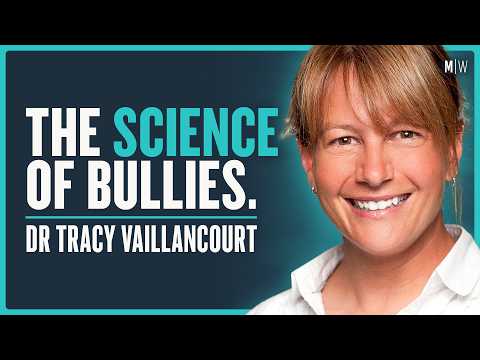
The Science Of Childhood Bullying & Adult Mental Health - Dr Tracy Vaillancourt
Chris Williamson (host), Dr Tracy Vaillancourt (guest)
In this episode of Modern Wisdom, featuring Chris Williamson and Dr Tracy Vaillancourt, The Science Of Childhood Bullying & Adult Mental Health - Dr Tracy Vaillancourt explores how Childhood Bullying Rewires Brains, Shapes Power, And Lasts Lifetimes Dr. Tracy Vaillancourt explains how bullying research has evolved from simple prevalence studies to examining neurobiology, power dynamics, and long‑term outcomes. She distinguishes between everyday aggression and true bullying, emphasizing that bullying is a systematic abuse of power that exploits our fundamental need to belong. High‑status, socially skilled bullies often benefit in life, while victims suffer profound and enduring mental, physical, and academic harms that can last decades. Current school interventions only reduce bullying by about 20%, and even successful reductions can intensify harm for the remaining victims, highlighting the need for power‑focused, context‑wide solutions.
How Childhood Bullying Rewires Brains, Shapes Power, And Lasts Lifetimes
Dr. Tracy Vaillancourt explains how bullying research has evolved from simple prevalence studies to examining neurobiology, power dynamics, and long‑term outcomes. She distinguishes between everyday aggression and true bullying, emphasizing that bullying is a systematic abuse of power that exploits our fundamental need to belong. High‑status, socially skilled bullies often benefit in life, while victims suffer profound and enduring mental, physical, and academic harms that can last decades. Current school interventions only reduce bullying by about 20%, and even successful reductions can intensify harm for the remaining victims, highlighting the need for power‑focused, context‑wide solutions.
Key Takeaways
Bullying is fundamentally about power, not just aggression or ‘bad homes’.
True bullying is repeated aggression in the context of a power imbalance; most bullies are high‑status, attractive, socially skilled kids abusing the power granted by their peers, not just dysregulated ‘Nelson’-type children from chaotic families.
Get the full analysis with uListen AI
High‑status bullies often thrive; the costs fall mostly on victims and society.
Longitudinal data show many bullies grow into successful, socially competent adults with strong dark‑triad traits, while the individuals and environments around them—classrooms, workplaces, relationships—bear the brunt of the damage.
Get the full analysis with uListen AI
Bullying causes lasting biological changes that raise lifelong mental health risk.
Chronic victimization dysregulates the stress system (HPA axis), alters cortisol patterns, and impairs memory; these changes can increase susceptibility to later problems like PTSD, depression, and poor physical health even decades after the bullying stops.
Get the full analysis with uListen AI
Victimization is often cyclical and socially amplified, not a one‑off event.
Around 30% of kids are bullied, 10% ruthlessly and repeatedly; victims can become perpetrators to escape isolation, bullying spreads by contagion within schools, and those bullied in childhood are more likely to face bullying and abuse in adulthood.
Get the full analysis with uListen AI
Current anti‑bullying interventions are modestly effective at best.
Meta‑analyses show only about a 20% reduction in bullying, with popular high‑status bullies largely impervious to programs; whole‑school approaches and bystander‑focused programs help, but gains are limited and fragile.
Get the full analysis with uListen AI
Reducing overall bullying can unintentionally worsen outcomes for the remaining few.
In the ‘healthy context paradox’, when school bullying drops, the small group still targeted often fares worse, likely because they feel uniquely defective and because the same intensity of aggression is concentrated on fewer victims.
Get the full analysis with uListen AI
Simple structural changes—especially adult supervision—powerfully cut bullying.
Bullying clusters where adults aren’t present (hallways, stairwells, playgrounds, bathrooms); during COVID, increased hallway/playground supervision tied to health measures led to an unprecedented ~50% bullying reduction without a formal program.
Get the full analysis with uListen AI
Notable Quotes
“Bullying is a systematic abuse of power.”
— Dr. Tracy Vaillancourt
“These are pretty successful individuals. They’re successful because they have this blend of pro‑social and antisocial.”
— Dr. Tracy Vaillancourt
“It’s a scar that never heals… you can identify somebody who was bullied at 10 and they still have higher mental health rates at 50 and at 60.”
— Dr. Tracy Vaillancourt
“We can get people to not actively bully others, but we can’t get kids to include kids.”
— Dr. Tracy Vaillancourt
“You don’t know what your top performance is. You think it didn’t do anything to you, but there’s going to be a biological component that definitely did.”
— Dr. Tracy Vaillancourt
Questions Answered in This Episode
If high‑status bullies usually prosper, what realistic incentives or constraints could actually change their behavior?
Dr. ...
Get the full analysis with uListen AI
How could schools design long‑term, power‑aware interventions that both reduce bullying and protect the few remaining victims from the ‘healthy context paradox’?
Get the full analysis with uListen AI
What would an effective therapy framework look like for adults trying to undo the biological and cognitive scars of childhood bullying?
Get the full analysis with uListen AI
How can parents who were bullied themselves avoid transmitting their threat‑sensitive worldview and attribution biases to their children?
Get the full analysis with uListen AI
Given that inclusion, not just the absence of bullying, is the real psychological need, what practical steps can schools and peers take to actively foster belonging for isolated kids?
Get the full analysis with uListen AI
Transcript Preview
How did you get interested in studying bullying?
I get asked that question all the time. People wanna think that it was because either I was a bully or I was bullied, but the truth of the matter was, I was just really interested in popularity, and popularity led me to bullying. Because the kids at my high school were the ones who bullied the most. Um, I went ahead and looked at that for my dissertation and found that they were four times more likely to bully others than those who didn't have power, who were not popular, and then it just kind of snowballed from there.
Okay. So how much work is being done in the world of evidence-based bullying intervention, stuff like that?
So the past 25 years we've studied this in earnest. It's been primarily correlational. I mean, it's gonna be hard to do experiments on bullying when you think about it. Um, it's, I mean, it's just not gonna work really. (laughs) But we've looked at it primarily from a correlational point of view. The first thing was just to sort of document the prevalence and the like, and then after that then people looked at, um, individual factors that were associated with it. Dan Olweus kind of led the charge. He's a Swede who, uh, was living in Norway at the time, um, conducted the largest study, uh, at the time, longest- largest longitudinal study, but also intervention study. Um, and then found a 50% reduction, but easy to do in Norway when you have everybody involved. It's a small country. Um, so anyhow, so he looked at, um, what happens to kids who bully as they move forward, so identified boys in grade nine, found that, uh, a large percentage of them were criminally- were involved in, um, the criminal justice system by the time they were age 24. So that was kind of like the first, I think, well conducted study in this area that was bon- beyond just descriptives, although there are, it is still descriptive to some extent. And then, um, some people then focused, um, on the so- sort of like the broader context that it happens in, so like not just at the individual level but what do school-related factors look like? Kids are nested within schools or nested within their families. How do those interrelate? And then my focus was always on the neurobiology of bullying. I was really interested in documenting how it hurt people, not just at that level where it could be easily dismissed where people just say, "Ah, you know, you just need to be more resilient. Suck it up." Um, "Yeah, she's sad but she'll get over it." I wanted to show that no, it, it affects them in a way that's profound and places them at risk for the rest of their lives. So that was kind of like my area of research and since then, um, others have followed. Um, there's not enough of us. I think that we need to be looking at the neurobiology a little bit more carefully. It's a profound psychosocial stressor. And so that's kind of like the evolution of bullying research, and then there's another side group that looks at it from an evolutionary perspective, and I know you had Tony Volk on before and I do that a little bit too with Tony and the like. Um, so, yeah, it's, I think it's, we're getting there.
Install uListen to search the full transcript and get AI-powered insights
Get Full TranscriptGet more from every podcast
AI summaries, searchable transcripts, and fact-checking. Free forever.
Add to Chrome