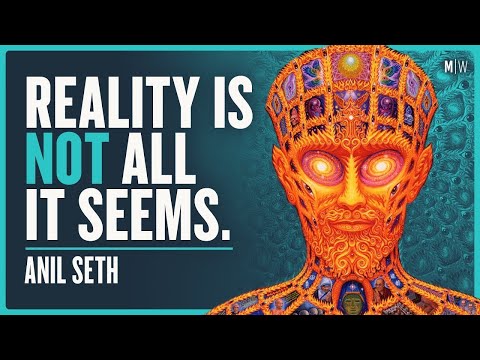
Is Reality Just A Hallucination In The Brain? - Anil Seth
Anil Seth (guest), Chris Williamson (host), Narrator
In this episode of Modern Wisdom, featuring Anil Seth and Chris Williamson, Is Reality Just A Hallucination In The Brain? - Anil Seth explores anil Seth argues reality and self are brain’s controlled hallucinations Anil Seth explains his “real problem of consciousness” approach, which focuses on explaining the features and mechanisms of conscious experience rather than solving the abstract “hard problem” outright.
Anil Seth argues reality and self are brain’s controlled hallucinations
Anil Seth explains his “real problem of consciousness” approach, which focuses on explaining the features and mechanisms of conscious experience rather than solving the abstract “hard problem” outright.
He argues that perception is a form of “controlled hallucination,” where the brain constantly predicts and updates a model of the world and the body to keep an organism alive under uncertainty.
The self, in his view, is not a fixed soul-like entity but a layered, continuously changing process of perceptions about the body, agency, emotion, and personal identity.
Seth discusses implications for animal consciousness, hallucinations, split-brain cases, psychedelics, and emotional life, emphasizing that recognizing the constructed, impermanent nature of experience can be both scientifically accurate and personally helpful.
Key Takeaways
Shift focus from the ‘hard problem’ to explaining specific properties of experience.
Instead of trying to magically bridge matter to subjective feeling in one leap, Seth advocates systematically explaining why different experiences (vision, emotion, self) have the character they do in terms of brain and body mechanisms; progress here may eventually dissolve the hard problem.
Get the full analysis with uListen AI
Perception is best understood as the brain’s prediction machine under uncertainty.
The brain continuously generates predictions about the causes of ambiguous sensory signals and updates them with incoming data; what we experience is the brain’s best guess, not a direct readout of reality, which he labels a ‘controlled hallucination’ constrained by the world.
Get the full analysis with uListen AI
The self is a changing process composed of multiple layers of experience.
Basic bodily existence, emotions, body-as-object, first-person perspective, agency, and narrative identity are distinct but normally integrated layers; they can come apart in illness or experiments, showing the self is constructed and not a single inner ‘thing’ or soul.
Get the full analysis with uListen AI
Biological regulation of the body is a fundamental driver of consciousness.
Seth argues the predictive brain evolved primarily to control and regulate the body (homeostasis), with world- and social-modelling built on top—so emotions and bodily feelings are not add-ons but central to how consciousness and self arise.
Get the full analysis with uListen AI
Studying breakdowns—hallucinations, split brains, brain lesions—reveals how consciousness works normally.
By modeling and comparing specific hallucination types, examining split-brain cases, and seeing which brain structures can be damaged without loss of consciousness, researchers can infer which mechanisms and regions are actually crucial for conscious experience.
Get the full analysis with uListen AI
Consciousness and selfhood likely extend to many non-human animals, especially via pain and body-regulation.
Given shared cortical and subcortical structures and the role of bodily regulation, Seth sees it as highly plausible that all mammals and possibly birds, cephalopods, and some fish are conscious, and that the capacity to suffer is a key ethical threshold.
Get the full analysis with uListen AI
Recognizing the constructed, impermanent nature of self and emotion can be psychologically beneficial.
Seth reports that understanding the self as a provisional, changing process—similar to insights from meditation and Buddhism—has helped him relate more adaptively to depression and emotional flux without denying the felt reality of those experiences.
Get the full analysis with uListen AI
Notable Quotes
“Consciousness exists. We all know what it’s like to have experiences of the world and self.”
— Anil Seth
“My suspicion and belief really is that by making progress on this real problem, then the hard problem will eventually fade away and just dissolve in a puff of philosophical smoke.”
— Anil Seth
“The self is not a thing. It’s a process… an unfolding process that encompasses different kinds of perceptual experience.”
— Anil Seth
“What we experience is not a readout of the sensory signal, but the brain’s predictions about what causes those signals.”
— Anil Seth
“Emotions are real in the same way that colors are real. They don’t exist out there independently of a mind, but they are critical to our mental lives.”
— Anil Seth
Questions Answered in This Episode
If our perception is a controlled hallucination, how should we think about ‘truth’ or objectivity in everyday life and in science?
Anil Seth explains his “real problem of consciousness” approach, which focuses on explaining the features and mechanisms of conscious experience rather than solving the abstract “hard problem” outright.
Get the full analysis with uListen AI
In practical terms, how could seeing the self as a process rather than a thing change how we approach mental health, identity, or personal growth?
He argues that perception is a form of “controlled hallucination,” where the brain constantly predicts and updates a model of the world and the body to keep an organism alive under uncertainty.
Get the full analysis with uListen AI
What would a robust, widely accepted ‘test for consciousness’ in animals, patients, or AI actually look like, and what ethical consequences would it carry?
The self, in his view, is not a fixed soul-like entity but a layered, continuously changing process of perceptions about the body, agency, emotion, and personal identity.
Get the full analysis with uListen AI
If bodily regulation is so central to consciousness, does this limit the kinds of artificial systems that could ever be genuinely conscious?
Seth discusses implications for animal consciousness, hallucinations, split-brain cases, psychedelics, and emotional life, emphasizing that recognizing the constructed, impermanent nature of experience can be both scientifically accurate and personally helpful.
Get the full analysis with uListen AI
How can ordinary people explore perceptual diversity and the constructed nature of experience safely, without relying on psychedelics or extreme interventions?
Get the full analysis with uListen AI
Transcript Preview
Most of us, at one point or another in our lives, have wondered, "Who am I really? Why am I me and not someone else? Where was I before I was born? What will happen after I die? Am I the same person from one year to the next?" These are very personal questions. When we take the self to be not the thing that does the perceiving, but an aspect of this flow of conscious experience that requires explanation itself, then I think we're making progress. (graphics whoosh)
What is the real problem of consciousness?
Ha! I think it's, it's the s- approach to understanding consciousness that I'm taking, and I think a lot of my colleagues also are, whether they know it or not. The real problem is in contrast to the so-called hard problem. The hard problem of consciousness is this problem, which seems very hard, of trying to figure out how in the world something like conscious experience, yeah, felt experience, the redness of red, the sh- the sharpness of pain, how that is generated by or is identical to stuff happening in the world of stuff, in matter, biological stuff. We're made of stuff. It's complicated stuff, but it's still stuff. How does that give rise to conscious experience? That's the hard problem. Now, we can try and solve it head-on, but no one's managed to do that yet. The real problem of consciousness is the w- is, is just say that consciousness exists, some philosophers even would have us doubt that. Consciousness exists. We all know what it's like to have experiences of the world and self. And they're related in intimate ways to the brain and the body, so can we try to explain properties of consciousness, like what experiences feel like, why a visual experience is different from an emotion? Can we explain properties of consciousness in terms of the brain and the body? And I think if we do that, that's addressing the, the real problem, and whether we eventually completely solve the hard problem or not is still up for grabs. But let's see how far we get, and my suspicion and, and belief really is that by making progress on this real problem, then the hard problem will eventually fade away and just dissolve in a puff of philosophical smoke.
What would an explanation of the real problem of consciousness look like? I'm trying to work out what sort of form that could actually take.
It's ... could take many forms, and there m- there are many different forms. They all kind of move us away from what the neuroscience of consciousness started like, which was finding correlations between things happening in our experience and things happening in the brain. For example, a correlation could be your, part of your brain, maybe your frontal cortex, lights up when you consciously see something, but doesn't when you don't. And that's a correlation. It's useful to know, but it's not the whole story. It's not ... We, we ... It doesn't give us a sense of satisfaction, and we all know, intuitively and in other areas, that correlations are not the same thing as explanations or causations. Like, I think there's, there's things like the historical price of cheese in Wisconsin correlates with the divorce rate in France, a thing which is all, you know, fun fact-
Install uListen to search the full transcript and get AI-powered insights
Get Full TranscriptGet more from every podcast
AI summaries, searchable transcripts, and fact-checking. Free forever.
Add to Chrome