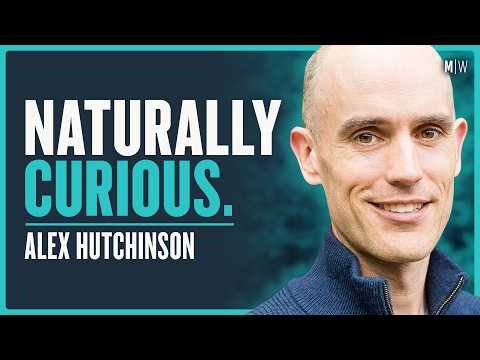
How Adventure Changes Who Are You - Alex Hutchinson
Chris Williamson (host), Alex Hutchinson (guest)
In this episode of Modern Wisdom, featuring Chris Williamson and Alex Hutchinson, How Adventure Changes Who Are You - Alex Hutchinson explores why Exploration, Uncertainty, And Effort Make Life More Meaningful Alex Hutchinson discusses his new book on exploration, examining why humans are drawn to novelty and how this drive is wired into our brains and genetics.
Why Exploration, Uncertainty, And Effort Make Life More Meaningful
Alex Hutchinson discusses his new book on exploration, examining why humans are drawn to novelty and how this drive is wired into our brains and genetics.
He explains the role of dopamine, uncertainty, and effort in making exploration both rewarding and risky—linking these mechanisms to addiction, social media use, and life design.
The conversation covers the explore/exploit dilemma: when to seek new experiences versus when to double down on what already works, and how optimism under uncertainty minimizes long‑term regret.
They also touch on cognitive maps, declining creativity, exercise and brain health, and practical ways to reintroduce adventure and uncertainty into routinized modern lives.
Key Takeaways
Treat novelty as a nutrient, not a constant snack.
Exploration feels good because it historically led to better resources and solutions, but like sugar, novelty can become empty calories (e. ...
Get the full analysis with uListen AI
Respect your ‘explorer wiring’—and channel it productively.
Variants of the DRD4 gene that promote novelty-seeking also correlate with ADHD and risk-taking; in today’s world that urge can fuel addiction or distraction, but it can also be directed toward useful adventures, careers, and learning if you choose the arena carefully.
Get the full analysis with uListen AI
Deliberately operate in the uncertainty ‘sweet spot.’
We’re most engaged when things are neither totally predictable nor utterly chaotic. ...
Get the full analysis with uListen AI
Reframe effort as a feature, not a bug.
From marathons to IKEA furniture, people value things more when they’ve worked hard for them. ...
Get the full analysis with uListen AI
Use ‘optimism under uncertainty’ to guide big decisions.
When choosing between options you can’t fully evaluate, favor the one with the best realistic upside (e. ...
Get the full analysis with uListen AI
Protect and train your cognitive maps by sometimes getting lost.
Relying exclusively on turn-by-turn GPS promotes stimulus–response navigation and may shrink hippocampal engagement, which is linked to dementia risk. ...
Get the full analysis with uListen AI
Don’t outsource all exploration to your younger self.
Creativity scores and disruptive ideas appear to be declining even as IQ rises. ...
Get the full analysis with uListen AI
Notable Quotes
“Exploring feels good because, on an evolutionary level, it led to good things.”
— Alex Hutchinson
“You don’t get a hit of dopamine when something is good; you get it when something is better than expected.”
— Alex Hutchinson
“Habits are the antithesis of exploration.”
— Alex Hutchinson
“Sometimes the harder we have to work at something, the more we like it.”
— Alex Hutchinson
“If there’s nothing in your life where you don’t already know the outcome, you might be missing something.”
— Alex Hutchinson
Questions Answered in This Episode
How can someone who craves control practically introduce more uncertainty without feeling overwhelmed or unsafe?
Alex Hutchinson discusses his new book on exploration, examining why humans are drawn to novelty and how this drive is wired into our brains and genetics.
Get the full analysis with uListen AI
Where in your life have you over-optimized routines to the point that you’ve squeezed out all meaningful exploration?
He explains the role of dopamine, uncertainty, and effort in making exploration both rewarding and risky—linking these mechanisms to addiction, social media use, and life design.
Get the full analysis with uListen AI
How might your use of technology—especially navigation and social media—be shrinking your ‘cognitive maps’ instead of expanding them?
The conversation covers the explore/exploit dilemma: when to seek new experiences versus when to double down on what already works, and how optimism under uncertainty minimizes long‑term regret.
Get the full analysis with uListen AI
What’s one decision you regret that might have turned out differently if you’d applied ‘optimism in the face of uncertainty’?
They also touch on cognitive maps, declining creativity, exercise and brain health, and practical ways to reintroduce adventure and uncertainty into routinized modern lives.
Get the full analysis with uListen AI
Are your hardest current efforts actually aligned with something meaningful, or are you just working hard on the most familiar path?
Get the full analysis with uListen AI
Transcript Preview
... episode 46 to episode s- 916, something like that.
You, you had to do 900 more people before you were ready for-
It's very important.
... for me again.
It's, uh, look, that was the level of tank emptying that I went through just having a straight-up conversation with you. It's really, um, it's great. I was saying before we started, it's really cool to watch the arc of people who you get to collaborate with and how that sort of progresses over time.
Yeah. It's, uh, I mean, e- exactly back at you. I, I, I was thinking, I've been thinking a lot in the days leading up to this interview of like, wow, you know, 2018.
(laughs)
Things were very different for both of us and, and the conversation I had with you in 2018 was such a pleasant surprise, and I- I'm glad to see that, uh, other people thought that your, uh, your interview abilities were, were as good as I did.
Yeah. Well, we'll see if I can, uh, keep you-
No pressure. No pressure.
Well, I- I was gonna say so the pleasant uncertainty today abound, we'll see, we'll see what I can achieve. Um, you've got interested in explorers. Why? What, what, what's interesting about explorers?
Yeah. I mean, what's not interesting about explorers? I, I, (laughs) you know, so where did this book start? I mean, since I was like five years old, I loved the idea of pretending that I was an explorer in the woods discovering things. But really, I think this book started actually around the time we spoke. After my last book came out, uh, I had, I wrote a book about endurance in 2018. And this is not intended as a gratuitous plug for that o- book, but the, the, the book did well, and it was the culmination of about 10 years, let's say, of really focusing in on the science of endurance, really narrowing and narrowing on an ever-decreasing specialty. Um, and it did well enough that I was like, "Hey, cool, I can be the science of endurance guy for the rest of my life. I can coast on, you know, I should start working on Endure 2, you know, Revenge of the Science of Endurance."
(laughs)
And there's a lot of reasons that that would have been a really smart thing to do. But I couldn't shake the feeling that it actually didn't sound that interesting to me, and I, I got interested in my lack of interest. I wondered, "Why, why do I have this pull to do something new?" And it connected with a lot of oth- other areas of my life. Why when I go on vacations do I like to try and get as far away, far off the beaten track as I can? Why am I always pulled to the unknown? And so I decided, actually, I'd kind of like to, to know the answers to those questions. Maybe I'll write about, I'll research that and turn that into my next book.
Install uListen to search the full transcript and get AI-powered insights
Get Full TranscriptGet more from every podcast
AI summaries, searchable transcripts, and fact-checking. Free forever.
Add to Chrome