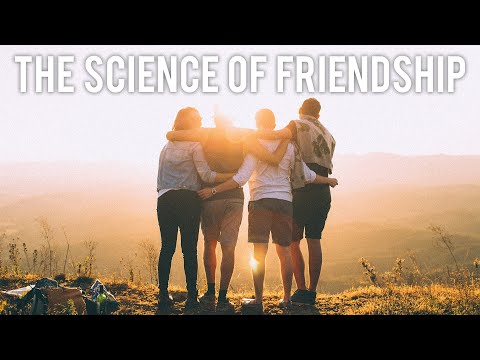
Understanding Friendship | Lydia Denworth | Modern Wisdom Podcast 152
Lydia Denworth (guest), Chris Williamson (host)
In this episode of Modern Wisdom, featuring Lydia Denworth and Chris Williamson, Understanding Friendship | Lydia Denworth | Modern Wisdom Podcast 152 explores why Friendship Matters: Loneliness, Evolution, and Digital Connection Today Lydia Denworth explains friendship as an evolutionarily vital, measurable relationship that is long-lasting, positive, and reciprocal, and argues it is as important for health as diet and exercise.
Why Friendship Matters: Loneliness, Evolution, and Digital Connection Today
Lydia Denworth explains friendship as an evolutionarily vital, measurable relationship that is long-lasting, positive, and reciprocal, and argues it is as important for health as diet and exercise.
She explores how our social brains evolved to manage complex relationships, why quality trumps quantity in friendships, and how loneliness physiologically harms the body.
The conversation debunks alarmist claims about a universal loneliness epidemic while still stressing that chronic loneliness accelerates aging, damages immunity, and undermines mental health.
They also examine digital friendships—especially in the context of COVID-19—concluding that technology can effectively supplement, but never fully replace, in‑person connection.
Key Takeaways
Friendship has three non‑negotiable pillars: longevity, positivity, and reciprocity.
A true friendship is stable over time, makes both people feel good, and involves mutual give-and-take; long histories without positivity or balance can be draining rather than protective.
Get the full analysis with uListen AI
High‑quality friendships are biologically protective and rival diet and exercise in importance.
Supportive social ties improve cardiovascular health, immunity, cognitive function, stress regulation, and even slow cellular aging, dramatically reducing health risks compared to having no close friends.
Get the full analysis with uListen AI
Loneliness is a biological warning signal, not just a mood.
Defined as the gap between desired and actual connection, loneliness triggers physiological stress responses and, if chronic, leads to worse health outcomes; feeling lonely should prompt deliberate efforts to reconnect.
Get the full analysis with uListen AI
You need only a few close friends, but at least one is critical.
The biggest health difference is between zero and one close friend; most people have roughly four core relationships (often a mix of family and friends), and more than six to eight truly close ties is rare.
Get the full analysis with uListen AI
Being a good friend requires intentional effort and showing up.
Actively listening, noticing what’s happening in others’ lives, expressing appreciation, and being there in both crises and celebrations are central; friendships with one-sided emotional labor tend to erode over time.
Get the full analysis with uListen AI
Technology can strengthen existing friendships but shouldn’t replace in‑person contact long term.
Online interaction mirrors offline networks and can deepen bonds when used as an additional channel, especially during crises like COVID-19, yet real-life eye contact and physical presence activate our social brains more fully.
Get the full analysis with uListen AI
Making adult friends is a skill that benefits from strategy and structure.
Joining groups around shared interests, scheduling regular connection (like deep weekly conversations), and sending simple “thinking of you” messages are practical ways to build and maintain meaningful adult friendships.
Get the full analysis with uListen AI
Notable Quotes
“Loneliness is your body's signal that you need to connect, just like thirst and hunger are a signal that you need to eat or drink.”
— Lydia Denworth
“Quality is more important than quantity, and the biggest step change is between zero and one friends.”
— Lydia Denworth
“Friendship really is fundamentally that reciprocal, cooperative part, a willingness to help in times of crisis, especially.”
— Lydia Denworth
“We haven't appreciated enough how hard it is to do [friendship] well, and we haven't been explicit enough that there's effort involved.”
— Lydia Denworth
“I hope this gives people permission to think about friendship as a priority… it's something you get to do.”
— Lydia Denworth
Questions Answered in This Episode
How can someone realistically audit their current friendships using the criteria of longevity, positivity, and reciprocity?
Lydia Denworth explains friendship as an evolutionarily vital, measurable relationship that is long-lasting, positive, and reciprocal, and argues it is as important for health as diet and exercise.
Get the full analysis with uListen AI
What early signs distinguish healthy solitude from harmful loneliness before physical health effects emerge?
She explores how our social brains evolved to manage complex relationships, why quality trumps quantity in friendships, and how loneliness physiologically harms the body.
Get the full analysis with uListen AI
In a post‑pandemic world, how can we deliberately use digital tools without letting them erode our in‑person friendships?
The conversation debunks alarmist claims about a universal loneliness epidemic while still stressing that chronic loneliness accelerates aging, damages immunity, and undermines mental health.
Get the full analysis with uListen AI
What practical steps can adults take if they feel their social skills have atrophied due to chronic loneliness or isolation?
They also examine digital friendships—especially in the context of COVID-19—concluding that technology can effectively supplement, but never fully replace, in‑person connection.
Get the full analysis with uListen AI
How should we navigate and communicate about long-standing friendships that have become ambivalent or emotionally draining?
Get the full analysis with uListen AI
Transcript Preview
Loneliness is your body's signal that you need to connect, just like thirst and hunger are a signal that you need to eat or drink. Um, and so if you're feeling it, you should take that as, you should take that seriously. You should take that as a warning.
(wind blowing) Lydia, has there ever been a better time to be talking about friendship?
It's pretty top of mind these days, isn't it? (laughs) Right now, um, it's critical that we hang out with our friends, that we help, uh, I'm sorry, you know what? I shouldn't be saying that right now. We shouldn't be hanging out. (laughs)
You can't hang out, and that's the problem, right? That's the challenge.
You can't hang out, right. Uh, and so, the, the, but the thing is that our need to connect is a fundamental piece of the fabric of society and of what it is to be human, and so we have to find ways to be with our friends from a distance-
(laughs)
... right now. (laughs) We have to show up from a distance.
Yeah, I suppose that previously, if we'd had a global pandemic at any other time in human history, we wouldn't have had the technology to facilitate this, our, our, um, tech friendship that we're about to have for the next 45 minutes or so, you know? Like...
No, that's right. Uh, you know, and the irony is that so many people are so worried about the effects of technology and digi- and the sort of digital resi- revolution on friendship and on social interaction, but right now, the, the timing is perfect for us to embrace digital friendship and all that it has to offer. And I hope what we do is that from this experience, we take the good and then, you know, we get back to spending some time in real life with people. I mean, that should never go away as being important, but since we can't do that right at this moment, uh, there, we are really fortunate that we have these ways to connect. And in fact, I'm having more Zoom video conferencing with my friends-
Mm-hmm.
... that I've, in fact, I never did that with my friends. I only did it for work, and now everybody wants to have a Zoom conference. It's really kind of hilarious.
Yeah, that's kind of funny, this, uh, proxy for friendship that we've got. So-
Right.
... um, how do you define a friendship?
Well, what's really interesting is that when biologists and neuroscientists and anthropologists really set out to study friendship more seriously recently, one of the things that they were trying to do from the start was define it and, and measure it, you know, figure out what it was exactly, because in science, you have to be able to me- you have to be able to measure. You need definitions. And really, it comes down to a very simple sort of minimal, there are three minimal requirements. A friendship is a relationship that's long-lasting, so it's stable and reliable. It's, you know, somebody you've known awhile. It's positive. It makes you feel good, both of you. And it's reciprocal, so there's cooperation involved. So you have to have give and take, right? It can't just be, it can't be lopsided, let's say. (laughs)
Install uListen to search the full transcript and get AI-powered insights
Get Full TranscriptGet more from every podcast
AI summaries, searchable transcripts, and fact-checking. Free forever.
Add to Chrome