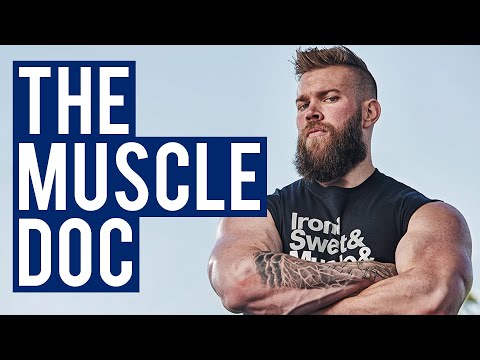
Protecting Your Body & Mind From Your Personality - Jordan Shallow | Modern Wisdom Podcast 267
Jordan Shallow (guest), Chris Williamson (host), Narrator
In this episode of Modern Wisdom, featuring Jordan Shallow and Chris Williamson, Protecting Your Body & Mind From Your Personality - Jordan Shallow | Modern Wisdom Podcast 267 explores from Mental Masturbation To Meaningful Work: Owning Body And Brand Jordan Shallow and Chris Williamson explore the gap between knowledge and execution, arguing that intentional effort and follow‑through matter more than endless optimization or intellectual posturing. They critique social media culture, where avatars outperform actual ability, and warn about the psychological damage of living as a dissonant online persona. Shallow lays out a practical, biomechanics‑driven framework for bulletproofing the body—focusing on shoulder, hip, and spine stability, especially as people return to training post‑lockdown. They close by discussing sustainable high performance in business and life: using metrics, deliberate deloads, and clearer definitions of ‘winning’ to avoid being destroyed by your own work ethic.
From Mental Masturbation To Meaningful Work: Owning Body And Brand
Jordan Shallow and Chris Williamson explore the gap between knowledge and execution, arguing that intentional effort and follow‑through matter more than endless optimization or intellectual posturing. They critique social media culture, where avatars outperform actual ability, and warn about the psychological damage of living as a dissonant online persona. Shallow lays out a practical, biomechanics‑driven framework for bulletproofing the body—focusing on shoulder, hip, and spine stability, especially as people return to training post‑lockdown. They close by discussing sustainable high performance in business and life: using metrics, deliberate deloads, and clearer definitions of ‘winning’ to avoid being destroyed by your own work ethic.
Key Takeaways
Intellectual gain without execution is largely useless.
Shallow argues many people collect information to look smart online but never actually ‘try’; real progress comes from deliberate, sometimes uncomfortable, action toward specific goals.
Get the full analysis with uListen AI
Define your own version of winning in the social media marketplace.
Chasing followers alone can produce fragile, unmonetizable brands; Shallow suggests measuring success by profitability, client retention, and actual value delivered instead of vanity metrics.
Get the full analysis with uListen AI
Avoid building a dissonant online persona that doesn’t match real life.
Living as two different people—your Instagram avatar and your offline self—can lead to anxiety, panic, and identity fracture; only post things that are true to how you actually live, and don’t do anything solely “for the ’Gram.”
Get the full analysis with uListen AI
Reintroduce training after breaks with structured, conservative programming.
Post‑lockdown, many people jump back in too hard; Shallow recommends written programs that respect lost capacity, avoid both huge overload and severe under‑loading, and progress gradually.
Get the full analysis with uListen AI
Build from mobility and stability before chasing strength and power.
For most people, addressing the shoulder, hip, and spine with mobility (range of motion), then stability (capacity to control end ranges), and only then strength/power prevents the majority of injuries.
Get the full analysis with uListen AI
Progress your ‘core’ intelligently across all three planes of motion.
Rather than random ab work, train anti‑flexion/extension, anti‑lateral flexion, and anti‑rotation with scalable progressions (e. ...
Get the full analysis with uListen AI
Use metrics and strategic deloads to make obsession sustainable.
Shallow applies training concepts to work: push as hard as possible until objective data (output, fatigue, quality) show diminishing returns, then deliberately pull back to recover before the next big push.
Get the full analysis with uListen AI
Notable Quotes
“People are just becoming a repository of useless information to prove that they're smart on the internet.”
— Jordan Shallow
“The nice part about the game is you get to define what winning is.”
— Jordan Shallow
“If there's a dissonance between who you are on the internet and who you are in real life, the more that wedge begins to divide, the more trouble you're actually going to be in.”
— Jordan Shallow
“You can't out corrective exercise bad exercise.”
— Jordan Shallow
“To me, there's no such thing as dedication and moderation.”
— Jordan Shallow
Questions Answered in This Episode
How can someone practically audit their own social media presence to see whether their online persona is drifting away from who they actually are?
Jordan Shallow and Chris Williamson explore the gap between knowledge and execution, arguing that intentional effort and follow‑through matter more than endless optimization or intellectual posturing. ...
Get the full analysis with uListen AI
If you’re a coach or PT with limited time and knowledge, what is the simplest starting framework for applying the shoulder–hip–spine model safely with clients?
Get the full analysis with uListen AI
Where is the line between healthy ambition and the self‑destructive “let it kill you” mentality in training and business?
Get the full analysis with uListen AI
How can trainers and knowledge workers build systems that force execution, rather than just more learning and “useless indexing” of information?
Get the full analysis with uListen AI
In a marketplace increasingly dominated by scalable fitness offerings (apps, classes, Peloton), what specific skills or results must a 1‑to‑1 personal trainer deliver to stay relevant and premium?
Get the full analysis with uListen AI
Transcript Preview
... 'cause I've gotten here by just pure grunt work. Like, sure, "Oh, how do you do this?" Well, y- if you go on a plane and you travel around the world for three years, and you live out of a suitcase, and you trash every relationship you've ever had, and you just say yes to every opportunity, you'll be able to do this. So I was like, "Yeah, great. Done that." Now, it's like, okay, how do I get to the next level? It's like, well, now you need to slow down. You're like, "I, I don't know what that means." So, it, it is difficult to have the discipline now from like a lifestyle perspective. To overcome this plateau, I need to express the discipline enough to remove myself from that attitude of like, just keep your head down, don't blink, take a bunch of drugs, and then just work until you can't work anymore, then work some more. So, that's, that's something that's frankly taken more wrestling with mentally than anything else I've ever done because of, you're telling me to not do something.
I saw something on your Insta that I really thought was interesting. "Have you tried trying?"
Yes.
What's that mean?
Uh, it means, especially where I, I operate very much in an academic space, and there's a large push into optimization, and I think a lot of times what we miss is intentionality, and we just actually miss the, the, the follow through and the execution, and actually just trying. So, a lot of people are just becoming a repository of useless information to, to prove that they're smart on the internet. Um, but that's not why I got into this. I got into it to get stronger, and everything I've learned was just to break a certain plateau. And really at the end of the day, I think what separates people who do things and who do things well is how they actually do things. So, people who try when they do shit tend to, just by a consequence of trying, do shit better.
That highlights something I've been thinking about a lot, which is the bridging the gap between insight and execution being where almost all of the gains are to be found.
Yeah, 'cause I mean, you know, I, I work decently close with professional bodybuilders, and you could fill a very large room with things they do poorly or incorrectly. But the one, the one catalyst that seems to set them apart in their sport is that they will just, regardless if, if running through walls is the way to do it, they'll do it more and harder than anyone else. So it's like, it almost creates, you know... Not that the, the intellectual pursuit is, is a moot point, but it's, if at the end of the day, are you trying to be big? Are you trying to be fast? Are you trying to be lean, or are you trying to be smart? 'Cause, you know, rarely do those things co-exist. Not that they can't, and when they can, we can reach something akin to optimization. But, uh, unless you have that, that execution, that voracity in the way you execute, then, then you're really just collecting, collecting, you know, IQ points for no re- I'd rather, I'd rather add two inches to my arm than 10 points to my IQ.
Install uListen to search the full transcript and get AI-powered insights
Get Full TranscriptGet more from every podcast
AI summaries, searchable transcripts, and fact-checking. Free forever.
Add to Chrome