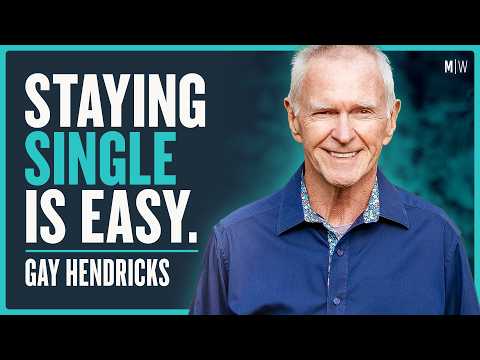
Deeply Connected Relationships - Gay Hendricks
Chris Williamson (host), Gay Hendricks (guest)
In this episode of Modern Wisdom, featuring Chris Williamson and Gay Hendricks, Deeply Connected Relationships - Gay Hendricks explores from Blame To Ownership: Building Truly Conscious, Connected Relationships Together Chris Williamson and Gay Hendricks explore what truly drives relationship quality beneath macro dating trends, evolutionary psychology, and modern culture: how partners actually relate day-to-day. Hendricks distills decades of work with 4,500+ couples into core practices of feeling your feelings, telling the truth, taking full responsibility, and adding generous appreciation. They discuss “10‑second sweaty conversations,” co‑commitment, and moving from victimhood and score‑keeping to 100% personal responsibility on both sides. The conversation emphasizes that deep, lasting love is a learnable skill set based on emotional honesty, timing, non‑defensive listening, and a team mindset rather than competition.
From Blame To Ownership: Building Truly Conscious, Connected Relationships Together
Chris Williamson and Gay Hendricks explore what truly drives relationship quality beneath macro dating trends, evolutionary psychology, and modern culture: how partners actually relate day-to-day. Hendricks distills decades of work with 4,500+ couples into core practices of feeling your feelings, telling the truth, taking full responsibility, and adding generous appreciation. They discuss “10‑second sweaty conversations,” co‑commitment, and moving from victimhood and score‑keeping to 100% personal responsibility on both sides. The conversation emphasizes that deep, lasting love is a learnable skill set based on emotional honesty, timing, non‑defensive listening, and a team mindset rather than competition.
Key Takeaways
Master three core skills: feel your feelings, tell the truth, take responsibility.
Hendricks argues that lasting relationships depend less on theory and more on repeating these three moves thousands of times: noticing your inner state, sharing it honestly, and owning your part instead of blaming.
Get the full analysis with uListen AI
Use ‘10‑second sweaty conversations’ to clear stuck truths.
Brief but scary truth‑telling (e. ...
Get the full analysis with uListen AI
Replace blame with ownership: responsibility is not about fault, it’s about power.
Most couples fight to occupy the victim position; shifting to ‘What am I doing to attract or maintain this? ...
Get the full analysis with uListen AI
Appreciation is an essential complement to honesty and responsibility.
Because most people grow up hearing predominantly negative feedback, deliberate, frequent appreciation of partners (and children) is rarely overdone and radically changes emotional climate and safety.
Get the full analysis with uListen AI
Create explicit agreements and structured check‑ins for feelings and logistics.
Short weekly ‘heart talks’ (feelings) and ‘stuff talks’ (practicalities) plus clear agreements around chores, timing, and commitments prevent tiny breaches from snowballing into chronic resentment.
Get the full analysis with uListen AI
Co‑commitment means two people each taking 100% responsibility, not 50/50.
The cultural ideal of “fair” 50/50 creates competition and score‑keeping; the only stable configuration Hendricks sees is each partner fully owning their inner world, behavior, and contribution to problems.
Get the full analysis with uListen AI
Choose partners for compatibility and growth, not to re‑enact old wounds.
If all your exes share the same flaw, you’re the common denominator; many people unconsciously pick partners who recreate childhood dynamics, instead of consciously choosing someone whose “gaps” complement theirs.
Get the full analysis with uListen AI
Notable Quotes
“There are really three big things you have to do reliably over and over again to have a good relationship: feel your feelings, tell the truth, and take responsibility.”
— Gay Hendricks
“Most couples’ arguments are a race to occupy the victim position.”
— Gay Hendricks
“People would sooner have a lifetime of misery than a few seconds of pain.”
— Chris Williamson
“Your voice box is really the only six inches of sexual apparatus that you need to worry about.”
— Gay Hendricks
“How to be fully yourself and in relationship at the same time—that’s what it’s all about.”
— Gay Hendricks
Questions Answered in This Episode
How can someone who’s never learned to identify their emotions practically start ‘feeling their feelings’ in daily life?
Chris Williamson and Gay Hendricks explore what truly drives relationship quality beneath macro dating trends, evolutionary psychology, and modern culture: how partners actually relate day-to-day. ...
Get the full analysis with uListen AI
What’s a safe, concrete way to initiate a ‘10‑second sweaty conversation’ with a partner who tends to react defensively?
Get the full analysis with uListen AI
How do you distinguish between a real incompatibility and a growth edge that could be transformed within the relationship?
Get the full analysis with uListen AI
What does it look like in practice for both partners to take 100% responsibility without enabling abusive or harmful behavior?
Get the full analysis with uListen AI
How can couples deliberately counteract criticism and score‑keeping with appreciation and co‑commitment, especially in long‑term relationships under stress (kids, careers, etc.)?
Get the full analysis with uListen AI
Transcript Preview
I wanted to explain, actually before we got started, why I'm so interested in this stuff now, and it maybe sort of frames it in the broader context of what I've been interested in over the last sort of three or four years. So, I got kind of interested in mating dynamics, um, probably about four years ago or so, and I started off where lots of people do, which is macro trends, so, uh, rates of coupling, birth rates, uh, sat- levels of satisfaction, uh, what's happening socioeconomically, how many people are single, so on and so forth. It's these sort of big trends, right? It's the big stuff that's happening up top. And as soon as you've found out that, wow, there's some real changes going on here and it seems like we're in a, uh, a- a turbulent time, you then ask, "Okay, well, what are the sort of underlying principles that drive human attraction?" And that led me down the path of evolutionary psychology. So, what are we looking at from a- a- a- an adaptive standpoint? We're looking at hypergamy and mate guarding and jealousy and male parental uncertainty and intrasexual competition and kind of that suite of things, which I guess are kind of some of our psychological source code. And then the next stage that I went on to was, okay, well, modern culture. How is the macro trend and the underlying sort of ancestral programming, how is that... What- what's happening in the modern world, changes that have happened that have sort of led us to some of this- this turbulence maybe occurring? So you're talking about sexual revolution and- and the creation of the pill and dating apps and- and technology and distraction and so on and so forth. And all of that was really interesting, and it kind of starts to form a- a perspective, right, about the world. But what I've sort of... This is my current working theory. I... All of that stuff's very interesting, but every person's actual day-to-day, the mechanism with which they interact with their relationship, is none of those things, right? They are all very highly contributing background noise. The mechanism that everybody's experience of their relationship is mediated through is how they relate. It is the way that they show up. It's their emotional state when there is a disagreement. It's how they communicate with their partner. It's whether they have unspoken expectations and premeditated resentments. So, for all of this stuff, I'm kind of like the worst Sherlock Holmes in history, looking around at all of these different places. "Oh, it's the trends. Oh, it's the ancestral programming. Oh, it might be the sexual revolution and what's happening with dating apps." But ultimately, everybody's experience of their relationship is how they show up, how consciously they are, what the sort of commitments and agreements are that they make. Like, what- what are the nuts and bolts and the- the mechanism through which their entire relationship is mediated? And, um, that has sort of led me to get interested in your work, in, uh, people like Stan Tatkin as well, uh, in an attempt to try and understand the actual mechanism of relating. And I just thought that might be, uh, a- a- an interesting little story arc to give you some- some background and lore to- to me and how I arrived at this stuff.
Install uListen to search the full transcript and get AI-powered insights
Get Full TranscriptGet more from every podcast
AI summaries, searchable transcripts, and fact-checking. Free forever.
Add to Chrome