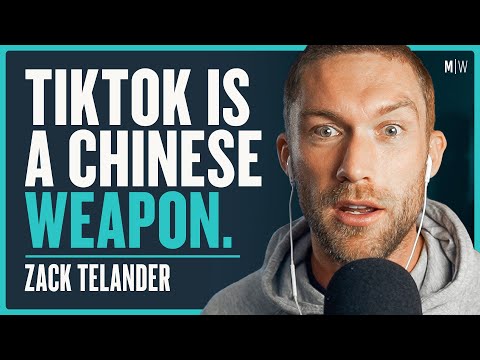
The App That's Reprogramming Your Mind - Zack Telander
Chris Williamson (host), Zack Telander (guest)
In this episode of Modern Wisdom, featuring Chris Williamson and Zack Telander, The App That's Reprogramming Your Mind - Zack Telander explores tikTok, Dopamine Tyranny, and How Apps Quietly Rewire Your Brain Chris Williamson and Zack Telander dissect an article about TikTok as a “pleasure weapon of mass destruction,” arguing that its design and algorithmic power are uniquely damaging to attention, impulse control, and long-term cognitive health. They highlight research linking smartphone addiction to gray matter loss and “digital dementia,” and describe “TikTok brain” as an emerging phenomenon of self-reported mental decline.
TikTok, Dopamine Tyranny, and How Apps Quietly Rewire Your Brain
Chris Williamson and Zack Telander dissect an article about TikTok as a “pleasure weapon of mass destruction,” arguing that its design and algorithmic power are uniquely damaging to attention, impulse control, and long-term cognitive health. They highlight research linking smartphone addiction to gray matter loss and “digital dementia,” and describe “TikTok brain” as an emerging phenomenon of self-reported mental decline.
The conversation broadens into how China’s CCP tightly restricts its home-version app Douyin for kids while exporting TikTok’s most addictive form to the West, framing it as a potential geopolitical weapon that exploits liberal market dynamics. They contrast this with Western debates over regulation, from social media to supplements, AI language models, workplace culture, and speech norms, showing how subtle nudges can reshape behavior and values over time.
They also explore cultural flashpoints—viral gym harassment videos, AI and Grammarly’s ideological bias, big-tech layoffs, absurd legal rulings about “bald” as sexual harassment, and Floyd Mayweather’s exhibition fights—to illustrate how algorithms, institutions, and incentives collectively influence norms, autonomy, and everyday life.
Ultimately, they argue that lasting solutions to digital overconsumption and cognitive erosion must be grassroots and cultural—akin to how public perception turned on cigarettes—rather than relying on authoritarian controls or top-down technocratic fixes.
Key Takeaways
Short-form, hyper-optimized feeds accelerate dopamine addiction and erode focus.
TikTok’s ultra-short videos and full-screen, swipe-only interface maximize rapid reward with minimal effort, training the brain to expect constant novelty and making sustained attention or deep work increasingly difficult.
Get the full analysis with uListen AI
Smartphone addiction is linked to structural brain changes and ‘digital dementia.’
Research cited shows associations between heavy smartphone use and gray matter shrinkage, along with rising anxiety, depression, poor memory, reduced attention span, low self-esteem, and weakened impulse control—creating a feedback loop that deepens addiction.
Get the full analysis with uListen AI
China’s strict controls on Douyin reveal what its creators fear most domestically.
The CCP limits Douyin to educational content for kids, caps use at 40 minutes a day, and bans late-night access, suggesting that while addictive entertainment is exported to the West, it is seen as too corrosive for their own youth.
Get the full analysis with uListen AI
Pleasure can be weaponized as effectively as pain in modern conflict.
The hosts highlight the article’s framing of TikTok as a ‘pleasure weapon of mass destruction’—a tool that neutralizes populations not by inflicting suffering, but by sedating them with endless entertainment until they are politically and cognitively impotent.
Get the full analysis with uListen AI
Algorithmic nudging and AI bias subtly reshape language, norms, and politics.
From TikTok’s content curation to Grammarly flagging words like “guys” and ChatGPT skewing left on political tests, they argue that tools marketed as neutral are in fact steering users’ language and beliefs, often without transparency.
Get the full analysis with uListen AI
Concept creep around harm and harassment can backfire on everyone.
Cases like the viral ‘creepy gym guy’ video (later walked back) and a UK ruling that ‘bald’ can be sexual harassment illustrate how expanding definitions of harm risk trivializing real abuse, increasing general anxiety, and delegitimizing serious claims.
Get the full analysis with uListen AI
Lasting change must come from cultural awareness, not authoritarian fixes.
They reject both Chinese-style control and unregulated dopamine arms races, arguing instead for public education on dopamine, attention, and tech harms—so that apps like TikTok become socially unfashionable and self-limiting, similar to how attitudes shifted toward cigarettes.
Get the full analysis with uListen AI
Notable Quotes
“This is the first pleasure weapon of mass destruction rather than a pain weapon of mass destruction.”
— Chris Williamson (quoting Gwern/Gwinda’s article)
“There’s a substantial body of research showing a strong association between smartphone addiction, shrinkage of the brain’s gray matter, and ‘digital dementia.’”
— Chris Williamson (quoting the article)
“You’ve got a choice between the tyranny of dopamine or the tyranny of the despot.”
— Chris Williamson (quoting the article)
“TikTok could turn the West’s youth into perpetually distracted dopamine junkies ill-equipped to maintain the civilization built by their ancestors.”
— Chris Williamson (paraphrasing/reading from the article)
“Trying to defeat the system by using the system is always going to be a difficult challenge.”
— Chris Williamson
Questions Answered in This Episode
If TikTok and similar apps are effectively ‘dopamine weapons,’ what concrete steps should individuals and parents take today to protect attention and mental health?
Chris Williamson and Zack Telander dissect an article about TikTok as a “pleasure weapon of mass destruction,” arguing that its design and algorithmic power are uniquely damaging to attention, impulse control, and long-term cognitive health. ...
Get the full analysis with uListen AI
How far should liberal democracies go in regulating foreign-owned social platforms without undermining their own commitments to free markets and free speech?
The conversation broadens into how China’s CCP tightly restricts its home-version app Douyin for kids while exporting TikTok’s most addictive form to the West, framing it as a potential geopolitical weapon that exploits liberal market dynamics. ...
Get the full analysis with uListen AI
At what point does algorithmic optimization for engagement become unethical manipulation, and who should decide where that line is?
They also explore cultural flashpoints—viral gym harassment videos, AI and Grammarly’s ideological bias, big-tech layoffs, absurd legal rulings about “bald” as sexual harassment, and Floyd Mayweather’s exhibition fights—to illustrate how algorithms, institutions, and incentives collectively influence norms, autonomy, and everyday life.
Get the full analysis with uListen AI
How can we design AI and language tools that are genuinely neutral—or at least transparently biased—so users can calibrate their trust appropriately?
Ultimately, they argue that lasting solutions to digital overconsumption and cognitive erosion must be grassroots and cultural—akin to how public perception turned on cigarettes—rather than relying on authoritarian controls or top-down technocratic fixes.
Get the full analysis with uListen AI
What cultural narratives or incentives would need to change for society to view compulsive scrolling the way we now view heavy smoking?
Get the full analysis with uListen AI
Transcript Preview
"There's a substantial body of research showing a strong association between smartphone addiction, shrinkage of the brain's gray matter, and 'digital dementia,' an umbrella term for the onset of anxiety and depression and the deterioration of memory, attention span, self-esteem, and impulse control. Crucially, the last of those increases the addiction." It's using, weaponizing, commercializing, and leveraging pleasure to sedate people into the outcomes that it wants. I have a bone to pick with you before we get into today's episode.
Okay.
What's this, for the people that are just, uh, listening?
Zevia. (laughs)
What's, what, how would you describe this? This would be a can of, of Zevia, wouldn't it?
Yeah.
You know what I'm going to say to you, don't you?
I've been drinking those since you've been gone.
(laughs)
(laughs)
For the people that don't know, we live in separate houses on the same plot of land, and I erroneously gave you the access code to my back door. You-
No, in all fairness-
While I've been away-
... you didn't give it to me. Our landlord gave it to us-
Right, okay.
... Christopher.
You've been going into my house, my fridge-
(laughs)
... and you left me one Zevia.
Yeah, yeah, you know, at least I left you one. (laughs)
(laughs) You're a mother- Ah, okay, anyway, uh, getting on. TikTok, one of my very good friends, Gwinda, that's been on the show three or four times, wrote a phenomenal article about TikTok, and I wanna go through it today with you. So, "In a survey asking American and Chinese children what job they most wanted, the top answer among Chinese kids was 'astronaut,' and the top answer among American children was 'influencer.' Since 1970, the Western average IQ has been steadily falling, at least in part due to ease of access to entertainment. So even if you're able to use your brain, the goals that you work toward are more pointless." You're a TikTok user, right?
Yep. Y- yeah, like, uh, it's, uh, the, the article's amazing, and everyone should, should definitely give it a read. Um, but I think one of the, like, there's, there's different sections to this, uh, and I think the top line actually, if I'd, if I'm not mistaken, the most downloaded, the most successful app in history, and the reason it's most successful app in history is because of a multitude of different factors, but a lot of it is like this, um, work to reward ratio, and it's very slanted towards the reward.
That's correct.
The least amount of work you can do, the most dialed in algorithm to feed you as quickly as possible, and, um, that is something that I didn't even know was happening to me when I downloaded TikTok, uh, but I remember one night I stayed up until like 5:30 in the morning, and I was probably on it from 2:00, no, I was probably on it from like midnight to 5:30. And it felt like I didn't even do anything. That was like... And, and then I realized like, "Wait a minute, you can't go to sleep at 5:30 in the morning and be a regular human being." Um, that's strictly because of TikTok, and so then I was able to mitigate that.
Install uListen to search the full transcript and get AI-powered insights
Get Full TranscriptGet more from every podcast
AI summaries, searchable transcripts, and fact-checking. Free forever.
Add to Chrome