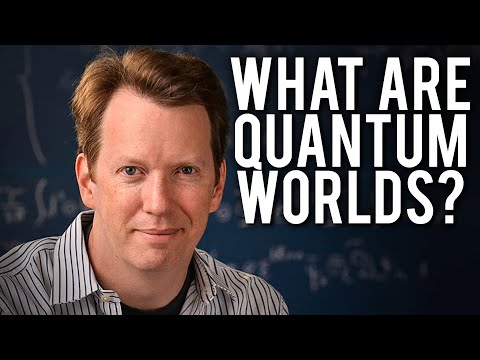
SEAN CARROLL | The Problem With Quantum Mechanics | Modern Wisdom Podcast 126
Sean Carroll (guest), Chris Williamson (host), Narrator, Narrator
In this episode of Modern Wisdom, featuring Sean Carroll and Chris Williamson, SEAN CARROLL | The Problem With Quantum Mechanics | Modern Wisdom Podcast 126 explores sean Carroll Explains Quantum Mechanics, Many Worlds, And Misused Mysticism Sean Carroll discusses why quantum mechanics, despite its success, remains conceptually unfinished, focusing on the long‑ignored measurement problem and the split between quantum and classical descriptions of reality.
Sean Carroll Explains Quantum Mechanics, Many Worlds, And Misused Mysticism
Sean Carroll discusses why quantum mechanics, despite its success, remains conceptually unfinished, focusing on the long‑ignored measurement problem and the split between quantum and classical descriptions of reality.
He explains entanglement, Bell’s theorem, and Hugh Everett’s Many Worlds formulation as a clean way to remove ad‑hoc 'measurement' rules and treat observers as fully quantum systems.
Carroll also describes how historical events, personalities, and academic incentives sidelined foundational work for decades, and how this vacuum helped enable pseudoscientific uses of 'quantum' in spirituality and self‑help.
He outlines his current research goal: starting from a fully quantum description and deriving space, time, gravity, and the classical world, rather than 'quantizing' classical theories after the fact.
Key Takeaways
The measurement problem exposes a fundamental split in quantum theory.
Standard quantum mechanics uses one rule for how systems evolve when unobserved and another rule (collapse) when 'measured,' without clearly defining what counts as a measurement. ...
Get the full analysis with uListen AI
Entanglement and Bell’s theorem force us to accept genuine nonlocality.
Entangled particles share a single joint quantum state such that measuring one instantaneously fixes correlations with the other, even light‑years away. ...
Get the full analysis with uListen AI
Many Worlds removes collapse by treating observers as quantum systems.
Everett’s formulation applies the Schrödinger equation to everything, including observers. ...
Get the full analysis with uListen AI
The classical world should be derived from quantum theory, not assumed.
Physicists usually start from classical models and then 'quantize' them, smuggling in classical notions like definite positions and trajectories. ...
Get the full analysis with uListen AI
Human observers are not special to quantum mechanics.
Modern, serious approaches treat 'observers' as ordinary quantum systems; no consciousness or human presence is required for quantum processes. ...
Get the full analysis with uListen AI
Foundations were neglected for sociological and historical reasons, not solved.
War, the shift to practical projects (like nuclear weapons), dominant personalities (Bohr vs. ...
Get the full analysis with uListen AI
Quantum gravity faces both technical and conceptual obstacles.
Technically, straightforward attempts to quantize general relativity produce infinities that are hard to tame. ...
Get the full analysis with uListen AI
Notable Quotes
“Physicists are extremely good at using quantum mechanics without understanding it.”
— Sean Carroll
“What quantum mechanics needs is getting rid of all these dumb rules about measurement and probability and collapse.”
— Sean Carroll (describing Hugh Everett’s move)
“If they don't make you uncomfortable, you're not doing it right.”
— Sean Carroll, quoting philosopher of physics David Albert on deep physical theories
“Quantum mechanics is true at all scales. You and I are perfectly quantum mechanical.”
— Sean Carroll
“It was just the bad old days when the idea of observers or experiences were thought to be in any way related to quantum mechanics.”
— Sean Carroll
Questions Answered in This Episode
If Many Worlds is conceptually simple but so alien, what concrete evidence or theoretical development would most help convince skeptics that it’s the right way to view quantum mechanics?
Sean Carroll discusses why quantum mechanics, despite its success, remains conceptually unfinished, focusing on the long‑ignored measurement problem and the split between quantum and classical descriptions of reality.
Get the full analysis with uListen AI
How exactly does decoherence carve out the classical world we experience from the universal wavefunction, and what are the limits of that process?
He explains entanglement, Bell’s theorem, and Hugh Everett’s Many Worlds formulation as a clean way to remove ad‑hoc 'measurement' rules and treat observers as fully quantum systems.
Get the full analysis with uListen AI
In a universe where spacetime itself can be in a quantum superposition, how should we even define 'locality' or 'distance' in a fundamental theory?
Carroll also describes how historical events, personalities, and academic incentives sidelined foundational work for decades, and how this vacuum helped enable pseudoscientific uses of 'quantum' in spirituality and self‑help.
Get the full analysis with uListen AI
Could a future, fully quantum theory of gravity and spacetime still leave room for genuine indeterminism, or would it be deterministic like Carroll’s Many Worlds picture?
He outlines his current research goal: starting from a fully quantum description and deriving space, time, gravity, and the classical world, rather than 'quantizing' classical theories after the fact.
Get the full analysis with uListen AI
What practical implications might a better understanding of quantum foundations have for future technologies beyond quantum computing—for example, in communication, metrology, or even our understanding of information itself?
Get the full analysis with uListen AI
Transcript Preview
In the 1920s, you know, Niels Bohr and Albert Einstein or Erwin Schrödinger and Werner Heisenberg could get together in the same room and talk about these things. Ten years later, they're all on different continents, right, or different countries, and they can't travel back and forth. And they didn't have the internet. So just the pace of progress was enormously slowed down. The focus of physicists shifted to very practical things, right? Building bombs and stuff like that. And then even if they did more impractical things like understanding particle physics and quantum field theory and all these other very pressing questions. So quantum mechanics, measurement problem kinds of questions were put on the back burner. And for that matter, it's not clear how to make progress on these questions, right? If you have a question about particle physics, you can take two particles and smash them together and do the experiment and see what happens. Eh, for the interpretations of quantum mechanics, as, as they used to be called, uh, it wasn't clear how you would ever know what the right answer was.
(wind blowing) I'm joined by Sean Carroll, theoretical physicist specializing in quantum mechanics, gravity and cosmology, research professor at the Department of Physics, the California Institute of Technology, and also the man behind the Mindscape podcast. Sean, welcome to the show.
Thanks very much for having me.
Super excited to have you on. Been a little while since we delved into physics on this show, so we're gonna have to get over a little bit of inertia, some audience and my inertia as well. And, uh, we'll, we'll kickstart everything back off again, right?
Inertia's part of physics. That's okay. We understand it.
You are the man. If there was ever a man to get over some inertia-
(laughs)
... it's you right there. Um, before we, before we even start talking about physics, Mindscape podcast that you... It's not been going super long, right? But you've had some insane guests, like Max Tegmark, Seth MacFarlane, the guy, the-
Yeah.
... the Family Guy creator-
(laughs)
... like the voice of Brian and Stewie Griffin. Like, that's insane.
Yeah. Yeah. No, it's been great. It's been like a year and a half. Uh, I've been very, very lucky in people saying it. Not everyone says yes. Um, but, uh, you know, I always wanted to be one, one of the things why I wanted to do the podcast was just so that I could talk to intelligent people about things other than physics. And, uh, I've gotten some, uh, great guests and all over the spectrum. So yeah, it's been fun.
Is that informing the direction of any sort of more writing that you're looking at? Are you p- are you tempted to branch out into anything after having these conversations?
I've always been tempted. You know, I've al- and I always do. So, um, you know, my previous book, The Big Picture, was very broad, a lot of, uh, philosophy, a lot of biology was in there. And my last book was pure physics. So the next book is not gonna be pure physics again. I wanna, you know, keep it, keep it mixing it up.
Install uListen to search the full transcript and get AI-powered insights
Get Full TranscriptGet more from every podcast
AI summaries, searchable transcripts, and fact-checking. Free forever.
Add to Chrome