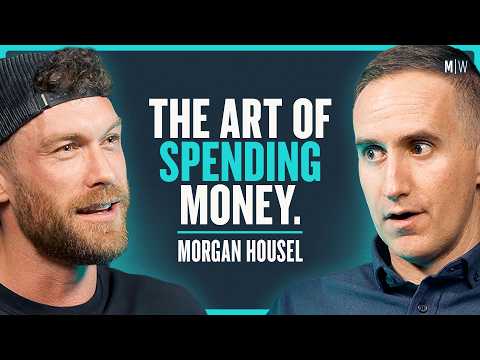
Mastering the Art of Spending Money - Morgan Housel
Chris Williamson (host), Morgan Housel (guest)
In this episode of Modern Wisdom, featuring Chris Williamson and Morgan Housel, Mastering the Art of Spending Money - Morgan Housel explores spending wisely means buying freedom, purpose, and peace—not status displays Morgan Housel argues that money is a “window into who you are,” with spending patterns reflecting ambition, insecurity, identity, and the need to signal—often to ourselves more than to others. He distinguishes being “rich” (visible consumption) from being “wealthy” (control of time and optionality), emphasizing that many high-net-worth people lack true independence and therefore feel trapped.
Spending wisely means buying freedom, purpose, and peace—not status displays
Morgan Housel argues that money is a “window into who you are,” with spending patterns reflecting ambition, insecurity, identity, and the need to signal—often to ourselves more than to others. He distinguishes being “rich” (visible consumption) from being “wealthy” (control of time and optionality), emphasizing that many high-net-worth people lack true independence and therefore feel trapped.
The conversation explores why happiness is fleeting (it’s fueled by surprise) while contentment can be durable, and why social media intensifies status anxiety by expanding our comparison set to a curated global highlight reel. They discuss practical errors at both extremes—reckless spending to impress strangers and fearful hoarding that prevents enjoying a safe retirement.
Housel uses stories (Vanderbilts, entrepreneurship profiles, FIRE retirees, billionaire heirs) to show how expectations, identity, and social incentives shape financial decisions. They close with a generational lens: housing affordability as a core social problem driven largely by zoning constraints, and the case for giving support/inheritance when it’s most useful (often around age 30).
Key Takeaways
Spending habits are autobiographical signals.
Big purchases (cars, homes, lifestyle flexes) often tell a story about wounds, ambition, or self-proof rather than pure enjoyment. ...
Get the full analysis with uListen AI
A big house only helps if it serves relationships or purpose.
Housel argues large homes can increase happiness when they enable connection (hosting friends, supporting a family mission) but often become burdensome trophies with upkeep and unused space.
Get the full analysis with uListen AI
True financial success is independence, not net worth.
Wealth is the ability to control your time and choices—“wake up and do what you want. ...
Get the full analysis with uListen AI
Happiness is fleeting; contentment is trainable mainly via benchmarks.
Happiness comes from surprise and adapts quickly; contentment lasts when you measure life internally (health, relationships, meaningful work) rather than externally (followers, admiration, status symbols).
Get the full analysis with uListen AI
Stop trying to impress strangers—it’s an elite financial advantage.
“Not needing to impress” is framed as a powerful asset because showy spending is a fast path to less money and fragile self-worth; most people aren’t thinking about you anyway.
Get the full analysis with uListen AI
You can’t fully rewire your risk personality—design around it.
Even experts like Kahneman didn’t “outlearn” their biases. ...
Get the full analysis with uListen AI
Housing affordability is a social crisis downstream of zoning.
Housel claims the U. ...
Get the full analysis with uListen AI
Notable Quotes
“The More You Are Snubbed While Poor, The More You Enjoy Displaying Being Rich.”
— Morgan Housel (quoting a 1929 Washington Post headline)
“Wealth without independence is a unique form of poverty.”
— Chris Williamson
“Money serves you best when it stops being the thing you think about.”
— Morgan Housel
“Spending money to show people how much money you have is a fast way to go broke and an expensive way to gain respect.”
— Morgan Housel
“A pretty good life is independence plus purpose.”
— Morgan Housel
Questions Answered in This Episode
You argue many luxury purchases are driven by “wounds” or self-signaling—how can someone distinguish genuine enjoyment from retributive materialism in real time?
Morgan Housel argues that money is a “window into who you are,” with spending patterns reflecting ambition, insecurity, identity, and the need to signal—often to ourselves more than to others. ...
Get the full analysis with uListen AI
On the big-house problem: what’s a practical framework (questions/metrics) for deciding whether a home upgrade is serving relationships vs serving status?
The conversation explores why happiness is fleeting (it’s fueled by surprise) while contentment can be durable, and why social media intensifies status anxiety by expanding our comparison set to a curated global highlight reel. ...
Get the full analysis with uListen AI
You say contentment is hard to train and people should mostly accept their temperament—what specific financial systems best protect “high-risk” personalities from self-sabotage?
Housel uses stories (Vanderbilts, entrepreneurship profiles, FIRE retirees, billionaire heirs) to show how expectations, identity, and social incentives shape financial decisions. ...
Get the full analysis with uListen AI
Your claim that housing is ‘easy to fix’ and mostly zoning-driven is provocative—what are the strongest counterarguments (e.g., labor/material constraints, financing, geography), and how do you respond?
Get the full analysis with uListen AI
If rising home prices don’t create real wealth for most owners, how should governments communicate and restructure incentives so homeowners support building more housing?
Get the full analysis with uListen AI
Transcript Preview
You are my favorite writer.
Thank you.
You have the most insights per word of anybody that's writing stuff at the moment.
Well, thanks. That, that means a lot to me. Thank you.
You could have chosen to write about anything. Why choose to write about spending money?
Well, I'll, I'll, I'll take it back to the start of my career, which was like a lot of young men, particularly in the, in the mid-2000s, uh, the ultimate goal... Before tech really existed, the ultimate goal was be an investment banker on Wall Street. And it's hard to remember that era, 'cause now, if you're a young person at Stanford or whatever, your goal is, like, go work at Google. Go work at, uh, at, at OpenAI. Back then, it was all, "Go work at Goldman Sachs." And so what I- my, my sole kinda life aspiration when I was 20 was to be an investment banker or a hedge fund manager.
Mm.
And I knew I, I loved investing. Even at that age, I used to go to Barnes & Noble and read investing books, and I, I loved it to begin with. I just l- I was fascinated with money. And then I haphazardly got a job as a writer, because I graduated in 2008. The economy was, uh, it was a wreck, and nobody was hiring. No banks were hiring. And so the only finance job that I could find was as a writer for The Motley Fool. Didn't wanna be a writer, hated writing, was embarrassed that I had dreams to be a powerful investment banker, and now I was a journalist? I was like, I, I hated that, but I actually, like, pretty quickly fell in love with it. And what I loved about it was I loved being an outsider who was not being influenced by the incentives of that career. And so if you are a hedge fund manager, you have a lot of incentives and biases based around that. If you are a financial advisor, there's a lot of just... You have to think a certain way to fit into that profession. And I felt like as a writer-- and I'm not a journalist.
Right.
Uh, as a writer, I could just be on the outside looking in. I felt like I was just up in the bleachers looking down and be like, "Let me try to figure out what's going on down there."
Felling abuse of the players on the pitch.
Yes, and then tell a story behind it. And to me, uh, money, I, I think I, I, I got lucky, because money, I, I, I think, has more fascinating social stories in it than almost any other field, where how you spend money and how you save money and your ambitions are such a window into who you are. And of course, there's a lot of other things in life that are more important than money, family and, and purpose and whatnot, but money is a very clear window into who you are. And so that, I, I, I feel like there's just an endless well of interesting stories to tell about it.
Install uListen to search the full transcript and get AI-powered insights
Get Full TranscriptGet more from every podcast
AI summaries, searchable transcripts, and fact-checking. Free forever.
Add to Chrome