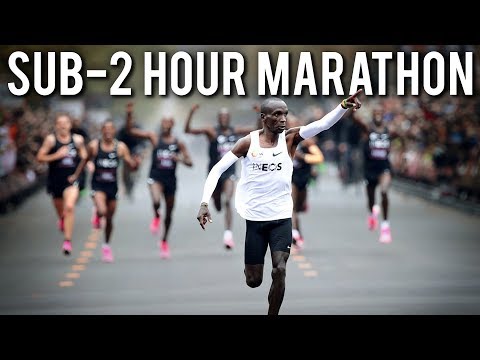
Analysing Eliud Kipchoge’s Sub-2 Hour Marathon | Alex Hutchinson | Modern Wisdom Podcast 113
Chris Williamson (host), Alex Hutchinson (guest)
In this episode of Modern Wisdom, featuring Chris Williamson and Alex Hutchinson, Analysing Eliud Kipchoge’s Sub-2 Hour Marathon | Alex Hutchinson | Modern Wisdom Podcast 113 explores inside Kipchoge’s Sub-Two Marathon: Talent, Tech, Shoes, and Limits Chris Williamson and science journalist Alex Hutchinson break down Eliud Kipchoge’s historic sub-two-hour marathon at the INEOS 1:59 Challenge, emphasizing both his once‑in‑a‑generation physiology and his exceptional mental resilience and lifestyle.
Inside Kipchoge’s Sub-Two Marathon: Talent, Tech, Shoes, and Limits
Chris Williamson and science journalist Alex Hutchinson break down Eliud Kipchoge’s historic sub-two-hour marathon at the INEOS 1:59 Challenge, emphasizing both his once‑in‑a‑generation physiology and his exceptional mental resilience and lifestyle.
They explain the engineered nature of the Vienna event—bespoke course, rotating pacemakers, pace car with lasers, custom nutrition—and why it doesn’t count as an official world record.
A major focus is the disruptive impact of Nike’s Vaporfly and related carbon‑plate shoes on performance, fairness, sponsorship, and record legitimacy, plus how governing bodies might regulate footwear technology.
They also touch on new fueling tech, tactical shifts toward ‘suicide pace’ racing, and what all this says about human limits, risk‑taking, and the future of endurance sport.
Key Takeaways
Genetic gifts plus decades of disciplined work underpin Kipchoge’s achievement.
Hutchinson stresses that no amount of science replaces innate talent and sustained, high‑volume training; Kipchoge is physiologically elite and mentally exceptional, with rare longevity at the top since 2003.
Get the full analysis with uListen
The INEOS 1:59 Challenge was a highly engineered exhibition, not a standard race.
Vienna was chosen after a global search for ideal weather, flatness, and logistics; an electric pace car, laser-guided pacemakers, hand‑delivered bottles, and a controlled crowd all optimized conditions, which is why it’s not ratified as a world record.
Get the full analysis with uListen
Drafting formations and micro‑course design can meaningfully affect marathon speed.
The rotating ‘V’ plus rear pacers were based on wind‑tunnel and fluid‑dynamics modeling to minimize drag, while course curvature and a short opening downhill were quantified in seconds gained or lost to fine‑tune overall pacing.
Get the full analysis with uListen
Nike’s Vaporfly line has materially rewritten distance running performance.
Independent data (e. ...
Get the full analysis with uListen
Unequal access to breakthrough shoes raises serious fairness and sponsorship dilemmas.
Early, hidden use of prototype Nikes at the 2016 Olympics, plus current use of unreleased models by various brands, pits athletes’ desire for performance against contract obligations and exposes weak enforcement of ‘widely available’ shoe rules.
Get the full analysis with uListen
Simple, enforceable equipment rules may be better than tech‑specific bans.
Rather than chasing each new material or plate configuration, Hutchinson favors a maximum sole‑thickness rule (already used in high jump) that caps how radical shoes can become while letting innovation continue within clear bounds.
Get the full analysis with uListen
Aggressive ‘kamikaze’ pacing may be reshaping championship racing culture.
Recent world championships featured unusually fast opening laps instead of cautious sit‑and‑kick tactics; Hutchinson argues that to truly find your limits, you sometimes must risk blowing up, a lesson that applies beyond elite sport.
Get the full analysis with uListen
Notable Quotes
“The first really important task is to pick your parents correctly.”
— Alex Hutchinson
“There’s still only one human in the world who could have done this.”
— Alex Hutchinson
“If you don’t control your mind, your mind controls you.”
— Eliud Kipchoge (as quoted by Alex Hutchinson)
“The moment we reach the point where you can go into a lab, measure ten people, and tell you with 99% certainty who’s going to win a race, that’s the moment sport loses its interest.”
— Alex Hutchinson
“If you really want to find out what your limits are, sometimes you’ve got to exceed them and crash and burn.”
— Alex Hutchinson
Questions Answered in This Episode
Where should governing bodies draw the line between acceptable innovation and unfair mechanical advantage in endurance sports?
Chris Williamson and science journalist Alex Hutchinson break down Eliud Kipchoge’s historic sub-two-hour marathon at the INEOS 1:59 Challenge, emphasizing both his once‑in‑a‑generation physiology and his exceptional mental resilience and lifestyle.
Get the full analysis with uListen AI
If every brand eventually matches Nike’s shoe technology, how should we reinterpret records set in the pre‑Vaporfly era?
They explain the engineered nature of the Vienna event—bespoke course, rotating pacemakers, pace car with lasers, custom nutrition—and why it doesn’t count as an official world record.
Get the full analysis with uListen AI
How much of Kipchoge’s edge is physiological versus psychological, and can ordinary athletes realistically train any of his mental traits?
A major focus is the disruptive impact of Nike’s Vaporfly and related carbon‑plate shoes on performance, fairness, sponsorship, and record legitimacy, plus how governing bodies might regulate footwear technology.
Get the full analysis with uListen AI
Should exhibition events like INEOS 1:59 be more formally integrated into record‑keeping, or kept clearly separate from official competition?
They also touch on new fueling tech, tactical shifts toward ‘suicide pace’ racing, and what all this says about human limits, risk‑taking, and the future of endurance sport.
Get the full analysis with uListen AI
What personal risks—physical, psychological, or reputational—are worth taking if you want to truly discover your own performance limits?
Get the full analysis with uListen AI
Transcript Preview
How does a human with two legs and two arms and a head create a physiology which is capable of running a two-hour marathon?
The first really important task is to pick your parents correctly. You've got to be born to, to, to run that fast. You can work as hard as you want and you can pull in all the science, but the thing we wo- don't want to do is say, "Oh, Kipchoge ran a sub two-hour marathon because there was a bunch of science and it made it easy." It's like, no, there's still only one human in the world who could have done this. There's, you know, all the other great runners in the world, you know, massively talented, have worked hard. They're still not at Kipchoge's level. Kipchoge is a super special guy. He's got the physical tools and, maybe just as importantly or at least p- part of the package is he's got the mental tools. He's been at the top since 2003. He won a world championships as a teenager 16 years ago, and that's unheard of. Nobody has that sort of l- or almost nobody has that sort of longevity.
(wind blowing) Alex Hutchinson has joined us again. Alex, welcome to the show.
Thanks a lot, Chris. It's great to be back.
It is timely to talk about endurance and running. This is the, we're at the, like, the genesis point of the, the new world of running right now, right?
Yeah, it's, it's, uh, it's certainly an exciting time. Put it this way, I, I, I did Canadian radio this morning, I'm talking to you, talking to New Zealand Radio in a few hours, and then Australia a few hours after that. So, people are talking about endurance right now, and hey, I'm, I'm, um, happy to see it.
I bet you are. So for those of you who don't already follow Alex, if you have even the slightest interest in running, @sweatscience on Twitter. Ever since the podcast that we did at the start of the year, I only follow, I think I follow, like, 82 people or something on Twitter. Um, so you make up more than, like, about 2% of probably what, what I see on Twitter every day.
All right. (laughs)
Um, and the articles that you've been putting out recently have been fascinating, so we're gonna go through, um, Eliud Kipchoge's recent, uh, marathon performance. Um, there's some really awesome breakdowns that you've done in the build-up to that and then afterward. Um, then we're gonna talk about some other records that have been broken. There's some, uh, controversy surrounding the shoes and the kit that people have been wearing. So we got, uh, we got a lot to get through today. It's gonna be exciting.
Fantastic. Yeah, it's been a, it's been a busy week, so, uh-
(laughs)
... we'll have lots to talk about.
Install uListen to search the full transcript and get AI-powered insights
Get Full TranscriptGet more from every podcast
AI summaries, searchable transcripts, and fact-checking. Free forever.
Add to Chrome