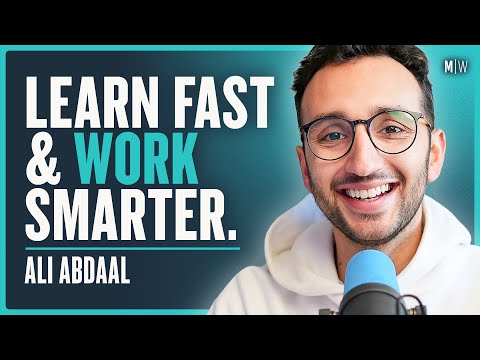
How To Learn & Remember Anything, Fast | Ali Abdaal | Modern Wisdom Podcast 231
Ali Abdaal (guest), Chris Williamson (host), Narrator
In this episode of Modern Wisdom, featuring Ali Abdaal and Chris Williamson, How To Learn & Remember Anything, Fast | Ali Abdaal | Modern Wisdom Podcast 231 explores test, Space, and Interleave: Ali Abdaal’s System for Faster Learning Ali Abdaal explains a science‑backed approach to learning that prioritizes effortful recall over passive review, arguing that testing yourself is the core driver of durable learning. He outlines four main principles: leaning into difficulty, active recall/testing, spaced repetition, and interleaving topics to keep the brain challenged.
Test, Space, and Interleave: Ali Abdaal’s System for Faster Learning
Ali Abdaal explains a science‑backed approach to learning that prioritizes effortful recall over passive review, arguing that testing yourself is the core driver of durable learning. He outlines four main principles: leaning into difficulty, active recall/testing, spaced repetition, and interleaving topics to keep the brain challenged.
The conversation moves from high‑level cognitive science (Make It Stick, Ebbinghaus’ forgetting curve, Range) into very practical systems: question‑based note‑taking, retrospective revision timetables, Pomodoro with friends, and digital tools like Anki and Notion.
They also touch on optimizing the environment and body for study — consistent routines, sleep, basic nutrition, ergonomics, and reducing friction so that good habits (like daily flashcards or filming videos) become easier than avoidance.
Throughout, Abdaal emphasizes treating exams like games to be strategically “gamed,” while still building genuine understanding via bird’s‑eye mind maps (spider diagrams) plus detailed flashcards.
Key Takeaways
Prioritize testing yourself over rereading to actually learn.
Repeated recall (trying to pull information out of your brain) builds memory far better than passive exposure; even a single self‑test after reading beats rereading the same material multiple times or summarizing it.
Get the full analysis with uListen AI
Lean into difficulty; if learning feels hard, it’s working.
Like progressive overload in the gym, cognitive strain is a signal that your brain is forming stronger connections; easy, “fluent” studying usually only builds familiarity, not true understanding.
Get the full analysis with uListen AI
Use spaced repetition to fight the forgetting curve.
Revisit material at increasing intervals (days, then weeks, then months) to slow exponential forgetting and move knowledge into long‑term memory; tools like Anki can automate this schedule.
Get the full analysis with uListen AI
Interleave topics instead of block‑learning a single thing for hours.
Switching between different but related topics just as you feel comfortable keeps the brain slightly off‑balance, increasing learning efficiency compared to doing endless drills of one type of problem.
Get the full analysis with uListen AI
Turn notes into questions; become your own examiner.
Rather than compiling polished notes, continually write questions for your future self (in Notion, Anki, or even Word) and practice answering them without looking, mirroring how you’ll be tested.
Get the full analysis with uListen AI
Replace forward‑planned revision timetables with a ‘retrospective’ one.
Instead of mapping months in advance, maintain a topic list where you record when you last studied each item and how well you know it; each day, pick the topic you’d be “most pissed off” to see on an exam tomorrow and work on that.
Get the full analysis with uListen AI
Reduce friction and optimize your environment to make good work effortless.
Small setup changes — studying in a library, removing distractions, pre‑mounting lights and cameras, using ergonomic chairs, keeping your phone away from bed — drastically lower resistance to starting and sustaining deep work or study.
Get the full analysis with uListen AI
Notable Quotes
“We learn by testing ourselves, we don't learn by reading stuff.”
— Ali Abdaal
“Memorization comes from repeated recall, not repeated exposure.”
— Chris Williamson (summarizing Make It Stick)
“The harder it feels to learn something, the more likely that information is to stick.”
— Ali Abdaal
“Friction is the most powerful force in the universe.”
— Ali Abdaal
“You shouldn't figure out what you're going to do in advance.”
— Ali Abdaal
Questions Answered in This Episode
How could I redesign my current study routine so that testing and recall become the default, rather than rereading and highlighting?
Ali Abdaal explains a science‑backed approach to learning that prioritizes effortful recall over passive review, arguing that testing yourself is the core driver of durable learning. ...
Get the full analysis with uListen AI
What would a practical spaced‑repetition schedule look like for my specific domain (e.g., law, coding, languages) over the next three months?
The conversation moves from high‑level cognitive science (Make It Stick, Ebbinghaus’ forgetting curve, Range) into very practical systems: question‑based note‑taking, retrospective revision timetables, Pomodoro with friends, and digital tools like Anki and Notion.
Get the full analysis with uListen AI
Where does comfort and ‘feeling productive’ mask the fact that I’m not actually learning — and how could I introduce more interleaving and desirable difficulty?
They also touch on optimizing the environment and body for study — consistent routines, sleep, basic nutrition, ergonomics, and reducing friction so that good habits (like daily flashcards or filming videos) become easier than avoidance.
Get the full analysis with uListen AI
If I treated my upcoming exam or qualification like a game to be strategically ‘gamed,’ what data (past papers, patterns, question types) would I start collecting today?
Throughout, Abdaal emphasizes treating exams like games to be strategically “gamed,” while still building genuine understanding via bird’s‑eye mind maps (spider diagrams) plus detailed flashcards.
Get the full analysis with uListen AI
What sources of friction currently stop me from studying or doing deep work (environment, tools, ergonomics, digital distractions), and which one change would give me the biggest return if I fixed it this week?
Get the full analysis with uListen AI
Transcript Preview
This is the single thing that makes the biggest difference in people's results for learning any- anything at all. And that is that we learn by testing ourselves, we don't learn by reading stuff. And this, again, it seem, is- is- is counterintuitive because when you tell people that they- they should test themselves on stuff, they'll say, "Oh, well, I- I have to learn it first and then I can revise it and then I'll test myself for the exam." There's evidence that shows that if you test yourself even before you start learning something, that's gonna improve your learning. If you test yourself immediately after you learn something, that's gonna improve your learning. If the only thing you do after reading something is just test yourself once, that is better than reading the same thing four times or writing a summary of it, or creating a mind map on it. All you have to do is just test yourself.
Ali, welcome to the show.
Thank you very much for having me. I was gonna say, it's always a bit strange to hear a British accent on the end of like, a productivity or like, uh, you know, (laughs) a, just like any kind of podcast 'cause, like, all of the ones I listen to are just so overwh- overwhelmingly American that when I- when I hear a Brit it's like, "Oh, it's one of my boys." (laughs)
These are my people.
Yeah.
This is my people here. Who do you listen to?
Oh, like all of the things I'm sure you do. Uh, started out with Tim Ferriss and then Farnam Street and I've got like 80 on my podcast, uh, library thing, which is, you know, now swelling. Um, I recently started listening to a lot of Dave Asprey as well 'cause I'm trying to get into the whole, like, hacking your health and- and all that stuff. Dabbled with a bit of Peter Attia. These are all, like, white American dudes though, so... (laughs)
(laughs)
Needs a bit of variety in my- in my podcast diet.
Yeah, I get that. I know that we're both mutual friends of Chris Sparks, Tiago Forte. Uh, have you been introduced to Taylor Pearson yet?
Uh, I know of him through his website and stuff, but I haven't spoken to him personally.
Phenomenal writer.
Yeah.
Like absolutely wonderful writer. Um, so today we are gonna be talking about how to learn and remember anything fast. This is right slap bang in your wheelhouse, I think.
Yeah, man. This is like my specialist subject.
(laughs) If he- if he was a-
This is what made my YouTube channel start to take off.
What was it, ma- like Mastermind? Was it-
Oh yeah, do you... Uh, yeah, Mastermind. That, I- I'm not sure if that's still on, but I used to fantasize about going on- on the TV show. And at the time my specialist subject would've been the Harry Potter books.
Install uListen to search the full transcript and get AI-powered insights
Get Full TranscriptGet more from every podcast
AI summaries, searchable transcripts, and fact-checking. Free forever.
Add to Chrome