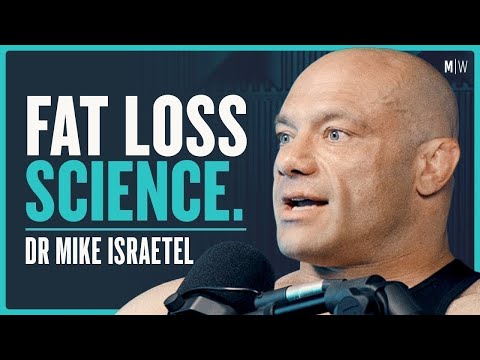
Eating Hacks, Best Foods & High IQ Training Methods - Dr Mike Israetel
Chris Williamson (host), Dr Mike Israetel (guest)
In this episode of Modern Wisdom, featuring Chris Williamson and Dr Mike Israetel, Eating Hacks, Best Foods & High IQ Training Methods - Dr Mike Israetel explores lose 10kg Sane: Science-Based Fat Loss Without Misery Or Myths Dr. Mike Israetel explains the physiology of fat gain and loss, emphasizing that body fat is primarily an evolutionary energy reservoir and that a sustained calorie deficit is the non-negotiable basis of fat loss.
Lose 10kg Sane: Science-Based Fat Loss Without Misery Or Myths
Dr. Mike Israetel explains the physiology of fat gain and loss, emphasizing that body fat is primarily an evolutionary energy reservoir and that a sustained calorie deficit is the non-negotiable basis of fat loss.
He dismantles popular myths about calories, set point theory, seed oils, sugar, meal timing, and “magic” diets, showing that food environment, palatability, and hunger drive are what really push people toward obesity.
The conversation lays out practical guidelines for protein, carbs, fats, step counts, cardio, and weight training so you can lose fat while preserving muscle and sanity, plus how to transition out of a diet without regaining the weight.
They also discuss GLP‑1 and newer anorectic drugs (Ozempic, Tirzepatide, etc.), arguing that pharmacology plus basic diet structure will likely make obesity largely optional for most people in the near future.
Key Takeaways
A calorie deficit is the only reliable way to lose body fat.
All excess energy eventually ends up stored as adipose tissue; when you consistently eat below your maintenance needs, the body is forced to pull energy from fat stores, regardless of diet style, hormones, or food timing.
Get the full analysis with uListen AI
You don’t have to count calories, but they always matter in the background.
Many people lose weight on keto, “clean eating,” or higher-activity phases without tracking because those changes *implicitly* lower intake and/or raise expenditure; if you’re not losing, tracking calories is the most powerful diagnostic tool you can add.
Get the full analysis with uListen AI
Protein is non‑negotiable; carbs and fats are largely interchangeable for fat loss.
Around 0. ...
Get the full analysis with uListen AI
Food choice should prioritize satiety and moderate palatability during a diet.
Minimally processed foods high in volume, water, and fiber (fruits, vegetables, whole grains, lean meats) keep you fuller on fewer calories, while extremely tasty, ultra-processed foods encourage overeating and make hunger feel worse at the same calorie level.
Get the full analysis with uListen AI
Daily movement and resistance training beat trying to out-run a bad diet.
Diet explains far more of weight change than exercise; aiming for roughly 8–10k+ steps per day plus regular lifting burns a meaningful number of calories, protects muscle, and is sustainable, whereas “I’ll just do more cardio” quickly hits fatigue and time limits.
Get the full analysis with uListen AI
To keep lost weight off, you must plan the *post-diet* phase as carefully as the diet.
Hunger and “diet fatigue” persist after the scale goal is reached; transitioning to maintenance calories using the same basic food structure for several weeks, then slowly reintroducing treats, massively reduces rebound weight gain.
Get the full analysis with uListen AI
Modern anorectic drugs make dieting dramatically easier by reducing hunger, not by breaking physics.
GLP‑1-based and newer multi-agonist drugs lower appetite so people spontaneously eat less; they don’t defy energy balance, but they do remove the main barrier—constant hunger—making substantial, sustained fat loss achievable for far more people.
Get the full analysis with uListen AI
Notable Quotes
“Calories are the thing that matters the most in fat loss, writ large, period, end of conversation.”
— Dr. Mike Israetel
“It is no more mandatory to count calories in order to lose fat than it is to count your money in order to become wealthy.”
— Dr. Mike Israetel
“We do not have an inactivity epidemic in the modern world. Sedentariness is not the big problem.”
— Dr. Mike Israetel
“If you think you’re tough and proving your willpower to yourself by losing fat, you’re right, but you’re not getting jacked, you’re not building a business… you’re draining all of your willpower on that one thing.”
— Dr. Mike Israetel
“Abs are made in the kitchen, not the weight room and not on the cardio machine—and it’s fucking true.”
— Dr. Mike Israetel
Questions Answered in This Episode
How can I identify my true maintenance calories without obsessively tracking forever?
Dr. ...
Get the full analysis with uListen AI
Given my personal hunger levels and food preferences, should I prioritize higher-carb or higher-fat diets when cutting?
He dismantles popular myths about calories, set point theory, seed oils, sugar, meal timing, and “magic” diets, showing that food environment, palatability, and hunger drive are what really push people toward obesity.
Get the full analysis with uListen AI
What’s a realistic multi-phase timeline for me to lose 10kg and keep it off using the “diet, then maintain” approach?
The conversation lays out practical guidelines for protein, carbs, fats, step counts, cardio, and weight training so you can lose fat while preserving muscle and sanity, plus how to transition out of a diet without regaining the weight.
Get the full analysis with uListen AI
How do I decide whether to consider a GLP‑1/anorectic medication versus relying solely on diet and training changes?
They also discuss GLP‑1 and newer anorectic drugs (Ozempic, Tirzepatide, etc. ...
Get the full analysis with uListen AI
Which specific food swaps (in my current diet) would most improve satiety without making meals feel joyless?
Get the full analysis with uListen AI
Transcript Preview
Look at how lean you are, lean, tight head.
I think most people when they get lean, they become more attractive. I become less because my grotesquity of my... whatever this is, is more revealed.
Someone commented on our last episode saying that watching Chris and Mike talk to each other is like seeing two alien head races meeting for the first time. I think it was a, a Predator versus Alien reference.
Which way am I?
I'm Predator because of this ledge.
Do you have a ledge?
I have a prominent, I have a prominent brow.
Hm. You could have been a good wrestler. That's good in wrestling-
Yeah, you can stick it in your face.
... rubbing it in people's faces.
Okay. You are Mr. Science Man, Dr. Science Man of exercise and getting jacked. Our last episode was fantastic. Everyone should go and check that out. Today I want to talk about how to lose fat. People can get jacked, but if you're not that lean, getting jacked kind of isn't as good as it could be if you were a bit more lean. So today I want to do one-stop shop, ultimate breakdown, fat loss. What is the fundamental physiology when it comes to fat loss?
So if you download the RP Diet Coach app, it actually makes tiny little app molecules that go into your bloodstream-
(laughs)
... and make you happy and lean.
(laughs)
No, wait, uh, the plug was supposed to be for later.
(laughs)
The fundamental physiology of getting leaner is a question of sort of what is your body fat there to do? And your body fat there is do, is, is there to do a few things for you. It lubricates your joints. It provides some of the architecture to your cell surfaces, et cetera. But adipose tissue is a subcategory of all of your body fat, and it's designed a little bit to protect internal organs and some other things like that. But it's mostly designed as an energy reservoir because in our evolved ancestral timeline, everything up until modernity, food availability was predictably intermittent. Which means you had some food today, maybe a lot of food, maybe the tribe killed a mammoth or something. And if you could only eat what was there and then you got full and then you were like, "Meh," and you kind of buzzed off, then the day after, it's rotting mammoth and you can't eat it anymore. And if you didn't gorge yourself like crazy and have somewhere to put that mammoth stuff, then in the next maybe two weeks that you didn't get a lot of food, some fraction of the people with that particular kind of adaptation that wasn't prone to or physiologically, anatomically able to store excess energy away was just gonna die. And their ancestors would not have and did not reproduce. Which is why all extant humans today have the ability to store adipose tissue as a reservoir for calories, uh, energy that we can use for later because of that predictable intermittency of calorie availability. It's curious that we're talking about how to lose fat. Notice we're not talking about how to gain fat because we're really already super good at that, okay?
Install uListen to search the full transcript and get AI-powered insights
Get Full TranscriptGet more from every podcast
AI summaries, searchable transcripts, and fact-checking. Free forever.
Add to Chrome