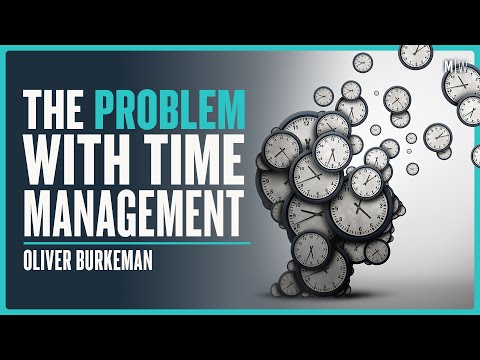
How To Properly Manage Your Time - Oliver Burkeman | Modern Wisdom Podcast 365
Oliver Burkeman (guest), Chris Williamson (host)
In this episode of Modern Wisdom, featuring Oliver Burkeman and Chris Williamson, How To Properly Manage Your Time - Oliver Burkeman | Modern Wisdom Podcast 365 explores stop Chasing Perfect Productivity: Embrace Finitude To Use Time Well Oliver Burkeman argues that most modern time management is a doomed quest for total control over an inherently uncontrollable, finite life. We live as if we can and should do more than is humanly possible, generating chronic overwhelm and the illusion that the right system will finally let us “catch up.”
Stop Chasing Perfect Productivity: Embrace Finitude To Use Time Well
Oliver Burkeman argues that most modern time management is a doomed quest for total control over an inherently uncontrollable, finite life. We live as if we can and should do more than is humanly possible, generating chronic overwhelm and the illusion that the right system will finally let us “catch up.”
Instead, he proposes a kind of active surrender: accept limitation, choose consciously what to neglect, and focus on doing fewer but more meaningful things, one at a time. This shift turns efficiency from an end in itself into a tool in service of what genuinely matters, including real leisure and presence in the moment.
Burkeman and Williamson explore how infinite inputs (email, opportunities, social media, self‑improvement goals) collide with our finite weeks, why leisure has become another form of work, and how rethinking plans, goals, and ‘being busy’ can reduce anxiety and increase fulfillment.
Key Takeaways
You cannot ‘win’ against time, only decide how to lose well.
Treating time as something you can finally dominate produces endless stress and bad decisions; recognizing that time will always ‘win’ lets you stop chasing impossible control and start making deliberate, humane trade-offs.
Get the full analysis with uListen AI
Efficiency without priorities just attracts more low-value work.
Getting faster and more organized in a world of infinite inputs doesn’t create freedom by default; it usually fills your schedule with more emails, requests, and tasks that never passed a meaningful importance filter.
Get the full analysis with uListen AI
Accept that important things will be left undone—by choice.
There will always be more meaningful projects than you can complete, so you must consciously decide which worthy domains to neglect (for now) instead of trying to be excellent at everything and failing everywhere.
Get the full analysis with uListen AI
Limit work-in-progress to focus and finish what matters.
Methods like time-boxing, Kanban-style ‘one big goal per domain,’ or a five-item max to-do list force you to confront trade-offs, reduce task-switching, and move meaningful projects over the finish line.
Get the full analysis with uListen AI
Use time as time, not just as fuel for future outcomes.
When every moment is judged only by what it produces later, you never actually inhabit your life; allowing some time to be intrinsically valuable (rest, play, presence) counters the impulse to turn leisure into self-improvement work.
Get the full analysis with uListen AI
Deliberately choose your ‘hill’ and accept temporary imbalance.
Focusing narrowly on a few domains for a defined period (career, training, parenting) makes you more competitive there and less tormented by guilt elsewhere, because you pre‑decided what would not get your best effort right now.
Get the full analysis with uListen AI
Plans are just thoughts in the present, not guarantees.
Seeing plans as present-moment intentions rather than hooks thrown into a controllable future reduces anxiety when reality deviates, and helps you use planning as a guide instead of a doomed attempt to eliminate uncertainty.
Get the full analysis with uListen AI
Notable Quotes
“You can't win the battle with time. In the end, time is going to win that battle.”
— Oliver Burkeman
“As you get really good at getting things done, you realize you're getting really good at getting the unimportant things done.”
— Oliver Burkeman
“You can't have to do more than you can do.”
— Oliver Burkeman
“The only way to really efficiently care about something in your life is to be okay with not caring about other things.”
— Oliver Burkeman
“You might as well spend your time doing things that matter to you. What have you got to lose, compared to someone who never got to be born?”
— Oliver Burkeman
Questions Answered in This Episode
If I fully accepted that I will never ‘catch up,’ what concrete changes would I make to my schedule this week?
Oliver Burkeman argues that most modern time management is a doomed quest for total control over an inherently uncontrollable, finite life. ...
Get the full analysis with uListen AI
Which genuinely important domains am I willing to fail or underperform in for the next six to twelve months, and which am I choosing to prioritize?
Instead, he proposes a kind of active surrender: accept limitation, choose consciously what to neglect, and focus on doing fewer but more meaningful things, one at a time. ...
Get the full analysis with uListen AI
How is my pursuit of productivity serving as a way to avoid uncomfortable feelings about uncertainty, limitation, or mortality?
Burkeman and Williamson explore how infinite inputs (email, opportunities, social media, self‑improvement goals) collide with our finite weeks, why leisure has become another form of work, and how rethinking plans, goals, and ‘being busy’ can reduce anxiety and increase fulfillment.
Get the full analysis with uListen AI
In what ways have I turned my leisure time into another productivity project, and what would it look like to let leisure be purposeless again?
Get the full analysis with uListen AI
If I limited myself to five active tasks or projects, which would make the cut—and what does that reveal about what actually matters to me?
Get the full analysis with uListen AI
Transcript Preview
As you get really good at getting things done, what tends to happen is that you realize that you're getting really good at getting the unimportant things done, and actually the important things are being pushed back over the horizon just as much as ever. And I think what's going on there is just the more you convince yourself that you can do everything, the less filtering you apply when something comes onto your radar. (wind blows)
Oliver Burkeman, welcome to the show.
Thanks very much for inviting me.
What's the unique challenge with time? Do we actually have time?
It's so weird. I mean, time is, time is fundamentally, I think, like, unlike any other thing, uh, in a million different ways, and probably also a million different ways related to physics that I hope you're not gonna ask me about. But, um, yeah, I mean, one of the things you're, I think, getting at there is like, yes, the very notion that we even have it to be managing or to be making good use of, or to be making poor use of, the very idea that it's even in our possession in the first place seems very flawed when you stop to think about it, because you don't ever really have... uh, you, you don't have, you don't possess next week or the rest of today. You, you expect it, um, but you don't, um, but you don't possess it in a way that you can sort of set it aside for later. Um, we just get one moment, uh, uh, one moment after each moment, and it's the same for everybody. Yeah.
What do most people get wrong about time management, then?
I think the sort of core, uh, mistake that I've certainly spent, you know, many years of my life making and maybe still make to some extent, and that I'm trying to address is, it's this idea that we can ever get into a position of mastery and contr- full control over time, right? So, so we feel like our... the... what you have to do in this situation of being overwhelmed by activities, obligations, tasks, ambitions, is, is to sort of become capable of, uh, meeting all of these, you know, being sort of optimal- optimally productive and capable of, of handling anything that's thrown at you, and also to feel kind of secure with respect to the, the future, to know that your plans are going to come into fruition. And, and I think that that desire to be in control of time, uh, sort of leads us massively astray because it's not possible. And so in trying to do this impossible thing, we end up actually spending time in really suboptimal ways because we're really chasing that feeling of, like, being in the driver's seat-
Is modern-
... uh, and, and, like, wanting to win the battle, right? And you can't win the battle with time. In the end, time is going to win that, that battle.
Install uListen to search the full transcript and get AI-powered insights
Get Full TranscriptGet more from every podcast
AI summaries, searchable transcripts, and fact-checking. Free forever.
Add to Chrome