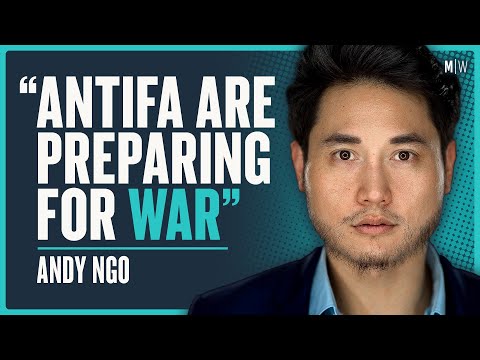
Andy Ngo - Antifa Unmasked: Inside America's Anarchy | Modern Wisdom Podcast 275
Andy Ngo (guest), Chris Williamson (host)
In this episode of Modern Wisdom, featuring Andy Ngo and Chris Williamson, Andy Ngo - Antifa Unmasked: Inside America's Anarchy | Modern Wisdom Podcast 275 explores andy Ngo exposes Antifa’s ideology, tactics, and impact on America Andy Ngo discusses his book "Unmasked" and outlines his view that Antifa is a decentralized network of anarchist-communist groups seeking to destabilize and ultimately abolish the American state, capitalism, and liberal institutions. He argues that 2020’s unrest, especially in Portland and Seattle’s CHAZ, revealed Antifa’s capacity for sustained political violence, organizational sophistication, and propaganda. Ngo criticizes media, Democratic politicians, and progressive prosecutors for normalizing or excusing riots, dropping charges, and reframing property destruction as non-violence. He also describes Antifa’s recruitment pipelines, overlap with BLM, armed escalation, and his own undercover experiences and personal targeting, warning that the underlying conditions for unrest remain unchanged under Biden.
Andy Ngo exposes Antifa’s ideology, tactics, and impact on America
Andy Ngo discusses his book "Unmasked" and outlines his view that Antifa is a decentralized network of anarchist-communist groups seeking to destabilize and ultimately abolish the American state, capitalism, and liberal institutions. He argues that 2020’s unrest, especially in Portland and Seattle’s CHAZ, revealed Antifa’s capacity for sustained political violence, organizational sophistication, and propaganda. Ngo criticizes media, Democratic politicians, and progressive prosecutors for normalizing or excusing riots, dropping charges, and reframing property destruction as non-violence. He also describes Antifa’s recruitment pipelines, overlap with BLM, armed escalation, and his own undercover experiences and personal targeting, warning that the underlying conditions for unrest remain unchanged under Biden.
Key Takeaways
Antifa is framed as anti-fascist but operates as anarchist-communist networks.
Ngo contends that behind the ‘anti-fascist’ branding are decentralized groups motivated by anarchist and communist doctrines, seeking to abolish the US state, borders, capitalism, and core liberal norms like free expression.
Get the full analysis with uListen AI
Sustained riots created embedded militant infrastructures in key cities.
He argues that months-long unrest in Portland and elsewhere allowed Antifa to build logistics, funding channels, recruitment systems, and interstate networks that can now be redeployed in future flashpoints.
Get the full analysis with uListen AI
Weak or sympathetic local governance and prosecutors fuel repeat violence.
Ngo highlights data from Portland showing over 90% of riot-related cases dropped and policies effectively decriminalizing felony rioting, asserting that lack of consequences encourages ongoing political violence.
Get the full analysis with uListen AI
Media narratives and partisan alignment shield Antifa from scrutiny.
He claims legacy media downplayed or mischaracterized riots as protests, adopted Antifa talking points (e. ...
Get the full analysis with uListen AI
Antifa’s recruitment exploits both educated ideologues and vulnerable outsiders.
Ngo describes two main cohorts: highly educated professionals exposed to radical academic theory, and unstable or marginalized individuals seeking belonging and purpose—used as ‘goons’ by more intellectual leaders.
Get the full analysis with uListen AI
Antifa and BLM have strategically converged despite ideological differences.
He argues that Marxist elements within BLM and anarchist-communists in Antifa collaborate tactically against police, property rights, and ‘the system,’ with Antifa often providing black-bloc security and street muscle.
Get the full analysis with uListen AI
Decentralization and armed escalation complicate any future response.
Ngo notes Antifa’s cell-like networks, encrypted communications, and willingness to arm and train with firearms, making traditional law-enforcement approaches harder and raising the risk of intensified left–right confrontation.
Get the full analysis with uListen AI
Notable Quotes
“Antifa claim to be anti-fascists. They're actually anarchist communists who are really working to destabilize governments.”
— Andy Ngo
“What they are really extremely good at is destruction and creating misery. That's all they can really do.”
— Andy Ngo
“The intellectualizing of their arguments tries to mask the ruthlessness of their worldview.”
— Andy Ngo (paraphrased and endorsed by Chris Williamson)
“People whose hatred for Donald Trump and his supporters overshadowed their support and love for their country in standing up for the rule of law.”
— Andy Ngo
“I don't care what Antifa calls themselves. I look at their ideology, I look at their actions... what they do are acts of terrorism.”
— Andy Ngo
Questions Answered in This Episode
How should law enforcement and policymakers distinguish between legitimate protest and organized political violence without suppressing civil liberties?
Andy Ngo discusses his book "Unmasked" and outlines his view that Antifa is a decentralized network of anarchist-communist groups seeking to destabilize and ultimately abolish the American state, capitalism, and liberal institutions. ...
Get the full analysis with uListen AI
What concrete mechanisms could the political left use to clearly disassociate from extremist factions without alienating its activist base?
Get the full analysis with uListen AI
How can media organizations improve coverage of political violence to avoid partisan blind spots and narrative-driven framing?
Get the full analysis with uListen AI
What interventions, if any, could redirect vulnerable recruits away from extremist groups like Antifa toward more constructive forms of activism?
Get the full analysis with uListen AI
Given Antifa’s decentralized, networked structure, what legal or investigative models (e.g., anti-gang or anti-mafia tools) are realistically applicable?
Get the full analysis with uListen AI
Transcript Preview
On many levels, I think there are a lot of Democrats whose hatred for Donald Trump and his administration and his supporters overshadowed their support and love for their country in standing up for the rule of law and standing up for America's institutions.
Was getting people to scream, "Stop selling Andy Ngo's book," in your hometown a part of your marketing strategy? Because it's pretty good free advertising.
Uh, it was not part of the strategy, but, uh, a lot of people did end up hearing about the book because of the six-day effort by Antifa to get it banned, which, uh, unfortunately was partially successful in that Portland's largest bookstore, uh, immediately came out and said they would not stock it on its shelves. Eh, and this is a bookstore, by the way, um, a very popular Portland institution that every year dedicates, um, a week to books that are censored and banned. So, um, there's sad irony there.
Too banned to be part of the unbanned book week?
Correct.
That's serious. But obviously, the elephant in the room is that almost everyone's gonna buy your book from Amazon or Barnes & Nobles or whatever.
Yeah. I hope so. And I, I mean, I'm just, you know, the goal is to get people informed about what's happening. And I think there's a lot of, um, misconceptions about Antifa, Antifa out there from both the left and the right. And, uh, this book tries to explain in, in one place where people can understand, um, the ideology, the history, and how they organize and what, what all that comes together actually looks like in practice. So I go into detail, particularly of what happened in the Pacific Northwest of the United States throughout 2020. Uh, my home city of Portland, which I've had to flee because of death threats against me, we had, um, more than 120 nightly days of violence. So, uh, in your country, Britain, you had sporadic violence that happened, uh, last year. Um, imagine if that was reoccurring day after day after day for months on end, and that's what happened in my city. And it's still ongoing.
(sighs) It's terrifying, man. So let's start. Who are Antifa?
The Antifa claim to be anti-fascists. Uh, they're actually anarchist communists who are really working to destabilize governments, particularly the jurisdictions in the United States, because they want to ultimately overthrow the US. So they take inspiration from historical anarchist communist communes, and they try to carry out these experiments wherever they can. And to do so in America was always a pipe dream for them, given how strong law enforcement institutions are, and the military, et cetera. But in 2020, things just completely was flipped upside down when after George Floyd died, then the, every excuse on the fringe extreme far left to carry out violence was excused in the mainstream left. And it was in that context that Antifa, BLM, for example, in Seattle, uh, the largest city in the Pacific Northwest, they actually claimed sovereign territory, or territory that they said was sovereign, from the United States for more than three weeks. And they actually had the blessing of the city council as well as the mayor. And immediately this, despite what the media was saying, describing it as a block party, summer of love, um, I spent time there a week undercover. I write about that in the book. Um, it devolved, um, within days into an area where there were shootings and people ended up getting killed and murdered there.
Install uListen to search the full transcript and get AI-powered insights
Get Full TranscriptGet more from every podcast
AI summaries, searchable transcripts, and fact-checking. Free forever.
Add to Chrome