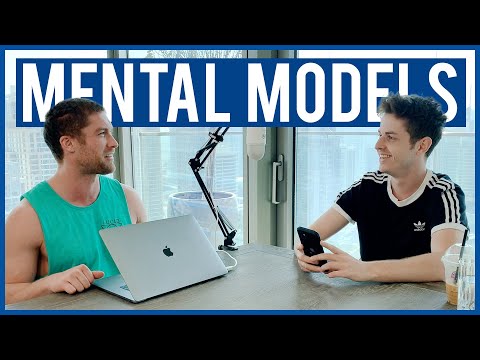
Mental Models 104 - Bear Or Bull? | George Mack | Modern Wisdom Podcast 253
George Mack (guest), Chris Williamson (host), Narrator
In this episode of Modern Wisdom, featuring George Mack and Chris Williamson, Mental Models 104 - Bear Or Bull? | George Mack | Modern Wisdom Podcast 253 explores mental Models, Coca-Cola, Bezos, And Bull-Or-Bear Bets On The Future Chris Williamson and George Mack explore how simple but powerful mental models explain everything from Coca-Cola’s dominance to Bezos’ and Musk’s decision-making. They dive into Charlie Munger’s numeracy-driven analysis of Coke, the importance of basic math in business, and psychological models like conditioning, anchoring, power laws, and opportunity-cost blindness. The conversation then shifts to leverage, delegation, remote work, and how misaligned incentives and overthinking cripple execution. They finish with a rapid-fire “bull or bear” game on elections, Kanye, sex robots, and remote work, using it to surface deeper questions about technology, politics, and society.
Mental Models, Coca-Cola, Bezos, And Bull-Or-Bear Bets On The Future
Chris Williamson and George Mack explore how simple but powerful mental models explain everything from Coca-Cola’s dominance to Bezos’ and Musk’s decision-making. They dive into Charlie Munger’s numeracy-driven analysis of Coke, the importance of basic math in business, and psychological models like conditioning, anchoring, power laws, and opportunity-cost blindness. The conversation then shifts to leverage, delegation, remote work, and how misaligned incentives and overthinking cripple execution. They finish with a rapid-fire “bull or bear” game on elections, Kanye, sex robots, and remote work, using it to surface deeper questions about technology, politics, and society.
Key Takeaways
Use one clear guiding principle to simplify complex decisions.
Bezos runs everything through “does this improve customer experience? ...
Get the full analysis with uListen AI
Numeracy is a superpower—stop hand-waving and start doing the math.
Munger shows you could have ‘designed’ Coca-Cola’s path to trillions just by sizing the market and doing basic arithmetic. ...
Get the full analysis with uListen AI
Exploit conditioning and anchoring in how you design products and offers.
Coca-Cola’s taste, brand, and trademarks are engineered to create only positive associations and near-infinite repeatability. ...
Get the full analysis with uListen AI
Aim for the top 1% in a niche to capture power-law rewards.
Outcomes in many domains (wealth, social media, sport, startups) follow power laws where the top performer earns disproportionately more than those only slightly worse. ...
Get the full analysis with uListen AI
Actively fight opportunity-cost blindness by testing alternative paths.
People see decisions as “this job vs. ...
Get the full analysis with uListen AI
Leverage and delegation free you from low-value tasks you’ve outgrown.
Both hosts admit to clinging to setup work, manual spreadsheets, and minutiae far too long out of anxiety and habit. ...
Get the full analysis with uListen AI
Design incentives so agents think and act like principals.
Employees or agencies with no skin in the game default to minimum-effort behavior, while even tiny equity stakes can unlock founder-level commitment. ...
Get the full analysis with uListen AI
Notable Quotes
“Maths is the only thing that’s probably true when you really think about it.”
— George Mack
“If it can enhance the customer experience, let’s do it.”
— George Mack (on Jeff Bezos’ guiding principle)
“Every decision [for Elon Musk] goes through ‘Will this get me nearer to Mars or not?’”
— George Mack
“Modern numeracy is the modern numeracy… because we very rarely ever think in numbers.”
— George Mack
“You’re being pulled in a million different directions, which comes back to direction over speed—just have a direction before you even think about speed.”
— Chris Williamson
Questions Answered in This Episode
How can an individual practically discover and commit to a single guiding principle for their own life or career, without it feeling contrived?
Chris Williamson and George Mack explore how simple but powerful mental models explain everything from Coca-Cola’s dominance to Bezos’ and Musk’s decision-making. ...
Get the full analysis with uListen AI
In what areas of your current work or business could a simple back-of-the-envelope calculation radically change your strategy or reveal uncomfortable truths?
Get the full analysis with uListen AI
Where are you most guilty of opportunity-cost blindness—staying put because you only see ‘this vs. nothing’ instead of ‘this vs. many better alternatives’?
Get the full analysis with uListen AI
Which parts of your day-to-day workload could be automated, outsourced, or eliminated entirely if you took leverage and your true hourly rate seriously?
Get the full analysis with uListen AI
As remote work and power laws intensify global competition, what unique combination of skills or positioning could realistically put you in the top 1% of a niche?
Get the full analysis with uListen AI
Transcript Preview
What's fascinating about Bezos, he's very similar to Musk in the sense that he has one guiding principle that every decision goes through. So for Bezos, it's just, "If it can enhance the customer experience, let's do it." Rather than, like, profit margin, it's just long-term, long-term, long-term. "Will this enhance the customer experience?" So he says this example of, "10 years from now, will people say to me, 'I want slower deliveries and a higher cost?'" And he's like, "No, no, nobody's ever gonna say that to me. They're always gonna say, 'I love the fact that it arrives next day. I love how cheap it is.' Therefore, I double down on that." And then Elon Musk, for as complex as an individual as he is, as intelligent as he is in how much he understands, every decision goes through, "Will this get me nearer to Mars or not? It's yes or no." And it's very, like, crazy how somebody as complex, sophisticated, and nuanced as that has just one guiding thing that shapes every single decision. At the scale they're at, the, uh, decision you have to make is just, "Will this enhance customer experience, or will this get me nearer to Mars? Yes or no?"
Ladies and gentlemen, welcome back. I am joined all the way from Dubai by the man himself, Mr. George Mack. How are you?
I'm not too bad. I'm not too bad. How are you?
I'm well. How could we not be well on the 25th floor, this beautiful Dubai Marina apartment? There's worse places to do a podcast, isn't there?
Yeah. It's a contrast to Newcastle and Manchester, right? Strong contrast.
Or Skype.
Yeah, and, or Skype, yeah.
The year of Zoom finished up in Dubai. So yeah, not, not bad. Big year, 2020. A lot of stuff's happened. What's some of the main insights that you've realized in 2020?
Oh, it's a good, that's a good question. Um, I was thinking obsessively about remote work and the effect that that has on location. Which, I mean, even the fact-
(laughs)
... that we're here right now is qui- quite a good little A/B test of that. Um-
Yeah.
Proof's in the pudding. But it's gonna be very, very interesting 'cause we were saying, like, "Are you bullish or bearish on people moving," particularly out of the UK, because the UK has very poor weather. Um, and for me at the minute, I've been thinking if I move abroad, what, what would the checklist be, or if I want to work remote? And as long as it has good weather, good time zone, and, like, relatively good economic, social activity, what does the UK have that, that... You know what I mean? Like, the UK, for me, is only viable for a few months of the year, and it's gonna be very interesting to see how many people leave en masse, or if they do leave en masse.
Install uListen to search the full transcript and get AI-powered insights
Get Full TranscriptGet more from every podcast
AI summaries, searchable transcripts, and fact-checking. Free forever.
Add to Chrome