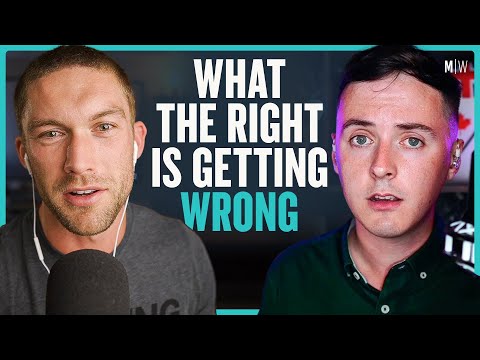
What The Right Is Getting Wrong - Darren Grimes | Modern Wisdom Podcast 361
Darren Grimes (guest), Chris Williamson (host)
In this episode of Modern Wisdom, featuring Darren Grimes and Chris Williamson, What The Right Is Getting Wrong - Darren Grimes | Modern Wisdom Podcast 361 explores darren Grimes On Brexit Backlash, Woke Politics, And ‘Steady’ Conservatism Chris Williamson interviews activist Darren Grimes about his role in the Brexit campaign, the backlash he’s faced, and why he believes young right‑wing voices are treated as illegitimate. Grimes argues that contemporary liberal and left politics have become extreme, paternalistic, and culturally dominant despite weak electoral performance, while conservative ideas are culturally marginalized and hard to ‘sell’ in an attention economy. They discuss environmental policy, trans issues, race and policing, media sensationalism, class snobbery, and the erosion of trust in institutions. Throughout, Grimes frames conservatism as a ‘philosophy of love’ for country, tradition, and ordinary people, contrasted with what he sees as self‑loathing progressivism and middle‑class guilt.
Darren Grimes On Brexit Backlash, Woke Politics, And ‘Steady’ Conservatism
Chris Williamson interviews activist Darren Grimes about his role in the Brexit campaign, the backlash he’s faced, and why he believes young right‑wing voices are treated as illegitimate. Grimes argues that contemporary liberal and left politics have become extreme, paternalistic, and culturally dominant despite weak electoral performance, while conservative ideas are culturally marginalized and hard to ‘sell’ in an attention economy. They discuss environmental policy, trans issues, race and policing, media sensationalism, class snobbery, and the erosion of trust in institutions. Throughout, Grimes frames conservatism as a ‘philosophy of love’ for country, tradition, and ordinary people, contrasted with what he sees as self‑loathing progressivism and middle‑class guilt.
Key Takeaways
Personal identity can intensify political backlash when it defies expectations.
Grimes argues that being gay, working-class, and from the North East makes his pro‑Brexit, conservative stance particularly hated by some progressives who assume people with those identities ‘belong’ to the left.
Get the full analysis with uListen AI
Conservatism struggles to compete in a media landscape that rewards drama and novelty.
He notes that conservative messaging—‘steady on, think again’—is inherently less exciting than radical slogans like ‘resist,’ making it harder to attract attention among young people and on social platforms.
Get the full analysis with uListen AI
Symbolic environmental targets can clash with economic realities for working‑class communities.
Grimes criticizes net‑zero policies that raise energy costs, threaten industrial jobs, and outsource emissions abroad, arguing these are driven more by virtue signaling than practical environmentalism.
Get the full analysis with uListen AI
Nuanced concerns about youth gender medicine and single-sex spaces are easily branded as bigotry.
Citing whistleblowers from the Tavistock clinic and figures like J. ...
Get the full analysis with uListen AI
Media amplification can distort the prevalence and nature of racism and social conflict.
Both speakers suggest that post–Euro 2020 racism coverage fixated on fringe or foreign online abuse and non‑racial vandalism, feeding a narrative of ‘racist Britain’ that doesn’t match many people’s lived experience.
Get the full analysis with uListen AI
Middle‑class guilt can fuel paternalistic, condescending politics that alienate voters.
Grimes contends that well‑educated liberals, especially from elite schools, often feel obliged to ‘fix’ society for others, underestimating working‑class agency and provoking backlash like Brexit and the 2019 Tory landslide.
Get the full analysis with uListen AI
Erosion of trust in legacy media and institutions is accelerating skepticism across the spectrum.
Williamson describes the past 16 months as destroying his default trust in media and political leadership, reinforcing the need for individual skepticism and independent sense‑making.
Get the full analysis with uListen AI
Notable Quotes
“Conservatism is the philosophy of love. It’s saying, ‘I actually quite like what we’ve done here. I want to protect it. I want to nurture it.’”
— Darren Grimes
“If you’re not trusting them to have sex, how can you trust them to change their gender?”
— Chris Williamson
“People like me on the right don’t think the left are evil; we just think they’re mistaken. They think we’re evil scum of the earth.”
— Darren Grimes (paraphrasing Roger Scruton and contrasting with Owen Jones)
“Indifference is the level that everybody should be aiming for with equality. Nobody gives a shit—that’s progress.”
— Chris Williamson
“There are so many problems in the world, and I think most of them are down to middle‑class liberals who feel guilty.”
— Darren Grimes
Questions Answered in This Episode
To what extent is Darren Grimes’ experience of backlash actually representative of how heterodox identities are treated more broadly in politics and media?
Chris Williamson interviews activist Darren Grimes about his role in the Brexit campaign, the backlash he’s faced, and why he believes young right‑wing voices are treated as illegitimate. ...
Get the full analysis with uListen AI
Is conservatism inherently harder to communicate in a social‑media era, or could different leaders and narratives make it ‘sexy’ without abandoning its principles?
Get the full analysis with uListen AI
Where should policymakers draw the line between rapid moral progress (e.g., on climate or gender) and the ‘steady on’ incrementalism Grimes advocates?
Get the full analysis with uListen AI
How can societies meaningfully address real instances of racism, sexism, and transphobia without feeding the kind of divisive, totalizing narratives criticized in this conversation?
Get the full analysis with uListen AI
Are middle‑class liberal elites uniquely paternalistic, or is this a cyclical pattern that simply shifts between different political and cultural groups over time?
Get the full analysis with uListen AI
Transcript Preview
Were I to do a protest right now, I'd stand up with a sign saying, "Steady. Steady on. Steady as she goes. Should we really be doing this? Think again?"
Very exciting.
Very exciting.
Riveting, riveting.
There's hardly anyone on the street that's gonna be like beeping their horn at me, is there? And saying (laughs) , "Well, maybe to get out the way." But not to actually say, "I wanna join this person's movement." And that's a problem conservativism has. (whoosh)
Darran Grimes, welcome to the show.
Thank you very much for having us. I'm dead excited about this one, I must say.
Two northern boys today.
Exactly.
The way it works. #BrexitReality is trending at the moment and people are upset. Is this, is this your fault? Have you done something here?
Do you know what? I don't think it is my fault this time. I can't say I've spent that much time on Twitter today, but I don't think it's me. There, there's always some form of Brexit reality, right? Despite the fact there's a global pandemic sort of wreaking havoc across the globe as we speak, and, uh, supply chains are being through, it's fair to say, a little bit of rough and tumble, that Brexit gets the blame. It's just the way things work on Twitter. It's a cesspit of FB, PE, remain sort of circle-jerkery, I'm afraid, Chris. That's the be all and end all of that.
It feels like you're still kind of one of the big public enemies-
Mm-hmm.
... around the Brexit debacle. I still had my head up my ass when Brexit was happening. I was actually flying back from some foreign country while the vote was going on. I was watching it live 'cause there was nothing else at 4:00 in the morning th- the timezone that I was in. What was your role in this? Why do people have sort of distaste, or some, some circles of Twitter have distaste for you when Brexit comes up?
So I, um, set up a campaign from my bedroom in Brighton. I was at Brighton University at the time, and that was 2015, December of 2015. And I set up a campaign called Believe. And it was a liberal-minded Brexit arguments that was there to cater to a younger audience, which I thought was being sort of a little bit left out of the debate and the argument. I thought there were actually legitimate arguments to make from a classical liberal perspective that simply weren't being made by the, the Vote Leave campaign. So anyway, I set this up, and I had just recently left the Liberal Democrats after that 'cause I thought I, I cannot get away from the fact that this party is unapologetically pro-EU, and I couldn't understand why, frankly. I, I just, I think there are legitimate liberal arguments for leaving the EU. I certainly think in many ways the EU, uh, on the world stage has been pretty damn protectionist and not very internationalist in its outlook. You know, the whole idea of, uh, I remember one advert in particular where they had a, there was a man dressed up in, in Asian garb, uh, uh, and there's this woman who's fending them off, and a sort of man who looks like he's in sort of, I don't know, Saudi ar- aristocrat dress fighting off this EU superwoman. And that was an advert calling, it's basically to try and parrot this idea of the EU as the protector for, of the EU, from, of EU countries, of the EU 28 at the time, from the rest of the world. And I thought, "Hang on a minute. How the hell is that compatible with any of the arguments that, you know, the Lib Dems parrot every two minutes about being inclusive and all the rest of it? If anything, that's exclusive." So I thought about this and I thought, "Well, this is entirely incompatible with everything that I've heard so far." I thought I was a liberal at the time. Uh, I, I'm not, um, but I didn't know that. I was quite sort of in, in my infancy of my political journey at the time, I would say. Um, and anyway, I set up this campaign, and I think it was pretty quick, actually, the, the venom and vitriol. I remember the day after the vote, I'd had precious little sleep. I had been campaigning for the d- official campaign for the last two days, out and about, you know, handing out leaflets and knocking on doors and all the rest of it to try and get out the vote. And I went into the Channel 4 studio the day after, and, uh, I was met by Sarah Morrison, who used to be... She was under Ted Heath, former leader of the Conservative Party, former Prime Minister of this country. She was his vice chairman of the Conservative Party. And I met her and I thought, "This is very exciting, you know, meeting such a, a, a d- a grand character within the Conservative history." And, uh, she was utterly vile. I'm afraid there's no other way of, of putting it. She said, they basically a- across that panel said I am thick, uneducated, I don't know, I didn't know what I was voting for, I, um, clearly have, I guess, betrayed my generation, and that my arguments weren't worth hearing. And that, I think, I'm afraid to say, has been what the last, what, five years now have all been about, which is this sort of contempt for those of us who are conservative-minded, who quite like our country, who quite like our monarch, who quite like our flag, who quite like the fact that we should make decisions in this country and that we, we champion that around the world, that sort of message of being the Mother of Parliaments, that democracy. And yet, all of these things I think just sort of... You're, you're derided as being a complete Neanderthal, you know, an idiot that doesn't know what's good for them. "Let us decide for you. That's what you've been doing all along. That's what you've been voting for. You did that with Blair, you did that with Cameron. You've been doing that for years and years. How dare you think you know what's good for you and your community."
Install uListen to search the full transcript and get AI-powered insights
Get Full TranscriptGet more from every podcast
AI summaries, searchable transcripts, and fact-checking. Free forever.
Add to Chrome