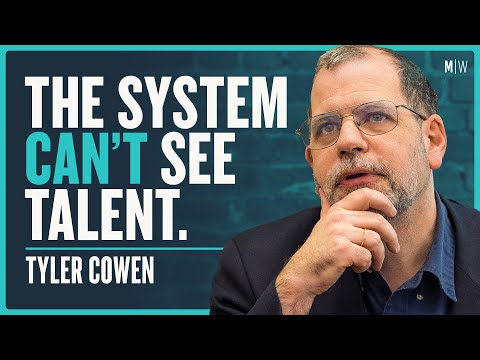
The Secret To Finding Great Talent - Tyler Cowen
Tyler Cowen (guest), Chris Williamson (host)
In this episode of Modern Wisdom, featuring Tyler Cowen and Chris Williamson, The Secret To Finding Great Talent - Tyler Cowen explores tyler Cowen Reveals How We’re Wasting a World Full of Talent Tyler Cowen argues that humanity has more talent than ever, but current systems of education, hiring, and credentialism systematically misallocate it. He critiques bureaucratic HR processes, homework-heavy schooling, and elite admissions that select for conformity over creativity, energy, and genuine ambition. Cowen outlines how to spot and attract high-impact, creative people using unconventional interviews, better sourcing, and movement-building ‘bat signals.’ The conversation also touches on fertility trends, cultural differences in ambition, experimental education, and why charisma, obsessiveness, and values matter so much in building effective organizations.
Tyler Cowen Reveals How We’re Wasting a World Full of Talent
Tyler Cowen argues that humanity has more talent than ever, but current systems of education, hiring, and credentialism systematically misallocate it. He critiques bureaucratic HR processes, homework-heavy schooling, and elite admissions that select for conformity over creativity, energy, and genuine ambition. Cowen outlines how to spot and attract high-impact, creative people using unconventional interviews, better sourcing, and movement-building ‘bat signals.’ The conversation also touches on fertility trends, cultural differences in ambition, experimental education, and why charisma, obsessiveness, and values matter so much in building effective organizations.
Key Takeaways
Most organizations systematically under-identify and misallocate talent.
Cowen argues that credentialism, overemphasis on seniority, and bureaucratic HR processes bias hiring toward conformist, homework-optimized candidates instead of creative, high-variance performers who can be 5–10x more valuable in idea-intensive roles.
Get the full analysis with uListen AI
Redesign interviews to reveal energy, depth, and real thinking.
Standard canned questions elicit rehearsed answers; better is to get candidates into genuine conversation about what they care about (e. ...
Get the full analysis with uListen AI
Sourcing is more critical than selection; make talent come to you.
Great talent strategy is less about the ‘genius in the chair’ choosing and more about building soft networks, scouts, and public ‘bat signals’ (like Peter Thiel’s talks or effective altruism communities) that cause high-potential people to actively seek you out.
Get the full analysis with uListen AI
Optimize for attributes, not just skills and credentials.
Companies tend to hire on visible skills and fire on invisible attributes; Cowen stresses energy, ambition, durability, social cooperation, and good value hierarchies as more predictive of long-run impact than small differences in IQ or formal qualifications once a basic threshold is met.
Get the full analysis with uListen AI
Avoid over-selecting for obedience and conformity in education and admissions.
Homework-heavy school systems and high-stakes elite college applications reward compliant hoop-jumping; Cowen suggests simpler thresholds plus randomization for elite admissions to reduce conformity bias and make room for more ‘John Lennon or Picasso’ types.
Get the full analysis with uListen AI
Toxic high-performers are almost never worth it.
One problematic person can drag down an entire group’s performance and morale; Cowen’s rule is to never hire toxic people for collaborative roles because such traits are very hard to fix and their net impact is usually negative.
Get the full analysis with uListen AI
Practice like an athlete if you want outsized impact.
Cowen notes that top performers (SEALs, stand-up comics, certain economists, creators like Rogan or MrBeast) iterate obsessively, refining answers or material dozens of times; most knowledge workers don’t systematically practice their craft, which keeps their performance plateaued.
Get the full analysis with uListen AI
Notable Quotes
“There is much more talent to tap into than ever before, but in most parts of the world, we are screwing it up.”
— Tyler Cowen
“We’re rewarding homework at every stage of the process, and then we’re shocked when we get too many conformists.”
— Tyler Cowen
“The way to do well at talent is to have talented people looking for you, not you looking for talented people.”
— Tyler Cowen
“Typically, companies hire on skills and fire on attributes.”
— Chris Williamson, summarizing Rich Diviney
“Just talk to them as you would talk to an actual human being. I know that sounds somewhat radical.”
— Tyler Cowen
Questions Answered in This Episode
If most hiring systems reward conformity, how can an individual candidate who is genuinely creative but nonconformist best signal their value without gaming the process?
Tyler Cowen argues that humanity has more talent than ever, but current systems of education, hiring, and credentialism systematically misallocate it. ...
Get the full analysis with uListen AI
What concrete changes could a mid-sized company implement in its HR and interview process within 3–6 months to meaningfully improve its ability to identify 5–10x performers?
Get the full analysis with uListen AI
How might a randomized component in elite university admissions practically work, and what unintended consequences might it create for both students and institutions?
Get the full analysis with uListen AI
In what ways can leaders cultivate a ‘bat signal’ like Peter Thiel or effective altruism if they don’t naturally have strong public profiles or charisma?
Get the full analysis with uListen AI
Given Cowen’s emphasis on attributes like ambition, obsessiveness, and values, how should young people deliberately develop these traits without burning out or becoming narrowly competitive?
Get the full analysis with uListen AI
Transcript Preview
There is much more talent to tap into than ever before, but in most parts of the world, we are screwing it up. So we require too much seniority for too many different jobs. There is too much credentialism. Our school feeder systems rely too much on homework, and this discriminates against rebellious people. And just in general, we're too slothful and bureaucratized when it comes to choosing talent. (airplane wind noise)
Tyler Cowen, welcome to the show.
Happy to be here.
I've just read a blog post from Mike Solana at PirateWires talking about population collapse. Have you read this one yet?
Uh, no, I have not, but I- I think I've heard that kind of argument before.
So he's got this great, uh, idea. I'm big into existential risk, have been for a long time, and he makes a really interesting argument about the great filter, Robin Hanson's thing, he says, "From this perspective, Elon's efforts are an obvious attempt to eliminate potential filters that threaten a blossoming civilization, like runaway climate change, nefarious artificial intelligence, or being stuck on Earth during a cataclysmic event. But among our greatest existential threats, population collapse is unique in that it lacks a noticeable immediate pain for us to rally against. There are no wildfires or smog-filled skies to capture the imagination of our journalists or filmmakers, thus inspiring no individual action. It is precisely because of this attention void that I believe we encounter the true great filter." What do you think about that?
I'm much more optimistic than Mike is. We have at least two countries, France and, and England, if you consider that a country, where fertility has returned to replacement levels. Now, that may or may not last, but I find that very encouraging, that it's possible. I think also we will have new technologies that lower the costs of raising children, and just theoretically, there are gains from trade from having more kids. Now the question is, can people selfishly capture the gains from more children? But I'm convinced that over time, especially if nation-states truly start to shrink, become vulnerable to foreign exploitation and capture, that we will find ways to get population numbers back up again. So people freaked out about this in the 1920s. It turned out they were wrong. Eventually, they'll be wrong again.
Well-
Maybe not in Singapore, but for the world as a whole.
(laughs) What do you think has caused that at least population slow?
There are things to do that are more fun than having kids. And then you have a number of cultures, uh, South Korea and Italy would be two examples, where the men just don't help out that much on raising the children. So women think, "Well, I would like to have a child. One is enough," and they stop. It's a real problem, I agree. But ultimately, we know the technology, unlike with some of these other problems, right? The technology is fun, and we will fix it.
Install uListen to search the full transcript and get AI-powered insights
Get Full TranscriptGet more from every podcast
AI summaries, searchable transcripts, and fact-checking. Free forever.
Add to Chrome