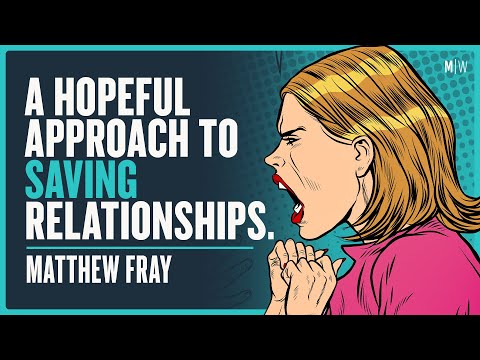
How To Avoid Destroying Your Relationship - Matthew Fray
Matthew Fray (guest), Chris Williamson (host)
In this episode of Modern Wisdom, featuring Matthew Fray and Chris Williamson, How To Avoid Destroying Your Relationship - Matthew Fray explores tiny betrayals, eroded trust: why good people become bad partners Matthew Fray unpacks how his divorce led him to realize that most relationships don’t end from dramatic betrayals, but from thousands of small moments of invalidation and disregard—“paper cuts” that quietly destroy trust.
Tiny betrayals, eroded trust: why good people become bad partners
Matthew Fray unpacks how his divorce led him to realize that most relationships don’t end from dramatic betrayals, but from thousands of small moments of invalidation and disregard—“paper cuts” that quietly destroy trust.
He argues that trust, defined as reliability and emotional safety, is more important than love for a relationship’s longevity, and that ordinary conflicts over dishes, laundry, or tone often symbolize deeper disrespect.
Much of the conversation focuses on men in heteronormative relationships, how “good guys” can still be bad spouses through defensiveness and minimization, and why taking responsibility for a partner’s emotional reality is crucial.
Chris Williamson and Fray also explore modern dating pessimism, the manosphere’s blame narratives, and the importance of hopeful, intentional relationship skills as learnable principles rather than mysterious charisma.
Key Takeaways
Trust outranks love in keeping relationships intact.
People frequently end relationships with partners they still love because they no longer trust the relationship to be safe, sustainable, or emotionally reliable; trust is about predictability and feeling prioritized, not just honesty or fidelity.
Get the full analysis with uListen AI
Small, repeated dismissals act like paper cuts that destroy connection.
Conflicts over a glass by the sink or laundry aren’t about the object itself but about the message: “My comfort and view matter more than your feelings. ...
Get the full analysis with uListen AI
Invalidation—especially through defensiveness—is a primary relationship killer.
Fray’s “invalidation triple threat” is: correcting your partner’s memory of events, correcting their feelings, or defending your intentions. ...
Get the full analysis with uListen AI
You don’t have to agree to validate; you must respond to the pain.
Using the “monster under the bed” analogy, Fray shows that the goal is not to prove whether the monster exists but to comfort the scared child. ...
Get the full analysis with uListen AI
Good people can still be bad spouses if they ignore impact.
Many men feel blindsided because they worked, provided, and never cheated, yet missed that their everyday habits and defensive reactions were hurting their partners. ...
Get the full analysis with uListen AI
Take radical responsibility for partner selection and your role in outcomes.
Fray rejects victim-only narratives (from the manosphere or elsewhere) and argues that choosing who you date and marry—and how you show up—are controllable levers. ...
Get the full analysis with uListen AI
Optimize life for peace and sanity, not just peaks and victories.
The agony of sleepless nights, obsessive rumination, and post-divorce emptiness shows that no amount of money or status can buy back sanity. ...
Get the full analysis with uListen AI
Notable Quotes
“I believe trust usurps love. If you had to rank the conditions that need to exist for relationships to thrive, I just think trust ranks number one.”
— Matthew Fray
“The dish communicates, ‘I’m going to choose me over you every time our experiences don’t align.’”
— Matthew Fray
“Even good people can be bad spouses.”
— Matthew Fray
“You can’t fix this feeling problem with things logic.”
— Chris Williamson
“I’m adamant that almost everybody is one or two principles away from a radically different life.”
— Chris Williamson
Questions Answered in This Episode
In your own relationships, what are the ‘dish by the sink’ behaviors that might secretly be signaling, “I choose me over you,” and how could you change them?
Matthew Fray unpacks how his divorce led him to realize that most relationships don’t end from dramatic betrayals, but from thousands of small moments of invalidation and disregard—“paper cuts” that quietly destroy trust.
Get the full analysis with uListen AI
How might your instinctive response when someone says, “That hurt me,” fit into Fray’s ‘invalidation triple threat,’ and what alternative script could you practice instead?
He argues that trust, defined as reliability and emotional safety, is more important than love for a relationship’s longevity, and that ordinary conflicts over dishes, laundry, or tone often symbolize deeper disrespect.
Get the full analysis with uListen AI
If trust, not love, is the top condition for lasting relationships, what concrete habits would you need to build (or drop) to become more trustable?
Much of the conversation focuses on men in heteronormative relationships, how “good guys” can still be bad spouses through defensiveness and minimization, and why taking responsibility for a partner’s emotional reality is crucial.
Get the full analysis with uListen AI
Where might you be holding a victim narrative—about exes, the dating market, or gender—and what personal responsibility in partner selection or behavior are you avoiding?
Chris Williamson and Fray also explore modern dating pessimism, the manosphere’s blame narratives, and the importance of hopeful, intentional relationship skills as learnable principles rather than mysterious charisma.
Get the full analysis with uListen AI
What would it look like to optimize your life for peace and sanity in your intimate relationships, even if that means forgoing some short-term ego gratifications or comforts?
Get the full analysis with uListen AI
Transcript Preview
I believe trust usurps love, that it ranks higher. If you had to, like, rank the conditions that need to exist for relationships to thrive, to survive, to last, I just think trust ranks number one. I think people routinely end relationships with people they love all of the time. (wind blows)
Matthew Frey, welcome to the show.
Hey, thank you so much. I'm really happy to be here. Appreciate your time.
How did you end up being here talking about divorce?
In 2013, my marriage ended, and I don't want to say that I didn't see it coming because there was an 18-month lead up to it where it was sort of like a slow decay and it was pretty awful and we were in different bedrooms. But there still was nothing that had prepared me for the experience of my wife literally, like, moving out, packing a suitcase, taking our little boy... I always want to make sure that people don't imagine, like, an angry woman kidnapping our child. She very peacefully an- and- and promising me that I'd see him tomorrow or the next day, you know, drove and said, "I'm going to be at my mom's." Th- that's what it was. I don't want to make it seem like she was a kidnap- kidnapping our son. But- but she left and it was brutal and I had a really difficult time with it. We'd been together for 12 years, married for nine of them, and I- I was 34 at the time, just about, and I don't know. I- I never had, like, a frame of reference for anything that sucked that bad before, that was that sort of awful. And that was it. It was- it was my personal crisis. The... Everybody can only know what they know, everybody can only have experienced whatever, um, adversity or pain that they've experienced. And I don't want to make excuses for my relatively non-resilient, fragile life up to that point, but it was simply the most difficult thing I'd encountered. I- I hated it and I had to get to work on figuring out what I'd done to contribute to it. I needed to selfishly protect my future self from having this happen again, and in that process, I believe I sort of evolved and came to some valuable insights and conclusions about ways in which I had a lot more power and influence in my relationship than I believed on the day she drove away, where I felt like a victim and I- I don't feel like a victim anymore.
It's interesting that you talk about the exit being, uh, unceremonial, unspectacular, you know? It wa- it- there- there wasn't... It wasn't a, someone threw a glass and then she stormed out and this, that and the other. And I think you mentioned about how you think most relationships end with a whimper rather than a bang.
Yeah, I think that there is... I mean, I don't, again, I don't like to try to speak for everybody. I'll speak for me and trust that lots of people also thought and felt this way. Growing up when marriages ended and I heard about it, I always assumed somebody had done something sort of overtly horrible, sexual infidelity, physical abuse, a crime, you know, just major deceit. Something- something really bad that we would all, like, sit around a table and agree, man, they definitely should have ended their marriage because of that awful thing that person did. And what I've come to believe in my work and in my personal life is that- that the great majority of relationships do not end that way, that they end from things that people want to fight about whether they should end over them. And those are conversations around somebody leaving a dish by the sink or a piece of laundry on the bedroom floor or the state of the- the bathroom when somebody walks into it, you know, after somebody got ready and brushed their teeth in the morning. And these are the little things that are so easy to write off as benign, as inconsequential, as no big deal, and because one person cares about it and because the other person insists that it's not a problem, the... It never gets repaired. The- the disharmony never heals, never gets repaired, and it's my strong belief that those pile up hundreds of times, thousands of times over the duration of a relationship, they erode trust in a way that I think of as like a paper cut each time and that the accumulation of these paper cuts compromises the stability, the integrity of the relationship. And then, you know, often it's something da- really overtly bad does happen. And I don't necessarily mean infidelity or something, but, like, an external trauma, like, uh, o- often the death of a loved one or- or, um, sickness, you know, somebody gets diagnosed with, like, a really scary disease and those break relationships in which the foundation of, like, safety and trust has been eroded.
Install uListen to search the full transcript and get AI-powered insights
Get Full TranscriptGet more from every podcast
AI summaries, searchable transcripts, and fact-checking. Free forever.
Add to Chrome